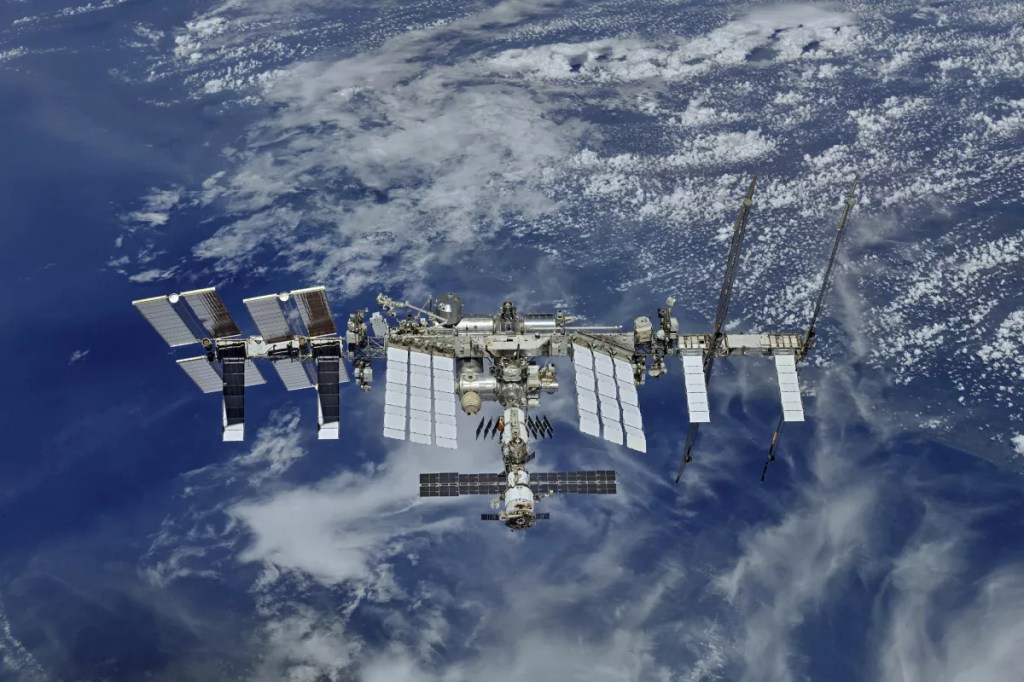
What’s Going on at the International Space Station?

Image (Credit): The Progress 82 cargo craft approaches the ISS on October 27, 2022. (NASA)

It appears that we now have two problematic capsules attached to the International Space Station (ISS). Late last year, we learned about a liquid coolant lead in the Russian Soyuz Crew Return Vehicle (Soyuz MS-22 crew ship), and now we have a leak in the second Russian capsule as well (Progress 82 cargo capsule). This is not a good sign for the seven ISS crew members, some of whom were already scheduled to go home.

After inspecting the Progress 82 spacecraft, it was set loose on Friday to burn up over the Pacific Ocean, as noted by NASA:

Loaded with trash, Progress 82 undocked from the space station’s Poisk module at 9:26 p.m. EST Friday, Feb. 17. The Progress deorbit was delayed about 24-hours while Roscosmos engineers analyzed imagery acquired after undocking of the radiator area of the spacecraft, which is the suspected region where a coolant leak occurred on Feb. 11.

As a result of this second incident, the Russian launch of a replacement capsule (Soyuz MS-23), scheduled for this week, may need to be delayed until the issues with both spacecraft are fully discussed and understood. In a discussion about the two leaks, an NPR commentator noted:

Analysts say Russia’s supply chain has been stretched thin due to the war in Ukraine.

This is not good news for anyone. If we cannot rely on the Russian missions, the SpaceX and Northrop Grumman will be doing double duty.

Pic of the Week: ISS Space Junk

Image (Credit): Canadarm2 robotic arm jettisoning flight support equipment toward the Earth’s atmosphere. (NASA)

This week’s image is a recent shot from the International Space Station (ISS) showing how it deals with unneeded equipment. Fortunately, this “space junk” will quickly burn up in the Earth’s atmosphere rather than remain a threat to the ISS. Given the size of that junk, I hope nothing else bumps into it on the way down.

Here is the story from NASA:

The Canadarm2 robotic arm is pictured extending away from the International Space Station after jettisoning flight support equipment toward the Earth’s atmosphere. The flight hardware secured a pair of roll-out solar arrays inside the SpaceX Dragon cargo ship’s trunk during its ascent to orbit and rendezvous with the space station in November 2022. The jettisoned support equipment drifted safely away from the station and will eventually harmlessly burn up in the atmosphere with no chance for recontacting the space station.

Note: As this story illustrates, NASA has a habit of tossing out the trash from orbit.

Space Stories: JWST Confirms Earth-Size Exoplanet, Russia Sending Rescue Mission to ISS, and IO Erupts

Image (Credit): James Webb Space Telescope (JWST) data associated with exoplanet LHS 475 b. (NASA, ESA, CSA, Leah Hustak (STScI))

Here are some recent stories of interest.

Webb Space Telescope: “NASA’s Webb Confirms Its First Exoplanet

Researchers confirmed an exoplanet, a planet that orbits another star, using NASA’s James Webb Space Telescope for the first time. Formally classified as LHS 475 b, the planet is almost exactly the same size as our own, clocking in at 99% of Earth’s diameter. The research team is led by Kevin Stevenson and Jacob Lustig-Yaeger, both of the Johns Hopkins University Applied Physics Laboratory in Laurel, Maryland.

ABC News: “Russia Will Launch New Capsule to Return Space Station Crew

Russia will send up a new capsule next month to bring back three space station crew members whose original ride home was damaged, officials said Wednesday. The two Russians and one American will stay several extra months at the International Space Station as a result of the capsule switch, possibly pushing their mission to close to a year, NASA and Russian space officials told reporters.

MSN Science Alert: “Massive Volcanic Outburst Detected on Jupiter’s Hellish Moon Io

In the space around Jupiter, a torus of plasma created and fed by Io’s volcanic emissions grew significantly richer between July and September of last year and persisted until December, showing the moon underwent a spate of volcanic activity that released a huge amount of material. For something that’s just a little bit bigger than Earth’s Moon, Io is an absolute beast of volcanism. It’s bristling with volcanoes, with around 150 of the 400 known volcanoes erupting at any given time, creating vast lakes of molten lava.

Space Quote: Starlab to Replace the ISS

Image (Credit): Image of Starlab from the Voyager Space website. (Voyager Space)

“This partnership with Voyager Space is the first step toward fielding the next generation of space stations to serve international astronauts. We are excited to support a project aimed at changing history…This collaboration is an important step in making Starlab a reality, providing a foundation for long-lasting European and American leadership in space. Our team is looking forward to diving in on the technology and putting our best engineers to work.”

-Statement by Jean-Marc Nasr, Executive Vice President of Space Systems at Airbus Defence and Space, in a press release regarding Voyager Space and Airbus Defence and Space partnering to develop and operate Starlab in 2028. The Low-Earth Orbit space station will serve NASA, ESA, and others in the scientific community following the retirement of the International Space Station. NASA has already awarded $160 million to Voyager and Nanoracks, its operating company, to create the new space station.

Top Astronomy Stories in 2022

Image (Credit): The stellar nursery 30 Doradus, nickname of the Tarantula Nebula, captured by the James Webb Space Telescope. (webb.nasa.gov)

Given that 2022 was a busy year, I thought I would highlight the top astronomy stories on the site – the good and the bad covering space missions to TV shows. Unlike other websites, I waited until the new year to create the list just in case we were visited by extraterrestrials. In this way, we now have a full catalog of the 2022 happenings.

Here is the list in no particular order other than science first, politics and commercial space second, and entertainment third.

  1. James Webb Space Telescope begins operation – see site link here;
  2. Double Asteroid Redirection Test (DART) successfully shifts the course of an asteroid pair – see site link here;
  3. Artemis I Orion capsule successfully orbits the Moon – see site link here;
  4. Commercial satellites become an increasing threat to Earth-based telescopes – see site link here;
  5. China completes its first space station – see site link here;
  6. Boeing is closer to being the second U.S. company to send astronauts to the International Space Station – see site link here;
  7. Ukraine invasion derails the Russian space program – see site link here;
  8. Russia reconfirms support for International Space Station – see site link here;
  9. Star Trek gets it right by returning to the past with Strange New Worlds – see site link here; and
  10. Star Wars gets it right with its new Andor series. – see site link here.

I cannot wait to see what 2023 will bring.