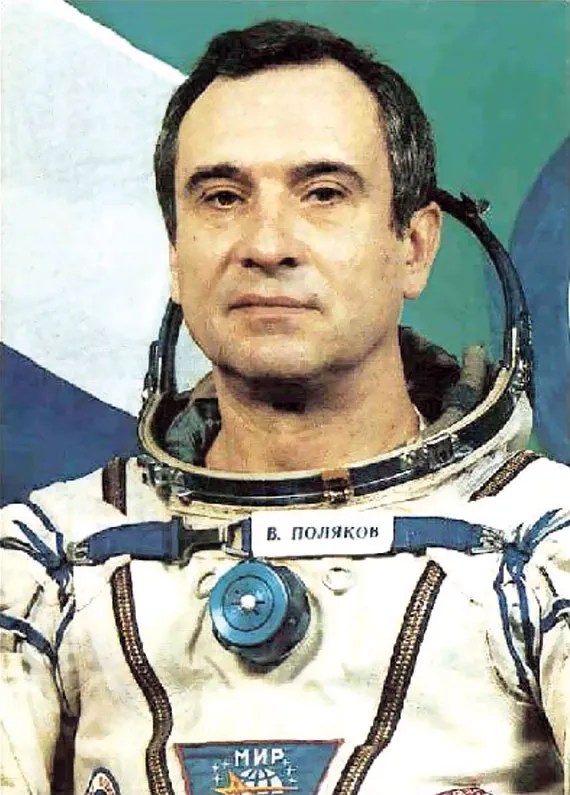
RIP: Cosmonaut Valery Vladimirovich Polyakov

Image (Credit): Cosmonaut Valery Polyakov. (NASA)

Last week cosmonaut Valery Polyakov passed away at the age of 80 (1942 to 2022). He still holds the record for the longest single spaceflight in history when he was aboard the Mir space station for 437 days and 18 hours during one stay between 1994 and 1995. By the time he retired later in 1995, he had spent 678 days in space.

Russians have a history of long tours in space, including four cosmonauts from the last century who spent at least one year in a single tour:

  • Valery Polyakov – 437 days aboard Mir (1994-95)
  • Sergei Avdeyev – 379 days aboard Mir (1998-99)
  • Vladimir Titov – 365 days aboard Mir (1987-88)
  • Musa Manaro – 365 days aboard Mir (1987-88)

When U.S. astronaut Astronaut Scott Kelly returned to Earth with cosmonaut Mikhail Kornienko from the International Space Station in 2016 after 340 days in space, the Russians were not so impressed according to a story in arsTECHNICA. The story notes cosmonaut Talgat Musabayev, serving as the head of the Kazakh space agency, stated, “Congratulations on your record. Of course it was already done 28 years ago.” 

Image (Credit): The Soviet Mir space station. (Encyclopaedia Britannica)

Soyuz Launch to Space Station a Success

Image (Credit): The Soyuz MS-22 rocket launch from earlier today. (NASA/Bill Ingalls)

Earlier today, the Russian Soyuz MS-22 rocket launched from Kazakhstan and successfully placed three new inhabitants on the International Space Station (ISS): NASA astronaut Frank Rubio and Russian cosmonauts Sergey Prokopyev and Dmitri Petelin. The three will stay on the ISS for the next six month, while three cosmonauts will be returning to Earth next week after completing their own six month tours.

Even with all of the Russian posturing back on the surface, it is great to see the ISS team is remaining above the fray. That is, if you ignore the flag-waving antics of the three returning cosmonauts. Sorry, I could not leave it alone.

More Space Travel Offers from China and NASA

Image (Credit): Artist’s impression of the Chinese Space Station. (China Manned Space Program)

The China Global Television Network recently reported that China is looking into offering space rides to commercial passengers by 2025, including suborbital flights, cargo flights, and trips to Chinese Space Station. For instance, suborbital flights are expected to be priced at 2 and 3 million yuan (or $287,200 to $430,800).

Given the growing U.S. space industry with its own range of space flight options, it was only a matter of time that China would enter this commercial space race. Russia has been in the game the longest, having sold seats to U.S. astronauts hoping to reach the International Space Station (ISS) following the demise of the space shuttle.

Not to be outdone, NASA has also announced plans to take commercial passengers to the ISS at $55 million per seat. According to Tech Times, NASA is seeking commercial partners for two such flights per year starting as early as 2023. We have already discussed the Axiom Mission 1 (or AX-1 mission) to the ISS earlier this year at about the same price, so this is not a new idea. I guess the Axiom Mission 1 went well enough for NASA to see this as a regular operation.

A variety of space travel options from a variety of countries and commercial suppliers shows that playing in space can be both fun and profitable. Just ask Captain Kirk.

That is fine, as long as the tourists do not get in the way of the real work that is being conducted. With the taxpayers still footing most of the space-faring bill, we do not want space travel to be seen as only a luxury for the wealthy (similar to electric vehicles in the U.S., up to now). Space and related space travel should be seen as something belonging to everyone.

Russian Rockets No Longer an Option

Image (Credit): Antares rocket on the launch pad. (Northrop Grumman)

Northrop Grumman is switching from Russian-made rocket engines to U.S.-made rocket engines for its Antares rocket ships that bring supplies to the U.S. International Space Station (ISS). Russia has not shipped any engines since March following its invasion of Ukraine, so Northrop Grumman needs an alternative. It can fly two more missions with the Russian-made rockets in its inventory.

Firefly Aerospace in Texas will be able to meet these needs. In a press release, Northrop Grumman stated:

Firefly’s propulsion technology utilizes the same propellants as the current Antares rocket, which minimizes launch site upgrades. The Antares 330 will utilize seven of Firefly’s Miranda engines and leverage its composites technology for the first stage structures and tanks, while Northrop Grumman provides its proven avionics and software, upper-stage structures and Castor 30XL motor, as well as proven vehicle integration and launch pad operations. This new stage will also significantly increase Antares mass to orbit capability.

Fortunately, we have some redundancy in ISS cargo missions, with SpaceX able to pick up slack as necessary. In fact, Northrop Grumman will be contracting with SpaceX to handle three of its missions as it prepares for the new Antares system for mid-to-late 2024.

ISS Research Projects

Image (Credit): International Space Station. (NASA)

Have you ever wondered about all of the scientific projects, past and present, on the International Space Station (ISS)? Quite a bit has happened onboard the station since it was first occupied back in November 2000.

Fortunately, NASA maintains an inventory of all of these projects. The Space Station Research Explorer provides information on all of the experiments, separated into six categories:

  • Biology and Biotechnology;
  • Earth and Space Science;
  • Educational Activities;
  • Human Research;
  • Physical science; and
  • Technology.

For instance, back in 2017 the station supported an experiment under “Earth and Space Science” titled ASTERIA:

The Arcsecond Space Telescope Enabling Research in Astrophysics (ASTERIA) is a six-unit (6U) CubeSat deployed from the International Space Station (ISS) that tests new technologies for astronomical observation, such as the detection of planets outside our solar system (a.k.a., exoplanets). Observing exoplanets requires repeated observation of stars over a long period of time from a dark environment, so that the small shadow of an orbiting planet can be detected passing through the star’s light. ASTERIA uses advanced pointing control technology, new thermal stabilization features, and the scalable CubeSat-platform to perform these complex measurements.

Some projects still lack information. These incomplete projects tend to be sponsored by ROSCOSMOS, though the Russian space agency has plenty of complete projects as well.

Poke around and see what you can find.