NASA’s FY 2023 Budget Request

Credit: NASA

So what else did NASA Administrator Bill Nelson share with the Senate Committee on Appropriations last week (beyond his comments about the International Space Station)? In his prepared statement regarding NASA’s $26 billion budget request, he highlighted a number of priorities for his agency, including:

  • the Artemis Program to bring astronauts back to the Moon and related exploration costs – $7.5 billion;
  • continued support for the ISS – $4.3 billion;
  • the space technology research and development portfolio for the Moon, Mars, and other areas, such as sending the CAPSTONE CubeSat to the Moon as a pathfinder for the Artemis program – $1.44 billion;
  • greater science funding for projects such as exploring solutions for bringing the samples of Martian rock and soil collected by the Perseverance rover to Earth through the Mars Sample Return mission – $8 billion; and
  • supporting the civil aviation manufacturing sector with test flights on its Low Boom Flight Demonstrator, which will enable environmentally and socially acceptable supersonic passenger flights, as well as continued work on the X-57 Maxwell, an all-electric aircraft – $971 million.

NASA certainly has a lot on its place, and I did not even highlight the focus on Earth iteself, such as the planned Earth System Observatory, which is an array of satellites, instruments, and missions designed to generate a 3D, holistic view of the entire planet.

We just provided a $40 billion aid package to Ukraine so that it can defend itself and have a better future. This $26 billion will take us out of the realm of Earth-bound conflicts and allow us to find our future in the stars, or at least the solar system. It is money well spent.

International Space Station: Russians Still Busy

Image (Credit): Five spaceships are parked at the space station including the SpaceX Dragon Freedom; the Cygnus space freighter; the Soyuz MS-21 crew ship; and the Progress 80 and 81 resupply ships.(NASA)

Earlier today, NASA announced that an uncrewed Russian cargo ship, Progress 81, arrived at the International Space Station (ISS) without incident. Work continues among the Americans and Russians aboard the ISS regardless of the situation on the ground, which is reassuring.

As NASA administrator Bill Nelson said last month at a Senate Appropriations Committee hearing, there have been a number of “misleading headlines” about the end of Russia’s participation in the ISS program. He also highlighed how US astronauts were able to work together with Soviets during the Cold war. Specifically, he stated:

I see nothing in the very even-keeled professional relationship between the cosmonauts and the astronauts, between mission control in Moscow and Houston, in the training of Russian cosmonauts in America and the training of American astronauts in Moscow and Baikonur…I see nothing that has interrupted that professional relationship, no matter how awful Putin is conducting a war with such disastrous results in Ukraine.

SpaceX is Worth About $125 Billion

Image (Credit): Starship rocket. (SpaceX)

Even though Tesla is having valuation issues these days as Mr. Musk pursues Twitter, SpaceX seems to be doing well. Nasdaq news reports that the company had no issues raising $1.5 billion in new funding. The valuation for the company is now $125 billion, up from $100 billion last year.

While the company is earning a good fee for its resupply missions to the International Space Station, it has other ventures to fund as well, including the Starship rocket for deep-space missions and the Starlink satellite system being used around the world (including Ukraine). SpaceX is able to build about 45 Starlink satellite per week.

The company has plenty of openings on its website, such as those listed below. Let’s hope SpaceX can stay out of the fray as Mr. Musk continues to kick up dust.

Image (Credit): SpaceX job postings. (SpaceX)

Starliner: Third Time’s the Charm

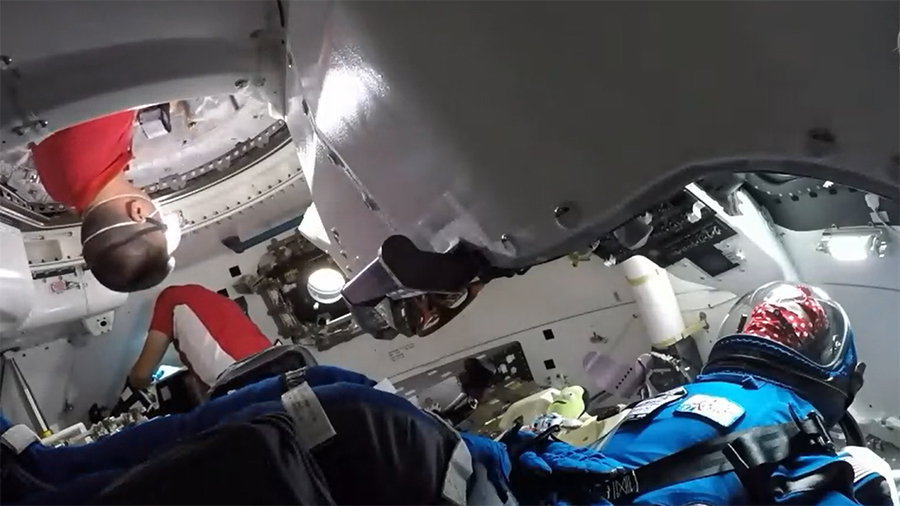
Image (Credit): NASA astronauts Bob Hines and Kjell Lindgren greet “Rosie the Rocketeer” inside the Boeing Starliner spacecraft shortly after opening its hatch. (NASA)

Finally, we have another spacecraft that appears capable of bringing astronauts into orbit. After two earlier tries, Boeing’s Starliner was successfully launched on Thursday and then connected with the International Spaced Stations (ISS) today. Now we just need it to undock on Wednesday and safely return.

In a press release, Jim Chilton, Boeing’s senior vice president for Space and Launch, stated:

Starliner has proven safe, autonomous rendezvous and docking capability…We’re honored to join the fleet of commercial spacecraft capable of conducting transportation services to the space station for NASA.

We needed this redundancy in our ISS program and now we have it.

You can read more about the mission here.

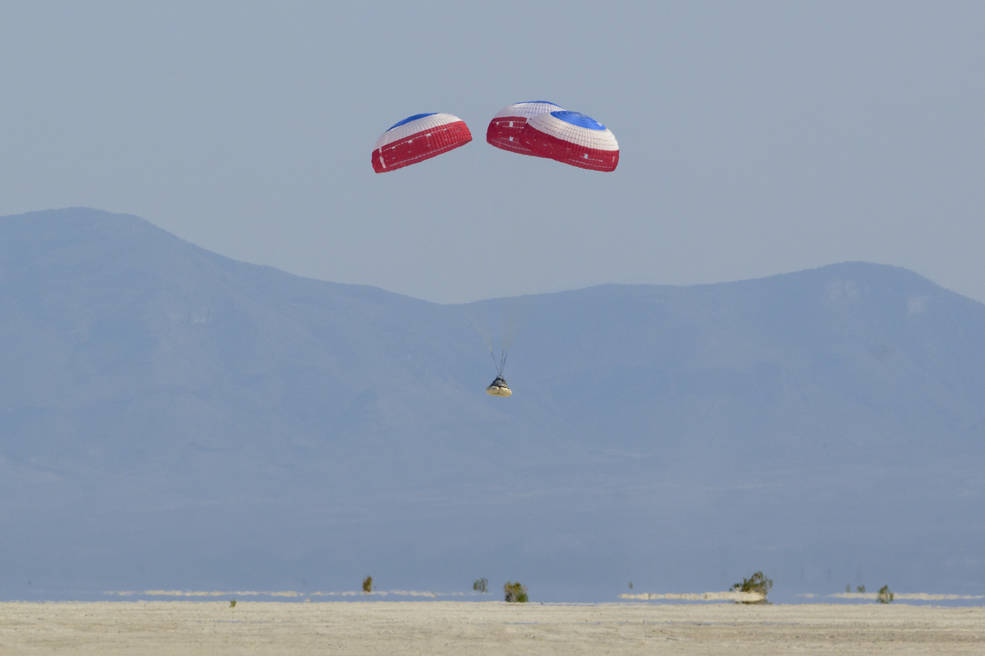
Update: The Starliner spacecraft safely returned to Earth on Wednesday, May 22nd. Joel Montalbano, manager of NASA’s International Space Station Program, stated:

Congratulations to the NASA and Boeing teams…I am excited to see the completion of a critical step in bringing another system online to transport long-duration crew members to and from the International Space Station. Soon, we hope to see crews arrive to the space station on Starliner to continue the important microgravity scientific research and discovery made possible by the orbiting laboratory.

Image (Credit): Boeing’s CST-100 Starliner spacecraft lands at White Sands Missile Range’s Space Harbor, Wednesday, May 25, 2022, in New Mexico. (NASA/Bill Ingalls)

KSC: Upcoming Launch Schedule & More

Image (Credit): The John F. Kennedy Space Center in Florida. (NASA)

If you are interested in what is being launched from the Kennedy Space Center (KSC), you can easily view this information at this website. For example, on May 19th, the Boeing CST-100 Starliner will be tested in orbit as it becomes another candidate to resupply the International Space Station. The site also highlights other interesting events and anniversaries, such as the December 7th 50th anniversary of the Apollo 17th launch.

One place holder on the KSC schedule with no clear date is the inaugural launch of NASA’s Space Launch System (SLS) rocket, the first phase of the Artemis Program. In a recent press release, NASA outlined the parameters for such a launch as well as the remaining days in 2022 that would satisfy these parameters. The four parameters are:

  1. The Moon’s position in its lunar cycle;
  2. A trajectory so Orion is not in darkness for more than 90 minutes at a time so that the solar array wings can receive and convert sunlight to electricity and the spacecraft can maintain an optimal temperature range;
  3. A trajectory that allows for the skip entry technique planned during Orion’s return to Earth; and
  4. Daylight conditions for Orion’s splashdown to initially assist recovery personnel when they locate, secure, and retrieve the spacecraft from the Pacific Ocean.  

The calendar still has plenty of possible dates. The question now is whether NASA can get all of the pieces together in time to make this happen in 2022.

Credit: NASA