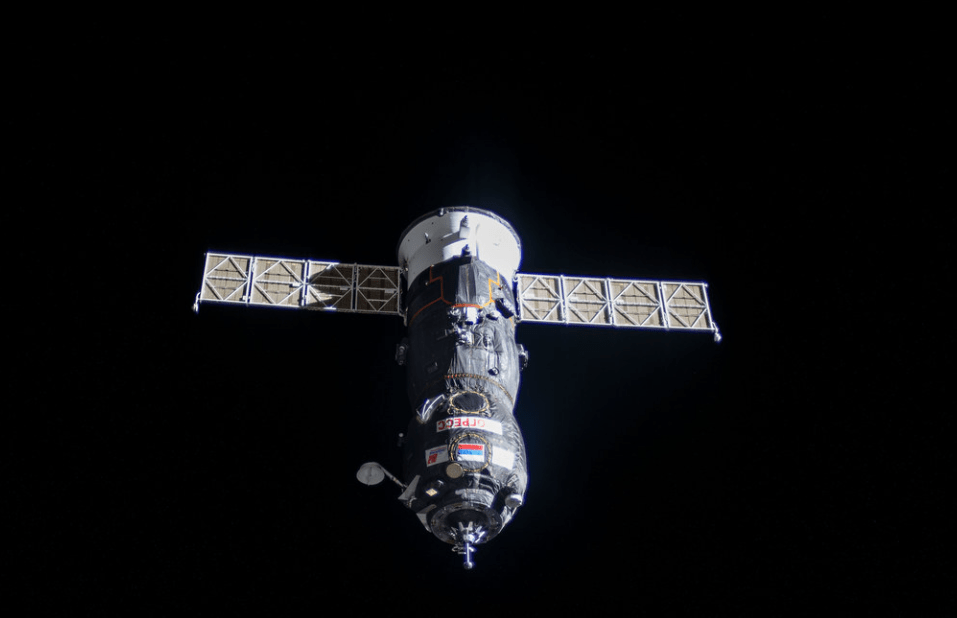
Starliner: Third Time’s the Charm

Image (Credit): NASA astronauts Bob Hines and Kjell Lindgren greet “Rosie the Rocketeer” inside the Boeing Starliner spacecraft shortly after opening its hatch. (NASA)

Finally, we have another spacecraft that appears capable of bringing astronauts into orbit. After two earlier tries, Boeing’s Starliner was successfully launched on Thursday and then connected with the International Spaced Stations (ISS) today. Now we just need it to undock on Wednesday and safely return.

In a press release, Jim Chilton, Boeing’s senior vice president for Space and Launch, stated:

Starliner has proven safe, autonomous rendezvous and docking capability…We’re honored to join the fleet of commercial spacecraft capable of conducting transportation services to the space station for NASA.

We needed this redundancy in our ISS program and now we have it.

You can read more about the mission here.

Update: The Starliner spacecraft safely returned to Earth on Wednesday, May 22nd. Joel Montalbano, manager of NASA’s International Space Station Program, stated:

Congratulations to the NASA and Boeing teams…I am excited to see the completion of a critical step in bringing another system online to transport long-duration crew members to and from the International Space Station. Soon, we hope to see crews arrive to the space station on Starliner to continue the important microgravity scientific research and discovery made possible by the orbiting laboratory.

Image (Credit): Boeing’s CST-100 Starliner spacecraft lands at White Sands Missile Range’s Space Harbor, Wednesday, May 25, 2022, in New Mexico. (NASA/Bill Ingalls)

KSC: Upcoming Launch Schedule & More

Image (Credit): The John F. Kennedy Space Center in Florida. (NASA)

If you are interested in what is being launched from the Kennedy Space Center (KSC), you can easily view this information at this website. For example, on May 19th, the Boeing CST-100 Starliner will be tested in orbit as it becomes another candidate to resupply the International Space Station. The site also highlights other interesting events and anniversaries, such as the December 7th 50th anniversary of the Apollo 17th launch.

One place holder on the KSC schedule with no clear date is the inaugural launch of NASA’s Space Launch System (SLS) rocket, the first phase of the Artemis Program. In a recent press release, NASA outlined the parameters for such a launch as well as the remaining days in 2022 that would satisfy these parameters. The four parameters are:

  1. The Moon’s position in its lunar cycle;
  2. A trajectory so Orion is not in darkness for more than 90 minutes at a time so that the solar array wings can receive and convert sunlight to electricity and the spacecraft can maintain an optimal temperature range;
  3. A trajectory that allows for the skip entry technique planned during Orion’s return to Earth; and
  4. Daylight conditions for Orion’s splashdown to initially assist recovery personnel when they locate, secure, and retrieve the spacecraft from the Pacific Ocean.  

The calendar still has plenty of possible dates. The question now is whether NASA can get all of the pieces together in time to make this happen in 2022.

Credit: NASA

Profile: Mid-Atlantic Regional Spaceport

Image (Credit): Rocket being launched from Virginia’s spaceport. (Mid-Atlantic Regional Spaceport)

When you think of NASA space launches you most likely think of Cape Canaveral in Florida, but what about Virginia? The Eastern Shore of Virginia hosts the Mid-Atlantic Regional Spaceport (MARS), which is currently being used for resupply missions to the International Space Station (ISS). Created by the Commonwealth of Virginia in 1995 at the site of a World War II Navy air station, it is the only other official spaceport on the east coast.

Northrup Grumman has been using the site for various missions, including resupplying the ISS as well as other federal payloads. Orbital Sciences Corporation (now part of Northrup Grumman) launched NASA’s Lunar Atmosphere and Dust Environment Explorer (LADEE) mission from the site in 2013. In addition, last year Rocket Lab announced it planned to use MARS for launches of its new reusable Neutron rockets.

In February 2022, Northrop Grumman successfully launched its 17th ISS resupply rocket from the spaceport. The Cygnus space freighter carried needed supplies to the astronauts conducting research in orbit. The freighter will also be used to “boost” the ISS, or adjust its orbit, as noted by NASA:

This Cygnus mission is the first to feature enhanced capabilities that will allow the spacecraft to perform a reboost, using its engines to adjust the space station’s orbit as a standard service for NASA. The agency has one reboost is planned while Cygnus is connected to the orbiting laboratory. A test of the maneuver was performed in 2018 during Cygnus’ ninth resupply mission.

You may recall that such boosting is something the Russian’s claimed earlier could not occur if they abandoned the space station. Fortunately, NASA has other rocket options should they be needed. Moreover, we have additional spaceports to keep our astronauts in the sky and well supplied.

Image (Credit): Northrop Grumman’s Cygnus space freighter is pictured moments before its capture with the International Space Stations’s robotic arm in February of 2021. (NASA)

Extra: Below is a map showing the location of MARS on the Wallop Islands. The address of the facility is 7414 Atlantic Rd, Wallops Island, VA 23337.

Image (Credit): Location of MARS on the Virginia shore. (Google Maps)

Female Dummies in Space?

Image (Credit): The Helga manikin to be used on the Orion capsule to the Moon. (German Aerospace Center)

No, it is not a new television show or a rude comment, but rather a real plan to test the effects of space radiation on manikins that simulate the female body. The test is in preparation for future Artemis missions to the Moon. NASA is concerned about the effects of radiation on female astronauts since their anatomy is different than that of males and may be more prone to certain types of cancer.

As reported by Phys.org, the two manikins – Helga and Zohar – will fly aboard the Orion capsule for about six weeks as part of his first uncrewed flight to the Moon. While Helga will fly in the Orion capsule unprotected, Zohar will be wearing a radiation protection vest. In this way, scientists can study the full effect of the vest.

The experiment was designed by the German Aerospace Center (hence the German manikin names), which has conducted similar studies aboard the International Space Station (ISS). However, the radiation levels for a lunar mission will be much higher than that found on the ISS.

The Artemis mission will be the first time a female leaves low-Earth orbit , so it is essential that we know the potential impact of this trip on females. We wish the best to both Helga and Zohar.

Whatever Happened to Bigelow’s Space Hotels?

Image (Credit): Artist’s rending of Bigelow’s orbiting inflatable hotels. (Bigelow Space Operations)

Do you remember all of the talk about inflatable space hotels? Back in 2018, the U.S. space company Bigelow stated these expandable space station components would be launched by 2021:

With the two launches of B330-1 and B330-2 expected in 2021, the time is now in 2018 to begin BSO activity. These single structures that house humans on a permanent basis will be the largest, most complex structures ever known as stations for human use in space.

Created in 1998, Bigelow licensed the expandable component idea from NASA in 2000 and tried to make it commercially viable. Originally called the TransHab, NASA had developed the idea as a new component for the International Space Station (ISS).  Bigelow eventually sold the idea back to NASA as the Bigelow Expandable Activity Module (BEAM), which was successfully attached to the ISS in 2016. While NASA originally planned to jettison the BEAM from the ISS after two-years of testing and validation, it remained a part of the ISS.

Bigelow saw possibilities for a lunar depot or base, while NASA saw the BEAM as a model for cargo trips to Mars:

The journey to Mars is complex and filled with challenges that NASA and its partners are continuously working to solve. Before sending the first astronauts to the Red Planet, several rockets filled with cargo and supplies will be deployed to await the crews’ arrival. Expandable modules, which are lower-mass and lower-volume systems than metal habitats, can increase the efficiency of cargo shipments, possibly reducing the number of launches needed and overall mission costs.

So after this success with the ISS and ideas for the future, where is Bigelow today? In March 2020, as COVID hit, the company laid off all of its employees and has yet to return to business. That does not mean this idea of expandable components disappears with the company, but it may need a new champion if it is to be part of the future space program.

Maybe Mr. Musk is looking for something to buy as part of his future Martian mission.

Image (Credit): NASA astronaut Randy Bresnik looks through the hatch of the International Space Station’s Bigelow Expandable Aerospace Module (BEAM) on July 31, 2017. (NASA, Randy Bresnik)