It is worth checking out the BBC’s Sky at Night podcast if you want to follow the stars or just listen to astronomers discussing the night sky. Two recent episodes in particular, both related to the James Webb Space Telescope (JWST), should be on your podcast list.
How James Webb Space Telescope Observes the Universe (broadcast on August 26, 2022): Dr Pamela Klaassen, an instrument scientist, reveals the science behind how JWST studies the cosmos, what its images show us, and the secrets it might uncover. She also discusses her work studying very large stars. Finally, the discussion covers the Square Kilometre Array Organization and how this brand new ground-based observatory will work in tandem with the JWST to unlock the secrets of the Universe.
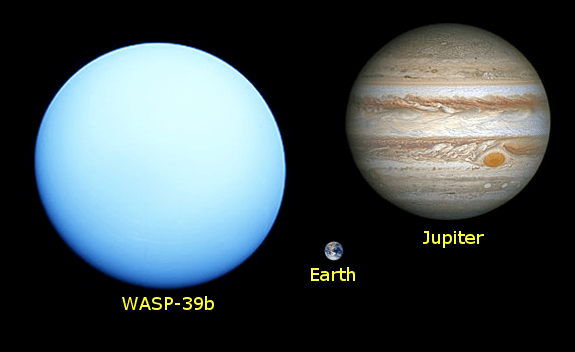
Exploring Exoplanets with JWST (broadcast on August 22, 2022): Dr Hannah Wakeford from the University of Bristol is part of an international collaboration of exoplanet hunters looking to see how the JWST can reveal the secrets of worlds orbiting stars beyond our solar system. One exoplanet priority for the JWST discussed during the episode is WASP-39b, the results of which were recently shared with the public.
Image (Credit): Comparison of exoplanet WASP-39b to Earth and Jupiter. (wasp-planets.net)
Yesterday, the University of Maryland reported that the James Webb Space Telescope (JWST) has detected carbon dioxide in the atmosphere of exoplanet WASP-39b, a gas giant about 700 light-years away. This is the first time carbon dioxide has been detected on a planet outside of our solar system.
Eliza Kempton, an associate professor of astronomy at the University of Maryland, stated:
The reason we hadn’t been able to definitively identify CO2 in the atmosphere of WASP-39 b previously was that we never had a telescope that could produce spectra across the right wavelength range…This discovery shows us that Webb is delivering on its promise of being a transformational facility for astronomical observations.
Natalie Batalha of the University of California at Santa Cruz, who leads the team, added:
Detecting such a clear signal of carbon dioxide on WASP-39 b bodes well for the detection of atmospheres on smaller, terrestrial-sized planets.
Again, the JWST is showing it is worth its weight in gold (see note below) as it peers through the universe and quickly observes things we only speculated about earlier.
Note: In fact, the JWST weights 14,300 lbs here on Earth, or 228,800 ounces. Today, gold costs $1,763.00 per ounce. So if the JWST was made of solid gold, it would cost about $403 million. Given that the JWST actually costed $10 billion to build and launch, in weight it is 25 times more valuable than gold.
Image (Credit): Jupiter as captured by the JWST. (NASA, ESA, CSA, Jupiter ERS Team; image processing by Ricardo Hueso (UPV/EHU) and Judy Schmidt)
This week’s image once again comes from the new James Webb Space Telescope (JWST), but instead of peering outside of our solar system, it is looking around closer to home. The image above of Jupiter is an amazing shot that shows the planet in all its glory – violent storms, glowing auroras, delicate rings, and orbiting moons. The particulars are labeled in the same image below.
The image came from the JWST’s Near-Infrared Camera (NIRCam), which NASA notes has:
…three specialized infrared filters that showcase details of the planet. Since infrared light is invisible to the human eye, the light has been mapped onto the visible spectrum. Generally, the longest wavelengths appear redder and the shortest wavelengths are shown as more blue. Scientists collaborated with citizen scientist Judy Schmidt to translate the Webb data into images.
This is a whole new way to see our neighborhood worlds as well as the worlds many light years away.
Image (Credit): Jupiter as captured by the JWST with all of the key areas labeled. (NASA, ESA, CSA, Jupiter ERS Team; image processing by Ricardo Hueso (UPV/EHU) and Judy Schmidt)
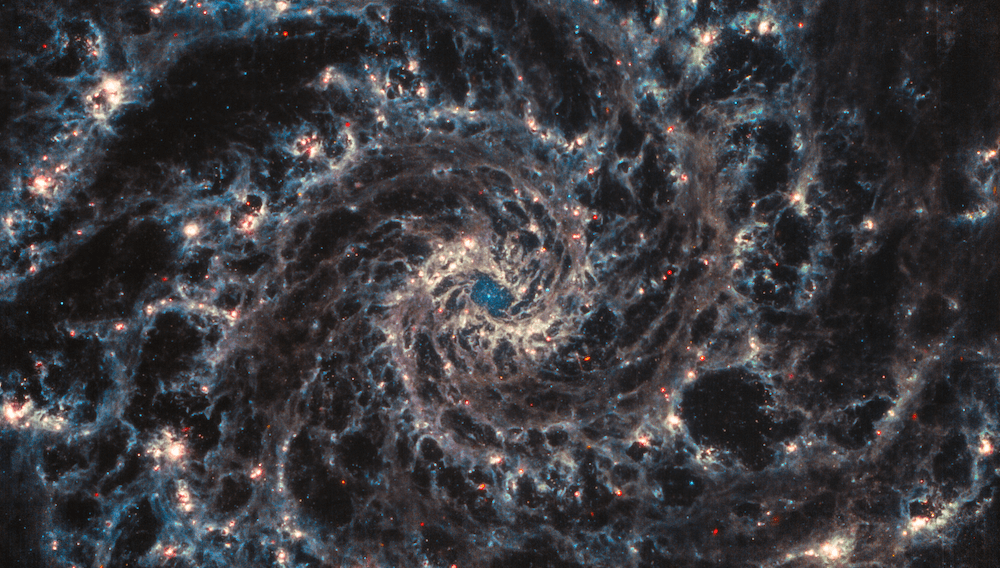
Image (Credit): View from above the spiral galaxy NGC 628. (NASA/ESA/CSA/Judy Schmidt)
Here is another recent images from the James Webb Space Telescope (JWST). This one is a unique close-up view of a spiral galaxy looking from above (or below) rather that from the side. It is NGC 628, which is about 32 million light years away.
You can see more such JWST images by visiting the Physics at High Angular resolution in Nearby GalaxieS (PHANGS) Survey site. The site also includes images from the Hubble Space Telescope, the Spitzer Space Telescope, the Atacama Large Millimeter/submillimeter Array (ALMA), and other sources.
Image (Credit): ALMA telescope image of AS 209 (ALMA (ESO/NAOJ/NRAO), A. Sierra (U. Chile))
Last week’s news that a young exoplanet has been spotted has generated quite a bit of interest. The discovery was reported in the journal The Astrophysical Journal Letters. Of course, if you read the abstract of the study itself, you may be confused with all the scientific jargon:
We report the discovery of a circumplanetary disk (CPD) candidate embedded in the circumstellar disk of the T Tauri star AS 209 at a radial distance of about 200 au (on-sky separation of 1.4 from the star at a position angle of 161°), isolated via 13CO J = 2−1 emission. This is the first instance of CPD detection via gaseous emission capable of tracing the overall CPD mass. The CPD is spatially unresolved with a 117 × 82 mas beam and manifests as a point source in 13CO, indicating that its diameter is ≲14 au…
We could not fund the space program if this is what we shared with taxpayers. Fortunately, the accompanying press release was better:
Scientists using the Atacama Large Millimeter/submillimeter Array (ALMA)— in which the National Radio Astronomy Observatory (NRAO) is a partner— to study planet formation have made the first-ever detection of gas in a circumplanetary disk. What’s more, the detection also suggests the presence of a very young exoplanet. The results of the research are published in The Astrophysical Journal Letters…While studying AS 209— a young star located roughly 395 light-years from Earth in the constellation Ophiuchus— scientists observed a blob of emitted light in the middle of an otherwise empty gap in the gas surrounding the star. That led to the detection of the circumplanetary disk surrounding a potential Jupiter-mass planet. Scientists are watching the system closely, both because of the planet’s distance from its star and the star’s age. The exoplanet is located more than 200 astronomical units, or 18.59 billion miles, away from the host star, challenging currently accepted theories of planet formation.And if the host star’s estimated age of just 1.6 million years holds true, this exoplanet could be one of the youngest ever detected. Further study is needed, and scientists hope that upcoming observations with the James Webb Space Telescope will confirm the planet’s presence.
My first point is that communication matters, and we need both the scientists and the communicators if the public is to learn anything about what is being funded.
My second point relates to information found later in the press release about the new planet being 200 astronomical units from its sun. Pluto is only 39 astronomical units away from our Sun, so this is quite a difference. Which makes me wonder about our solar system and its various components. Even the hazy image above is more than we have of our own solar system as we guess about a ninth planet out there somewhere and hypothesize about the Oort Cloud. Should a civilization many light years away focus its best telescopes on our solar system , what could they tell us?
We seem to be explorers looking out over the sea at far-away islands not even understanding the components of the island we stand on. We certainly learn more every day as we pick and probe at the objects around us, yet it is clear that our knowledge of our own home has plenty of gaps. Maybe the solar system images from afar should be seen as weak reflections from our own solar system.
Given that the James Webb Space Telescope has yet to turn its attention to AS 209, we can expect even more surprises related to this distant solar system, and maybe our own.





 Our Awesome Universe