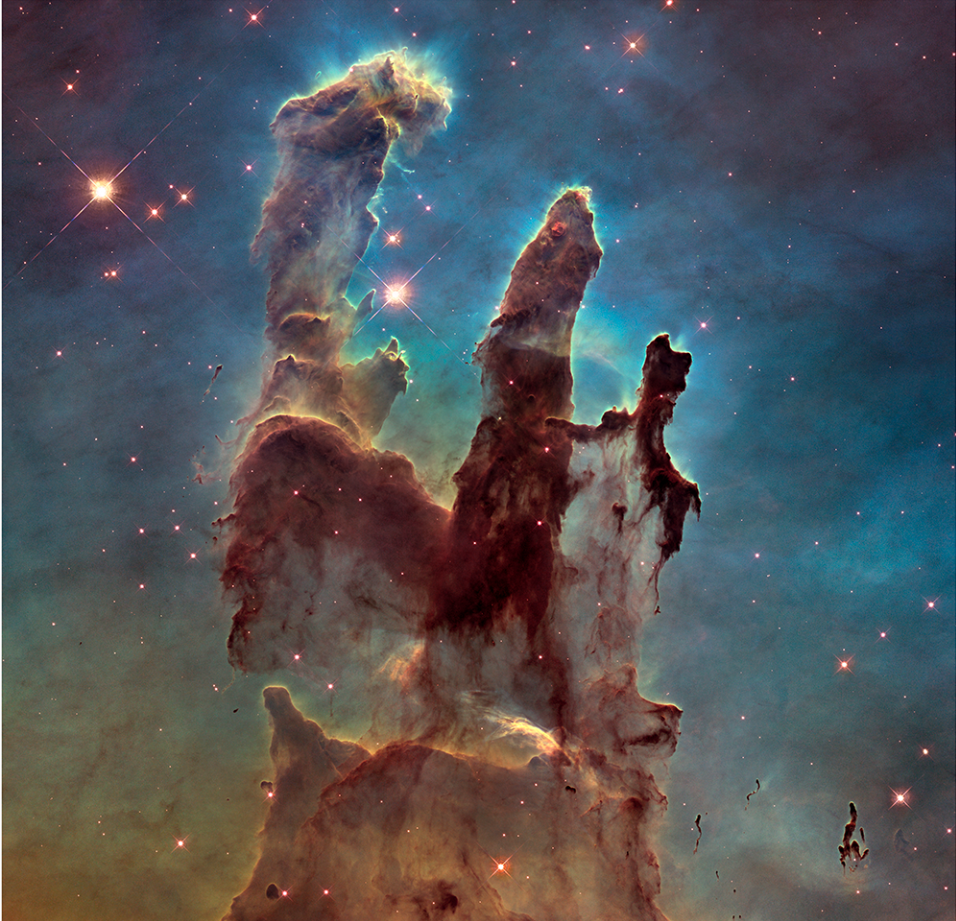
Image (Credit): View from above the spiral galaxy NGC 628. (NASA/ESA/CSA/Judy Schmidt)
Here is another recent images from the James Webb Space Telescope (JWST). This one is a unique close-up view of a spiral galaxy looking from above (or below) rather that from the side. It is NGC 628, which is about 32 million light years away.
You can see more such JWST images by visiting the Physics at High Angular resolution in Nearby GalaxieS (PHANGS) Survey site. The site also includes images from the Hubble Space Telescope, the Spitzer Space Telescope, the Atacama Large Millimeter/submillimeter Array (ALMA), and other sources.
Image (Credit): ALMA telescope image of AS 209 (ALMA (ESO/NAOJ/NRAO), A. Sierra (U. Chile))
Last week’s news that a young exoplanet has been spotted has generated quite a bit of interest. The discovery was reported in the journal The Astrophysical Journal Letters. Of course, if you read the abstract of the study itself, you may be confused with all the scientific jargon:
We report the discovery of a circumplanetary disk (CPD) candidate embedded in the circumstellar disk of the T Tauri star AS 209 at a radial distance of about 200 au (on-sky separation of 1.4 from the star at a position angle of 161°), isolated via 13CO J = 2−1 emission. This is the first instance of CPD detection via gaseous emission capable of tracing the overall CPD mass. The CPD is spatially unresolved with a 117 × 82 mas beam and manifests as a point source in 13CO, indicating that its diameter is ≲14 au…
We could not fund the space program if this is what we shared with taxpayers. Fortunately, the accompanying press release was better:
Scientists using the Atacama Large Millimeter/submillimeter Array (ALMA)— in which the National Radio Astronomy Observatory (NRAO) is a partner— to study planet formation have made the first-ever detection of gas in a circumplanetary disk. What’s more, the detection also suggests the presence of a very young exoplanet. The results of the research are published in The Astrophysical Journal Letters…While studying AS 209— a young star located roughly 395 light-years from Earth in the constellation Ophiuchus— scientists observed a blob of emitted light in the middle of an otherwise empty gap in the gas surrounding the star. That led to the detection of the circumplanetary disk surrounding a potential Jupiter-mass planet. Scientists are watching the system closely, both because of the planet’s distance from its star and the star’s age. The exoplanet is located more than 200 astronomical units, or 18.59 billion miles, away from the host star, challenging currently accepted theories of planet formation.And if the host star’s estimated age of just 1.6 million years holds true, this exoplanet could be one of the youngest ever detected. Further study is needed, and scientists hope that upcoming observations with the James Webb Space Telescope will confirm the planet’s presence.
My first point is that communication matters, and we need both the scientists and the communicators if the public is to learn anything about what is being funded.
My second point relates to information found later in the press release about the new planet being 200 astronomical units from its sun. Pluto is only 39 astronomical units away from our Sun, so this is quite a difference. Which makes me wonder about our solar system and its various components. Even the hazy image above is more than we have of our own solar system as we guess about a ninth planet out there somewhere and hypothesize about the Oort Cloud. Should a civilization many light years away focus its best telescopes on our solar system , what could they tell us?
We seem to be explorers looking out over the sea at far-away islands not even understanding the components of the island we stand on. We certainly learn more every day as we pick and probe at the objects around us, yet it is clear that our knowledge of our own home has plenty of gaps. Maybe the solar system images from afar should be seen as weak reflections from our own solar system.
Given that the James Webb Space Telescope has yet to turn its attention to AS 209, we can expect even more surprises related to this distant solar system, and maybe our own.
Image (Credit): Artist’s rendering of 25 hot Jupiters captured by the NASA/ESA Hubble Space Telescope that have been analysed by an international team of astronomers, enabling them to answer five open questions important to our understanding of exoplanet atmospheres. (ESA/Hubble, N. Bartmann)
“We are interested in understanding the diversity and atmospheric compositions of planets between the size of Earth and Neptune…“‘Super-Earths’ and ‘mini-Neptunes’ are the most common types of planets in our galaxy. But we only have a few examples of atmospheric measurements from these types of planets.”
-Statement by Johanna Teske, a staff scientist at the Carnegie Institution of Washington who is co-leading a Webb observation team with Natasha Batalha at NASA’s Ames Research Center in Northern California. She was discussing the James Webb Space Telescope’s role to better understand exoplanets. Her comments and more are included in a NASA news article, “Exoplanets: What NASA Will See with the Webb Telescope.”
Image (Credit): The new James Webb Space Telescope Forever stamp. (U.S. Postal Service)
“It is like humanity just got a brand-new pair of eyeglasses for the distant universe…We are suddenly seeing that those green areas on the tops of trees are actually made of thousands of individual leaves. We suspected it, but we are now seeing it for the first time.”
Image (Credit): The Cartwheel Galaxy, located about 500 million light-years away, as captured by the JWST. (NASA, ESA, CSA, STScI)
This week’s picture is one of the latest images from the James Webb Space Telescope (JWST). It shows the Cartwheel Galaxy, which is about 500 million light-years away. The Hubble’s view of this same galaxy is provided below.
NASA’s James Webb Space Telescope has peered into the chaos of the Cartwheel Galaxy, revealing new details about star formation and the galaxy’s central black hole. Webb’s powerful infrared gaze produced this detailed image of the Cartwheel and two smaller companion galaxies against a backdrop of many other galaxies. This image provides a new view of how the Cartwheel Galaxy has changed over billions of years.
The Cartwheel Galaxy, located about 500 million light-years away in the Sculptor constellation, is a rare sight. Its appearance, much like that of the wheel of a wagon, is the result of an intense event – a high-speed collision between a large spiral galaxy and a smaller galaxy not visible in this image. Collisions of galactic proportions cause a cascade of different, smaller events between the galaxies involved; the Cartwheel is no exception.
The collision most notably affected the galaxy’s shape and structure. The Cartwheel Galaxy sports two rings — a bright inner ring and a surrounding, colorful ring. These two rings expand outwards from the center of the collision, like ripples in a pond after a stone is tossed into it. Because of these distinctive features, astronomers call this a “ring galaxy,” a structure less common than spiral galaxies like our Milky Way.
The bright core contains a tremendous amount of hot dust with the brightest areas being the home to gigantic young star clusters. On the other hand, the outer ring, which has expanded for about 440 million years, is dominated by star formation and supernovas. As this ring expands, it plows into surrounding gas and triggers star formation.
Image (Credit): An image of the Cartwheel Galaxy taken with the NASA/ESA Hubble Space Telescope. (ESA/Hubble & NASA)