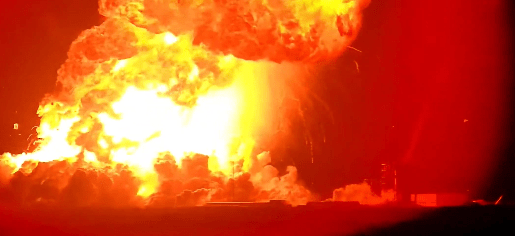
Image (Credit): The explosion of a Starship rocket during testing at the Brownsville, Texas Starbase on June 18, 2025. (LabPadre Space)
As shown in the image above, SpaceX lost one of its Starships yesterday in a massive explosion at the Brownsville, Texas Starbase, making the Moon and Mars seem even farther away. Fortunately, no one was injured during this failed test firing of the Starship 36 rocket engines.
We should expect some problems along the way, but the trend is going backwards for Mr. Musk.
Engineering teams are actively investigating the incident and will follow established procedures to determine root cause. Initial analysis indicates the potential failure of a pressurized tank known as a COPV, or composite overwrapped pressure vessel, containing gaseous nitrogen in Starship’s nosecone area, but the full data review is ongoing. There is no commonality between the COPVs used on Starship and SpaceX’s Falcon rockets.
Georgia Tech scientists have uncovered evidence that a mountain on the rim of Jezero Crater — where NASA’s Perseverance Rover is currently collecting samples for possible return to Earth — is likely a volcano. Called Jezero Mons, it is nearly half the size of the crater itself and could add critical clues to the habitability and volcanism of Mars, transforming how we understand Mars’ geologic history. The study, “Evidence for a composite volcano on the rim Jezero crater on Mars,” was published this May in the Nature-family journal Communications Earth & Environment, and underscores how much we have left to learn about one of the most well-studied regions of Mars.
Due to its diffuse nature, roughly half of ordinary matter in the universe went unaccounted for and had been considered “missing”—until now. In a new study in Nature Astronomy, a team of astronomers at Caltech and the Center for Astrophysics | Harvard & Smithsonian (CfA) has, for the first time, directly detected and accounted for all the missing matter. To do this, the team used brief, bright radio flashes in the distant cosmos, called fast radio bursts (FRBs), to illuminate the matter lying between the FRBs and us. “The FRBs shine through the fog of the intergalactic medium, and by precisely measuring how the light slows down, we can weigh that fog, even when it’s too faint to see,” says Liam Connor, assistant professor at Harvard and lead author of the study, who performed much of the work while a Caltech research assistant professor working with Vikram Ravi, assistant professor of astronomy at Caltech.
Members of the House and Senate called in the White House to promptly offer a new candidate for NASA administrator after the surprise withdrawal of Jared Isaacman’s nomination. In briefings organized by the Aerospace Industries Association June16, representatives of House and Senate delegations to the Paris Air Show said it was critical that the agency get permanent leadership as it deals with potential significant cuts to its budget in the coming fiscal year.
Image (Credit): Graphic showing NASA missions either eliminated (red x) or severely cut (red !) in the most recent White House budget request. (Astronomy Magazine)
In a graphic covering the solar system and everything else, you can visualize for yourself the enormous impact of the proposed cuts. Very few programs are safe, including those we share with the European Space Agency (ESA) and others. In fact, only the “Biological and Physical” missions (shown in orange) seem to be mostly untouched.
For example, under “Planetary” missions (shown in purple), we see the end of:
Some of this may have made sense if there was a good discussion of existing missions and a thoughtful process to wind some of them down. But that is not how this White House works, and we are all the poorer for it.
In addition to many in NASA and the public at large, some in Congress are pushing back on these excessive losses. This is still somewhat early in the budget process for FY 2026, but did anyone really expect this to be the starting point in NASA’s budget discussions?
The greatest space agency in the world is being hacked to pieces, along with many other US scientific programs. The costs will be felt for generations to come. Just as Apollo helped to lift a nation, these cuts are designed to harm that legacy and ultimately the nation.
Note: If you cannot see the image clearly here, you can go to this link.
According to the Washington Post, the leaders at NASA and the Department of Defense (DOD) have finally figured out that Mr. Musk is a potential threat to our space program and national security. Now where did they get that idea?
NASA and Pentagon officials moved swiftly this past week to urge competitors to Elon Musk’s SpaceX to more quickly develop alternative rockets and spacecraft after President Donald Trump threatened to cancel Space X’s contracts and Musk’s defiant response.
Why did it take so long? And maybe instead of nagging SpaceX’s competitors, NASA and the DOD need to do more.
Boeing’s Starliner may need some propping up at the moment as an alternative to getting humans to the International Space Station (ISS), and other parties that can assist with the ISS and military satellite launches may need help as well.
Such careful planning should have been done long ago. Compromising NASA is one thing, but putting our nation’s defense in the hands of one unreliable man was foolish from the start. David killed the Goliath represented by the large aerospace companies, but now David has gone mad. Great plan, everyone.
It may be time to consider nationalizing SpaceX if it become an Achilles heel to our nation, particularly if Mr. Musk decides to take all of his marbles and go home (or simply loses all of his marbles).
This reminds me of Russia where President Putin put so much power into the hands of one of his warlords only to see that warlord turn his weapons on Moscow.
I expect things will settle down, but the risk remains. It is time for NASA and DOD to make some clear plans to expand the procurement base and rapidly fund alternatives to SpaceX.
As far as the future of NASA, which is the focus of this website, this is another wrench in the machinery. The White House budget already guts much of NASA’s programs, leaving most of the focus on Artemis, which needs a SpaceX Human Landing System, and Mars, which has been pushed to the front of the line only because of Musk’s influence at the White House.
So now what?
It seems Mr. Musk is not the only party undergoing a rapid unscheduled disassembly.
A total of 41 science projects would get the ax under the proposal, which would be NASA’s biggest single-year cut in the agency’s history, according to the Planetary Society. Many of the science missions President Donald Trump looks to cancel are still in development, while others are extended operations with uncrewed vehicles already deployed to orbit. Here’s a look at six different types of space missions, from Mars exploration to future moon landings, that could be under threat if Trump’s budget were to go into effect.
President Donald Trump wants to decimate NASA’s climate research capacity. That could ultimately disrupt multiple sectors of the economy, writes Scott Waldman. In the White House budget documents released last week, Trump proposed slashing a quarter of NASA’s funding, specifically targeting the agency’s research on climate change. But many of NASA’s instruments that track human-caused climate change provide other critical data. The agriculture industry, for example, relies on satellites and instruments that not only track climate change but also keep tabs on shifts in climatic zones that affect plant growth. Trump wants to eliminate funding that keeps those tools operational.
NASA is being directed to phase out multibillion-dollar programs, managed from its flagship center in Huntsville, that are designed to ferry people to and from the moon…Eliminating SLS and Orion will, “[pave] the way for more cost-effective, next-generation commercial systems that will support subsequent NASA lunar missions,” according to budget documents. Both are key programs for Marshall Space Flight Center, one of the largest of NASA’s 10 field centers, which employs nearly 7,000 federal workers and contractors in Huntsville and manages a multibillion-dollar budget related to human spaceflight.





 Our Awesome Universe