Pic of the Week: The End of Ingenuity

Image (Credit): Shadow of the Ingenuity helicopter’s rotor blade on the surface of Mars. (NASA, JPL-Caltech)

This week’s image shows the shadow of little helicopter that could and continued to do so for 72 flights on Mars. The photo taken by NASA’s Ingenuity Mars helicopter shows one of its rotor blades after it finished its last flight on January 18, 2024. During the landing, one of the blades was damaged, permanently grounded the helicopter forever more.

The amazing little helicopter surpassed all expectations and became a very helpful buddy to the Perseverance rover. It may be the end of Ingenuity, but it should also be seen as the start of more missions that pair rovers and helicopters on Mars.

NASA Administrator Bill Nelson has some final words regarding this unique helicopter in a video that you can watch here.

In addition, Teddy Tzanetos, Ingenuity’s project manager at NASA JPL, had this to say:

It’s humbling Ingenuity not only carries onboard a swatch from the original Wright Flyer, but also this helicopter followed in its footsteps and proved flight is possible on another world.
Space Stories: Finding Water on Mars, Mini Solar Sails, and a Balloon-borne Telescope

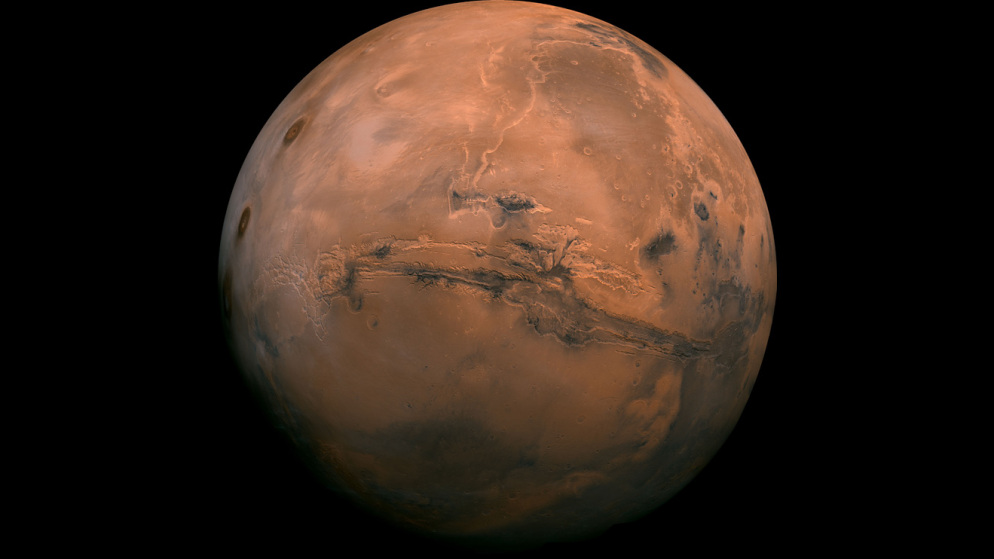
Image (Credit): Image of Mars. (NASA)

Here are some recent stories of interest.

Planetary Science Institute: Vast, Potential Ice-Rich Deposit Found in Martian Equatorial Region

A potential ice-rich portion of the Medusae Fossae Formation deposits may contain the largest volume of water in the equatorial region of Mars. Data from the Mars Advanced Radar for Subsurface and Ionospheric Sounding (MARSIS) –  a subsurface radar sounder on the Mars Express orbiter searching for water and studying the Martian atmosphere – reveals layering in the Medusae Fossae Formation (MFF) deposits. These layers are likely due to transitions between mixtures of ice-rich and ice-poor dust, analogous to those in Polar Layered Deposits, according to the paper “Evidence of Ice-Rich Layered Deposits in the Medusae Fossae Formation of Mars” in Geophysical Research Letters. 

University of California: “Small Solar Sails Could be the Next ‘Giant Leap’ for Interplanetary Space Exploration

Nearly 70 years after the launch of the first satellite, we still have more questions than answers about space. But a team of Berkeley researchers is on a mission to change this with a proposal to build a fleet of low-cost, autonomous spacecraft, each weighing only 10 grams and propelled by nothing more than the pressure of solar radiation. These miniaturized solar sails could potentially visit thousands of near-Earth asteroids and comets, capturing high-resolution images and collecting samples.

NASA: “NASA’s GUSTO Prepares to Map Space Between the Stars

On a vast ice sheet in Antarctica, scientists and engineers are preparing a NASA experiment called GUSTO to explore the universe on a balloon. GUSTO will launch from the Ross Ice Shelf, near the U.S. National Science Foundation’s McMurdo Station research base, no earlier than Dec. 21. GUSTO, which stands for Galactic/Extragalactic ULDB Spectroscopic Terahertz Observatory, will peer into the space between stars called the interstellar medium. The balloon-borne telescope will help scientists make a 3D map of a large part of the Milky Way in extremely high-frequency radio waves. Examining a 100-square-degree area, GUSTO will explore the many phases of the interstellar medium and the abundances of key chemical elements in the galaxy.

Tap Into an Upcoming Mars Discussion

The Mars Society’s President and founder Dr. Robert Zubrin is in Europe this week to meet with fellow Mars enthusiasts. You can tap into one of those discussions tomorrow if you are interested.

On January 18, Dr. Zubrin will hold a discussion with UK Astronomer Royal Lord Martin Rees on the topic “How to Explore Mars.” You may remember Dr. Rees from some of his books, including Gravity’s Fatal Attraction: Black Holes in the Universe and The End of Astronauts.

You can go here to get your online spot at the London discussion. Just keep in mind the time difference.

Hopefully, a recorded version will be available shortly after the event.

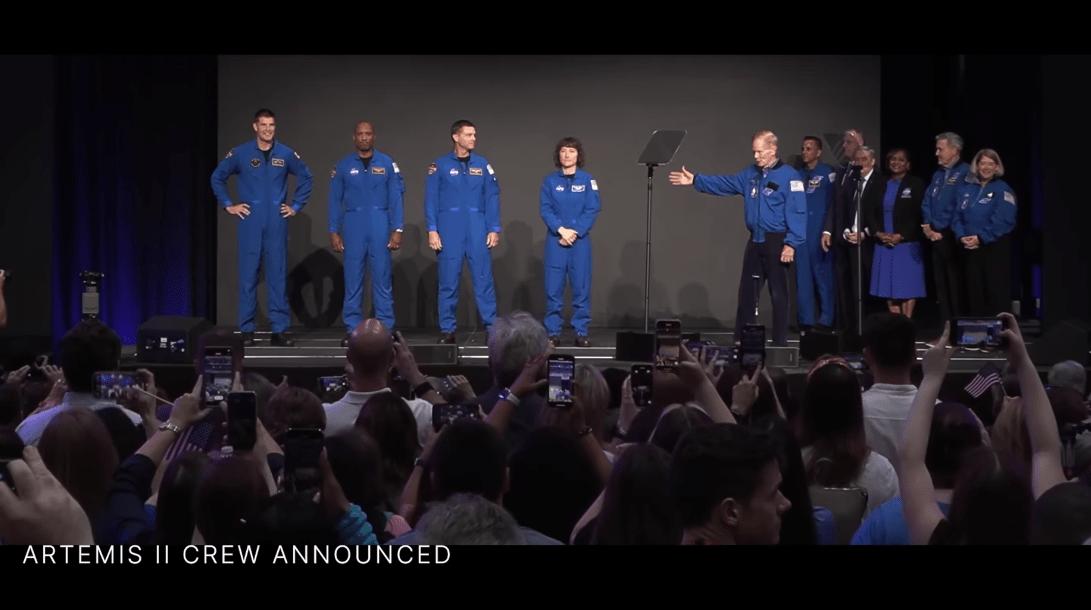
NASA Had a Busy Year

Image (Credit): The introduction of the Artemis II crew, just one of many items highlighted in NASA’s new video summarizing 2023. (NASA)

This is the time of year for lists, so I wanted to highlight one of the more important lists, at least in the opinion of this writer. That’s right, we need to remember the important space milestones from this year.

Fortunately, NASA recently summed up its successes in 2023 with a new video titled NASA 2023: Nothing is Beyond Our Reach. The video highlights many of the Agency’s accomplishments this year, including the launch of the Psyche mission, the announcement of a crew for the Artemis II mission, and the OSIRIS-REx capsule retrieval.

It is quite a list. Luckily, NASA provided a list of links so you can read more about the various efforts:

Time to read up on 2023 before we dive into more activities in 2024.

Note: You can read a more detailed list of accomplishments at this NASA site.

Martian Habitat: One More Try

The image above is one more attempt with an AI program to create a Martian habitat. As with the images in my last post, I asked the AI image program Freepik to respond to the following request: “Realist painting, surface of Mars, rocket and habitat in the foreground, ultra detailed.”

The image generated was better than either DALL-E 2 or Microsoft’s Image Creator (DALL-E 3) in terms of a semi-realistic and clearly planned habitat on Mars. Of course, an even more likely habitat would be below the surface, but I do not want to be too picky. But like the Microsoft program, Freepik added a moon that does not exist in the real world (or the real Mars, I should say).

I tried a different request to see it this would continue to happen. My request was: “Martian colony in the year 2400.” In this case, I was more satisfied with the result. In two of the four images, Freepik provided a viable habitat and did not display a moon. One of the images is displayed below. Unfortunately, the other two still has moons.

It will be hit or miss with many of these programs. You will need to know more than the program in terms of context. We are still early in the game and it is likely the AI programs will slowly remove these make-believe elements. But until then, don’t start using these images in any official publications or you will be spending a lot of time explaining yourself.