Tomorrow’s launch of a classified US Air Force payload will be the last use of the United Launch Alliance (ULA) Atlas V rocket for such missions. It will the rocket’s 100th national security launch.
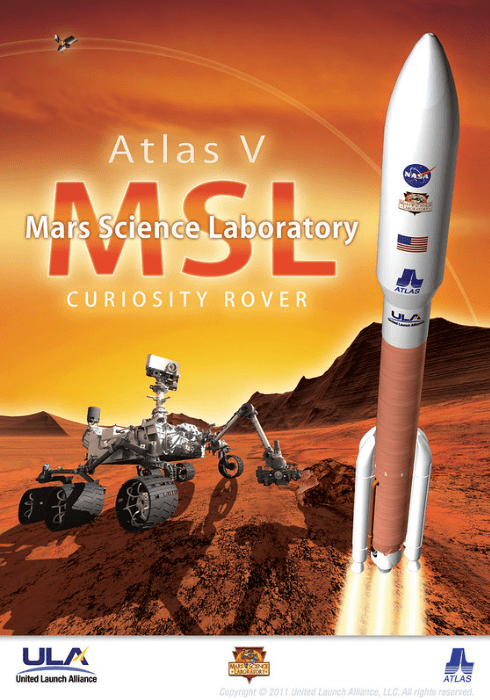
The Atlas rocket, first built in 1957, is America’s longest-serving active rocket. Over the years, the rockets have launched numerous critical government and commercial missions, including NASA missions. For instant, it sent NASA’s Curiosity Rover to Mars. Most recently it sent the Boeing Starliner to the International Space Station (now the Starliner needs to find its own way back).
More Atlas V missions are planned even with the absence of national security missions, but the ULA’s focus is turning towards its new Vulcan rocket, which is still being tested.
The era of the Atlas rocket is quickly coming to a close.
Image (Credit): NASA’s Perseverance Mars Rover. (NASA)
“Cheyava Falls is the most puzzling, complex, and potentially important rock yet investigated by Perseverance…On the one hand, we have our first compelling detection of organic material, distinctive colorful spots indicative of chemical reactions that microbial life could use as an energy source, and clear evidence that water — necessary for life — once passed through the rock. On the other hand, we have been unable to determine exactly how the rock formed and to what extent nearby rocks may have heated Cheyava Falls and contributed to these features.”
–Statement by Ken Farley, Perseverance project scientist of Caltech in Pasadena, regarding a recent finding by the Perseverance rover on Mars. The rock, labeled “Cheyava Falls,” may answer whether Mars was home to microscopic life in the distant past.
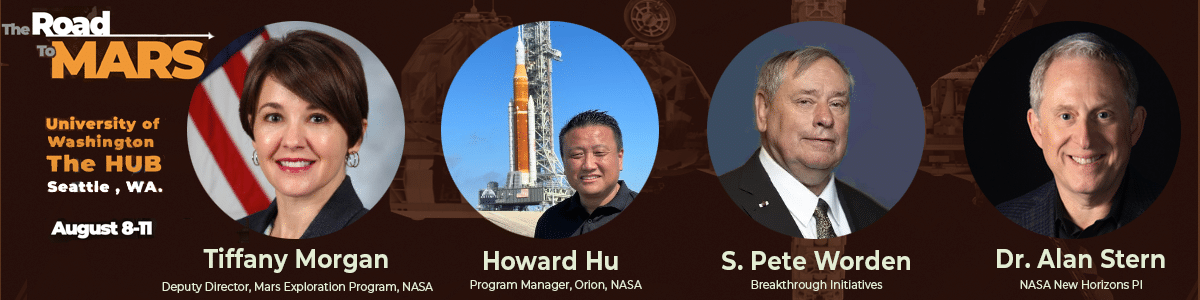
You still have time to sign up for the Mars Society’s 27th Annual International Mars Society Convention, happening from August 8-11 in Seattle, WA.
Some of the guests include:
Tiffany M. Morgan, Deputy Director of the Mars Exploration Program in NASA’s Science Directorate, who will give an address about “Exploring Mars Together, DRAFT Plan for a Sustainable Future for Science at Mars.”
Howard Hu, the Orion Program Director at NASA, who will give an address about “NASA’s Artemis plans for returning to the Moon and beyond,”
Brig. General (Ret.) Dr. S. Pete Worden, Chairman of the Breakthrough Prize Foundation, who will give an address about “Life in the Universe and Private Sector Space Science Initiatives.”
Dr. Alan Stern, a renowned planetary scientist and commercial astronaut, who will give an address about “The Other Red Planet” focusing on Pluto.
These are just a few of the names and presenters this year. You can also watch the presentations from prior conventions if you want to see what you missed.
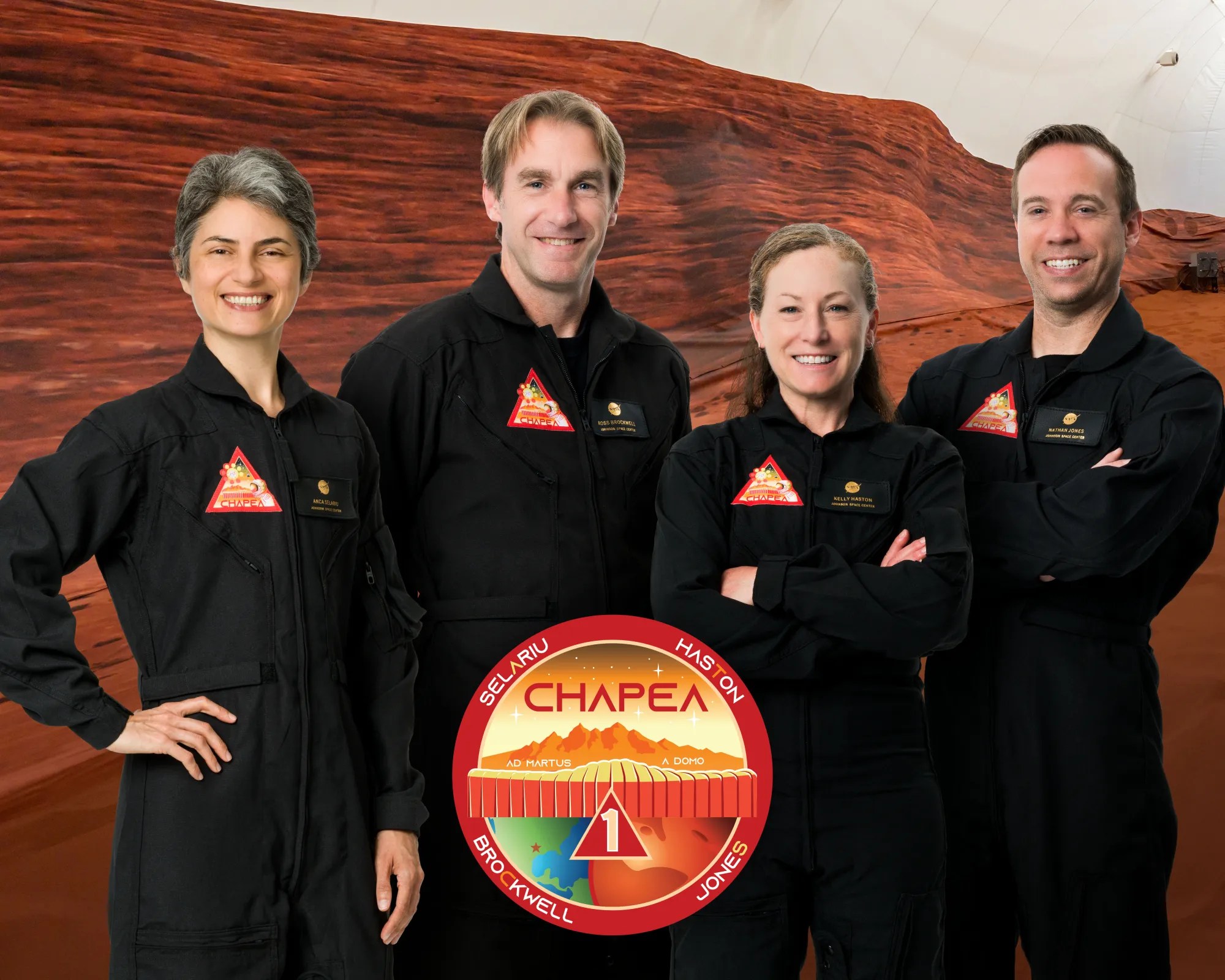
Image (Credit): Official mission 1 CHAPEA crew portrait (from left to right: Anca Selariu, Ross Brockwell, Kelly Haston, Nathan Jones). (NASA)
“”It would still cause me a great deal of thought, but I think my answer now is it would be very difficult to leave my partner, to leave my people, for that amount of time, because it would be far more than a year…That commitment, it’s going to be a tremendous effort when people go, and I really applaud whoever gets to do that. But I’m not sure it’ll be me.”
–Statement by Kelly Haston, a Canadian research scientist, after spending 378 days as part of NASA’s yearlong Mars simulation project. She was part of a team of four individuals who lived together during this period at the Johnson Space Center in Houston in what is called the Crew Health and Performance Exploration Analog (CHAPEA) project. The next simulation mission is planned for next year.
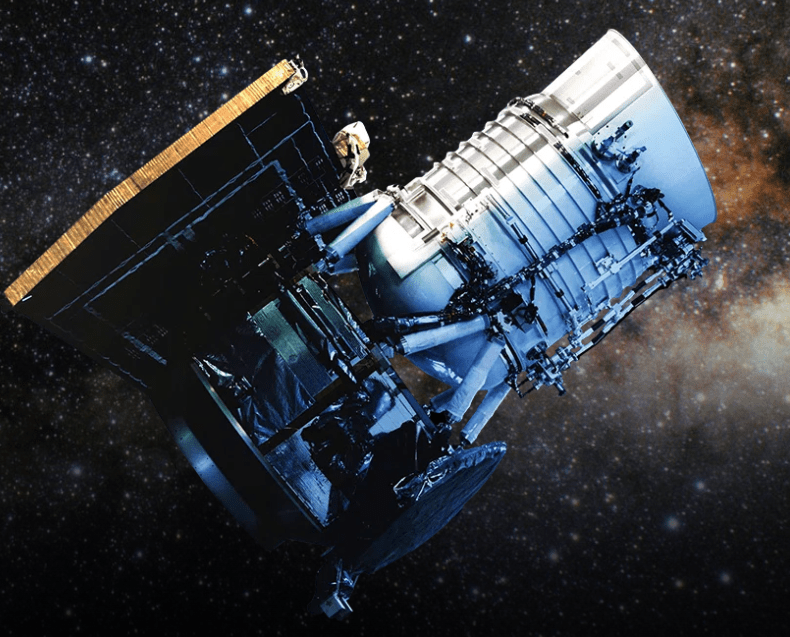
A NASA space telescope designed to “hunt” asteroids and comets that could pose a threat to life on Earth and orbiting spacecraft will soon burn up in orbit. In late 2024 or early 2025, the agency’s Near-Earth Object (NEO) Wide-field Infrared Survey Explorer—or NEOWISE—is expected to come home in pieces following the conclusion of its second mission later this month…However, NASA has a replacement lined up: the Near Earth Object Surveyor (NEO Surveyor), set for a 2027 launch. The infrared space telescope is the first to be designed specifically for hunting large numbers of NEOs in and around Earth orbit. It has a baseline development cost of $1.2 billion to which NASA committed in 2022.
Four volunteers who spent more than a year living in a 1,700-square-foot space created by NASA to simulate the environment on Mars have emerged. The members of the Crew Health and Performance Exploration Analog mission — or CHAPEA — walked through the door of their habitat at NASA’s Johnson Space Center in Houston on Saturday to a round of applause…Haston and the other three crew members — Anca Selariu, Ross Brockwell and Nathan Jones — entered the 3D-printed Mars replica on June 25, 2023, as part of a NASA experiment to observe how humans would fare living on the Red Planet.
Russia is aiming to create the four-module core of its planned new orbital space station by 2030, its Roscosmos space agency said on Tuesday. The head of Roscosmos, Yuri Borisov, signed off on the timetable with the directors of 19 enterprises involved in creating the new station. The agency confirmed plans to launch an initial scientific and energy module in 2027. It said three more modules would be added by 2030 and a further two between 2031 and 2033.