Movie: Good Night Oppy

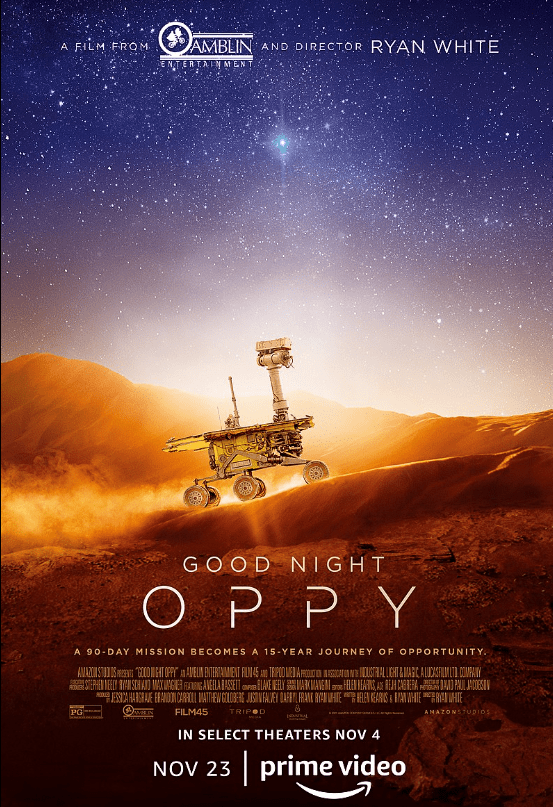
Image (Credit): Movie poster for Good Night Oppy. (Amazon Studies)

Here is a new space movie that should keep the crowds happy, and it is based on a true success – our mission to Mars. Good Night Oppy, produced by Amazon Studios, is the story of NASA’s Opportunity Mars rover. You can watch a preview here.

Amazon Studies has this preview:

Good Night Oppy tells the inspirational true story of Opportunity, a rover that was sent to Mars for a 90-day mission but ended up surviving for 15 years. The film follows Opportunity’s groundbreaking journey on Mars and the remarkable bond forged between a robot and her humans millions of miles away.

The film, narrated by Angela Bassett, has the same feel as the 1985 film The Dream is Alive, which was narrated by Walter Cronkite and covered the space shuttle missions. While one might claim these are simple feel good movies, I say spread the word about the space missions far and wide. We should be proud of what we have done as well as where we plan to go.

The film will be available in selected theaters today and on Amazon Prime November 23, 2022.

You can learn more about the Opportunity rover here, and its sister rover Spirit here.

Image (Credit): DVD cover of the firm The Dream is Alive. (Threshold Corporation)

Pic of the Week: Marian Dust Devils

Image (Credit): Dust devils swirling across Jezero Crater, as viewed by NASA’s Perseverance Mars rover. (NASA/JPL-Caltech/SSI)

This week’s image is from earlier this year when NASA’s Perseverance Mars rover captured whirling dust on the Red Planet’s surface. Here is more on the dust devils from NASA:

During its first couple hundred days in Jezero Crater, NASA’s Perseverance Mars rover saw some of the most intense dust activity ever witnessed by a mission sent to the Red Planet’s surface. Not only did the rover detect hundreds of dust-bearing whirlwinds called dust devils, Perseverance captured the first video ever recorded of wind gusts lifting a massive Martian dust cloud.

A paper recently published in Science Advances chronicles the trove of weather phenomena observed in the first 216 Martian days, or sols. The new findings enable scientists to better understand dust processes on Mars and contribute to a body of knowledge that could one day help them predict the dust storms that Mars is famous for – and that pose a threat to future robotic and human explorers.

“Every time we land in a new place on Mars, it’s an opportunity to better understand the planet’s weather,” said the paper’s lead author, Claire Newman of Aeolis Research, a research company focused on planetary atmospheres. She added there may be more exciting weather on the way: “We had a regional dust storm right on top of us in January, but we’re still in the middle of dust season, so we’re very likely to see more dust storms.”

Space Stories: A New Martian Crater, the Final Piece of China’s Space Station, and the Falcon Heavy Flies Again

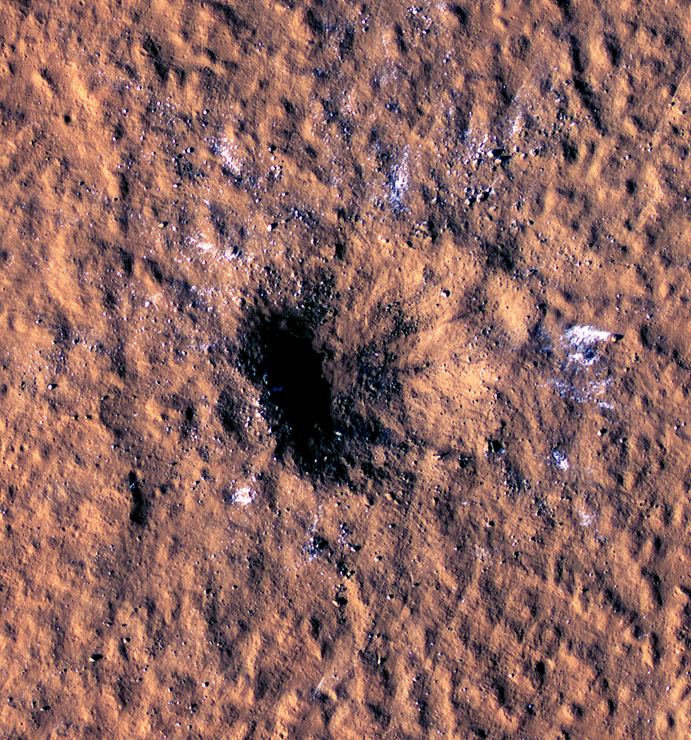
Image (Credit): Recent impact crater on the surface of Mars. It was formed on December 24, 2011 in the Amazonis Planitia region. (NASA/JPL-Caltech/University of Arizona)

Here are some recent stories of interest.

NASA: “NASA’s InSight Lander Detects Stunning Meteoroid Impact on Mars

NASA’s InSight lander recorded a magnitude 4 marsquake last Dec. 24, but scientists learned only later the cause of that quake: a meteoroid strike estimated to be one of the biggest seen on Mars since NASA began exploring the cosmos. What’s more, the meteoroid excavated boulder-size chunks of ice buried closer to the Martian equator than ever found before – a discovery with implications for NASA’s future plans to send astronauts to the Red Planet.

Aljazeera: “Final Module Docks at China’s ‘Heavenly Palace’ Space Station

The final module required for the completion of China’s Tiangong space station has successfully docked with the core structure, state media say, a key step in Beijing’s ambitious plans for space exploration…The module – named Mengtian, which means “heavenly dream” – was launched on Monday on a Long March 5B rocket from the Wenchang launch centre on China’s tropical island of Hainan, CCTV reported.

Wall Street Journal: “SpaceX’s Falcon Heavy Rocket, World’s Most Powerful Rocket, Launches After Three-year Hiatus

SpaceX’s Falcon Heavy — a towering, three-pronged vehicle that is the most powerful operational rocket in the world — returned to the skies on Tuesday for the first time since mid-2019. The rocket launched at 9:41 a.m. ET from NASA’s Kennedy Space Center in Florida, hauling satellites to space for the US military in a secretive mission dubbed USSF-44.

Has Russia Lost its Space Mojo?

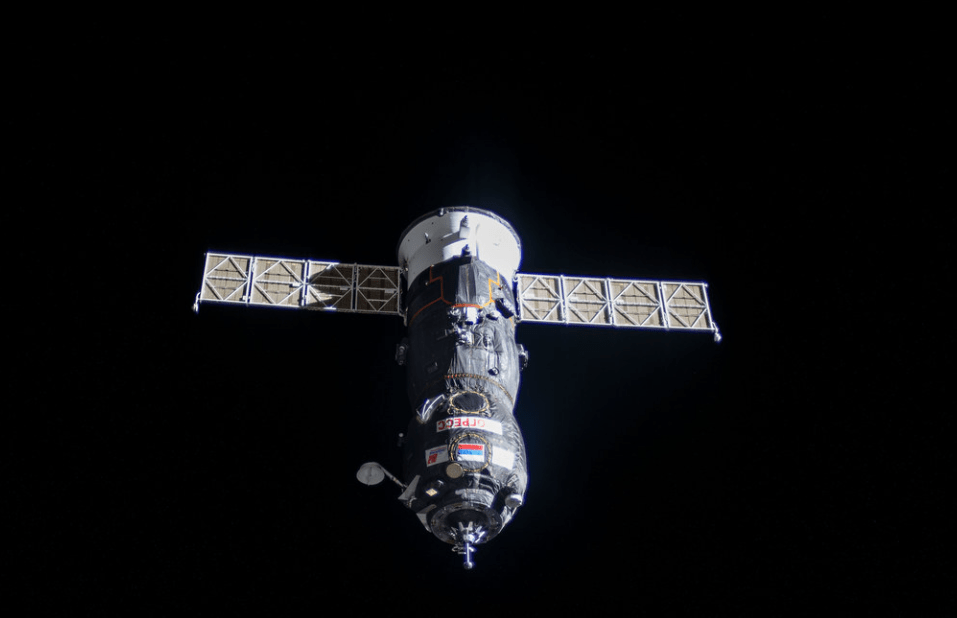
Image (Credit): Russia’s Progress 76 resupply ship approaching the ISS in July 2020. (NASA)

Marina Koren’s article in The Atlantic, titled “The Russian Space Program Is Falling Back to Earth,” has plenty to say about the state of Russia’s space program. Her assessment is pretty bleak outside of the continued collaboration related to the International Space Station (ISS).

She notes:

Beyond the ISS, though, Russia’s space portfolio isn’t all that grandiose these days. Although cosmonauts fly into orbit regularly, Russia does not have a rover on the far side of the moon, as China has, or orbiters around Mars, as India and the United Arab Emirates have. It does not have a fleet of space telescopes like the U.S has. The Soviet Union was the first to send a human being to space, decades ago, and its early accomplishments are a distinct point of national pride. But the Russian space program has stalled for years, plagued by sparse budgets. And that was before Vladimir Putin’s onslaught on Ukraine: Some of the space plans the country still had in the works are falling apart. Now the Russian space effort may be more adrift than ever.

The Russian invasion of Ukraine may be the last straw. It led to the cancellation of various collaborative space projects with other nations. For instance, back in March the European Space Agency (ESA) was forced to suspend its joint ESA/Roscosmos ExoMars Rover mission to Mars.

China seems to be pulling ahead of Russia in the space race, with Russia taking a back seat on future projects, such as a Moon base or new space station. On the ground, Russia has shown it is not up to a war with Ukraine, making its role as a military power questionable. The article notes that Russia’s status as a space power is now also in question.

And shooting down another nation’s satellites will not be seen as a sign of strength in either the military or space arena.

Space Stories: Approaching Lucy, Chinese Space Ambitions, and Conan the Bacterium

Image (Credit): Image from NASA’s Lucy spacecraft showing the Earth and Moon from 890,000 miles away (look closely – the moon on the left is a very pale dot). (NASA/Goddard/SwRI)

Here are some recent stories of interest.

NASA.gov: “NASA’s Lucy Spacecraft Captures Images of Earth, Moon Ahead of Gravity Assist

On October 13, 2022, NASA’s Lucy spacecraft captured [the above] image of the Earth and the Moon from a distance of 890,000 miles (1.4 million km). The image was taken as part of an instrument calibration sequence as the spacecraft approached Earth for its first of three Earth gravity assists. These Earth flybys provide Lucy with the speed required to reach the Trojan asteroids — small bodies that orbit the Sun at the same distance as Jupiter. On its 12 year journey, Lucy will fly by a record breaking number of asteroids and survey their diversity, looking for clues to better understand the formation of the solar system.

SpaceNews.com: “China Considering Mission to Ceres and Large Dark Matter Space Telescope

The Chinese Academy of Sciences is considering potential missions including a Ceres orbiter and a huge telescope to hunt for clues about the nature of dark matter. More than 20 candidates are vying for funding for further study under the Chinese Academy of Sciences Strategic Priority Program on Space Science, also known as the New Horizon Program, and are currently undergoing evaluation.

Space.com: “Extremophiles on Mars Could Survive for Hundreds of Millions of Years

One of Earth’s toughest microbes could survive on Mars, lying dormant beneath the surface, for 280 million years, new research has shown. The findings increase the probability that microbial life could still exist on the Red Planet. Deinococcus radiodurans, nicknamed “Conan the Bacterium,” is one of the world’s toughest microbes, capable of surviving in radiation strong enough to kill any other known life-form. Experiments have now shown that if Conan the Bacterium or a similar microbe existed on Mars, it could survive 33 feet (10 meters) beneath the surface, frozen and dried out, for 280 million years.