Space Stories: Lost Lunar Lander, Exoplanet Elements, and the Molten Middle of Mars

Image (Credit): Artist’s rendering of the HAKUTO-R Mission 1 Lunar Lander orbiting the Moon. (ispace)

Here are some recent stories of interest.

Astronomy.com:Japanese Lunar Lander Loses Contact Moments Before Touchdown

The Japanese start-up ispace attempted to become the first private company to successfully soft-land a commercial spacecraft on the Moon today (Tuesday, April 25). However, it now appears that the landing attempt — like several other such attempts in recent years — has failed…Ispace currently plans to attempt at least two more lunar landings over the next few years, applying lessons learned during today’s landing attempt to increase their odds of success.

Phys.com:Scientists Discover Rare Element in Exoplanet’s Atmosphere

The rare metal terbium has been found in an exoplanet’s atmosphere for the first time. The researchers at Lund University in Sweden have also developed a new method for analyzing exoplanets, making it possible to study them in more detail…”Detecting heavy elements in the atmospheres of ultra-hot exoplanets is another step towards learning how the atmospheres of planets work. The better we get to know these planets, the greater chance we have of finding Earth 2.0 in the future,” concludes Nicholas Borsato.

NASA:NASA InSight Study Provides Clearest Look Ever at Martian Core

While NASA retired its InSight Mars lander in December, the trove of data from its seismometer will be pored over for decades to come. By looking at seismic waves the instrument detected from a pair of temblors in 2021, scientists have been able to deduce that Mars’ liquid iron core is smaller and denser than previously thought.

Space Stories: Merging Galaxies, Anniversary for TESS, and Helicopter Flights on Mars

Image (Credit): Arp 220 as captured by NASA’s James Webb Space Telescope. (NASA, ESA, CSA, STScI, Alyssa Pagan)

Here are some recent stories of interest.

PetaPixel:Webb Captures Star-Forming Galactic Merger Brighter Than 1 Trillion Suns’”

NASA’s James Webb Space Telescope has captured a stunning “smash-up” of two spiral galaxies. Collectively called Arp 220, the collision of the pair of galaxies has facilitated massive star formation. Arp 220 is located within the constellation Serpens, about 250 million light-years from Earth. Arp 220 gets its namesake because it is the 220th object in Hallton Art’s Atlas of Peculiar Galaxies. Arp 220 is “peculiar” because it’s an ultra-luminous infrared galaxy (ULIRG), and the nearest ULIRG to Earth.

Phys.org:NASA’s TESS Celebrates Fifth Year Scanning the Sky for New Worlds’”

Now in its fifth year in space, NASA’s TESS (Transiting Exoplanet Survey Satellite) remains a rousing success. TESS’s cameras have mapped more than 93% of the entire sky, discovered 329 new worlds and thousands more candidates, and provided new insights into a wide array of cosmic phenomena, from stellar pulsations and exploding stars to supermassive black holes.

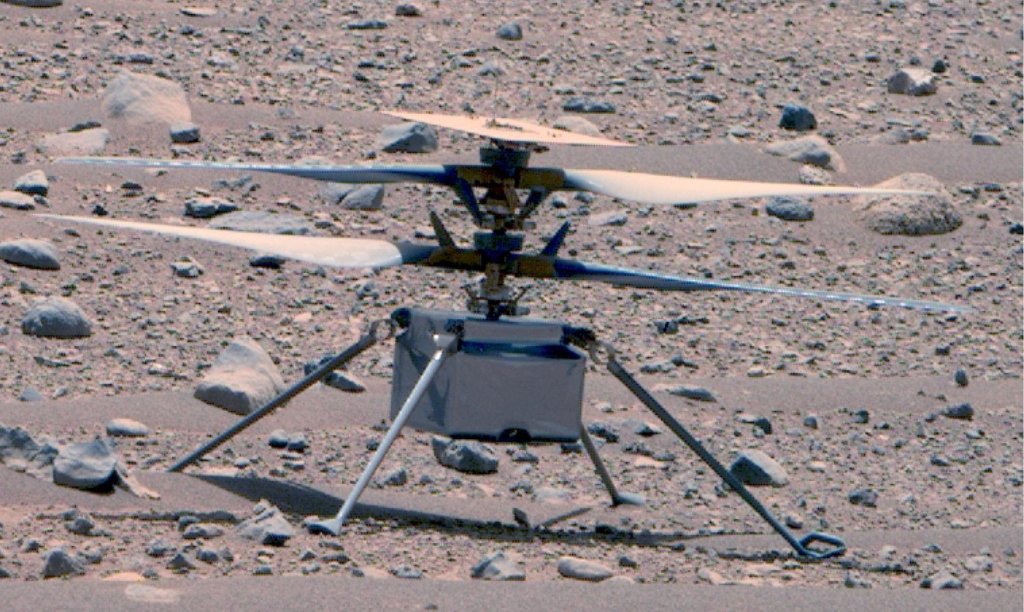
NASA:NASA’s Ingenuity Mars Helicopter Completes 50th Flight’”

NASA’s Ingenuity Mars Helicopter has completed its 50th flight on Mars. The first aircraft on another world reached the half-century mark on April 13, traveling over 1,057.09 feet (322.2 meters) in 145.7 seconds. The helicopter also achieved a new altitude record of 59 feet (18 meters) before alighting near the half-mile-wide (800-meter-wide) “Belva Crater.”

Television: Fired on Mars

Credit: WarnerMedia

A new series is coming to HBO Max on April 20th.

The series, Fired on Mars, is described as an “Existential workplace comedy set on the Martian campus of a modern tech company.” It stars Pete Davidson. It’s animated. And HBO Max seems to be doing the bare minimum to advertise it. Or, more to the point, it is doing nothing to advertise it.

Does that peek your interest of scare you away?

I am more in the latter category, but I will watch the first episode to see that I think.

Update: I watched the first few episodes and decided that was enough. It really has very little to do with Mars. The planet is just a backdrop to an office drama that is not very interesting. If you want a good science fiction office drama you would do better watching Severance on Apple TV+.

If You Thought the Skies Were Crowded, Just Wait

Credit: Starlink.

The Washington Post recently published a story, “China’s military aims to launch 13,000 satellites to rival Elon Musk’s Starlink,” that can only terrify astronomers here on Earth trying to view the stars. The title says it all – the space race continues to clutter the skies with more and more low-Earth satellites broadcasting back to the surface. It is a dippy Dyson Sphere that contains scientists rather than energy.

Starlink’s success in Ukraine really bothers the Chinese, who see the network as a lifeline for Taiwan as well. The article quotes Chinese military researchers, who state:

Once the Starshield is completed, it will be tantamount to installing networked surveillance cameras all over the world. At that time, military operations including the launch of ballistic missiles, hypersonic missiles and fighter jets will hardly escape the monitoring of the United States.

I would prefer the space race between the US and China focused on the Moon or Mars rather than local invasions, but that is the state of the world at the moment. Not that the race to the Moon was a completely tame affair. For instance, the US contemplated exploding a nuclear bomb on the surface of the Moon to impress the Russians and everyone else. Fortunately, Project A119 never happened.

Pic of the Week: Martian Sample Depot

Image (Credit): NASA’s Perseverance Mars rover captured this portrait of its recently completed sample depot on Jan. 31, 2023. (NASA/JPL-Caltech/ASU/MSSS)

This week’s image shows the Perseverance Mars rover looking back on its work – the depositing of 10 titanium sample tubes on the surface of the Red Planet should they be needed as backups (see image below marking the sample locations). The rover is carrying the official samples, but this depot was set up just in case something happens to the rover.

Here is a little more from NASA:

Eight of those tubes are filled with rock and regolith (broken rock and dust), while one is an atmospheric sample and one is a “witness” tube...

The depot represents a backup collection of samples that could be recovered in the future by the Mars Sample Return campaign, a joint effort between NASA and ESA (European Space Agency) that aims to bring Mars samples to Earth for closer study. The rover began building the depot on Dec. 21, 2022, precisely spacing the tubes in case they need to be retrieved at a future date.

The primary tubes reside in the belly of Perseverance, which would pass them, along with future samples taken during the mission to a Sample Retrieval Lander as part of the campaign. If anything were to happen to the rover to prevent it from delivering tubes directly to the lander, samples could be retrieved from the depot instead. (Learn more about all 18 samples taken so far.)

Image (Credit): NASA’s Perseverance Mars rover captured this portrait of its recently completed sample depot on Jan. 31, 2023. The locations of the 10 samples are clearly marked. (NASA/JPL-Caltech/ASU/MSSS)