Space Stories: Starliner Not on the Schedule, More Questions About Artemis, and the Origin of Most Meteorites

Image (Credit): The International Space Station. (NASA)

Here are some recent stories of interest.

Space NewsNASA Further Delays First Operational Starliner Flight

NASA will use SpaceX’s Crew Dragon for its two crew rotation missions to the International Space Station in 2025 as it continues to evaluate if it will require Boeing to perform another test flight of its Starliner spacecraft. In an Oct. 15 statement, NASA said it will use Crew Dragon for both the Crew-10 mission to the ISS, scheduled for no earlier than February 2025, and the Crew-11 mission scheduled for no earlier than July. Crew-10 will fly NASA astronauts Anne McClain and Nichole Ayers along with astronaut Takuya Onishi from the Japanese space agency JAXA and Roscosmos cosmonaut Kirill Peskov. NASA has not yet announced the crew for the Crew-11 mission.

BloombergNASA’s $100 Billion Moon Mission Is Going Nowhere

There are government boondoggles, and then there’s NASA’s Artemis program. More than a half century after Neil Armstrong’s giant leap for mankind, Artemis was intended to land astronauts back on the moon. It has so far spent nearly $100 billion without anyone getting off the ground, yet its complexity and outrageous waste are still spiraling upward. The next US president should rethink the program in its entirety.

CNRSThe Origin of Most Meteorites Finally Revealed

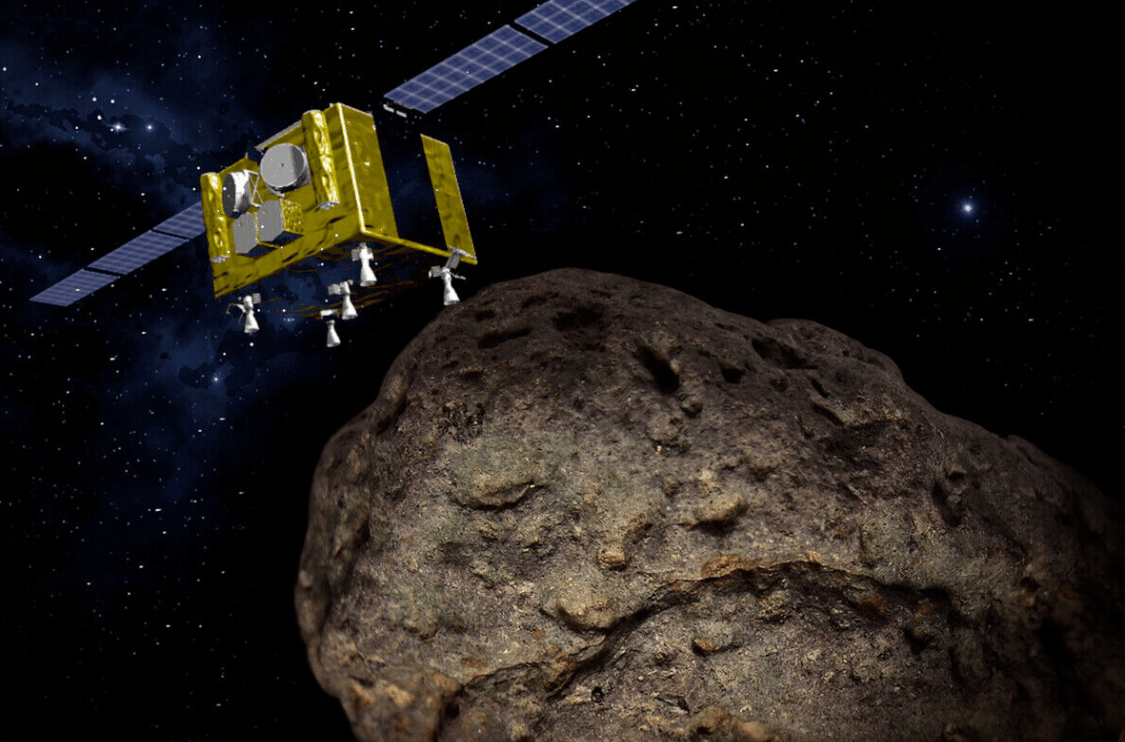
An international team led by three researchers from the CNRS1 , the European Southern Observatory (ESO, Europe), and Charles University (Czech Republic) has successfully demonstrated that 70% of all known meteorite falls originate from just three young asteroid families. These families were produced by three recent collisions that occurred in the main asteroid belt 5.8, 7.5, and about 40 million years ago. The team also revealed the sources of other types of meteorites; with this research, the origin of more than 90% of meteorites has now been identified. This discovery is detailed in three papers, a first published on 13 September 2024 in the journal Astronomy and Astrophysics, and two new papers published on 16 October 2024 in Nature.

Space Quote: Axiom Space and Prada Reveal Artemis III Space Suit

Image (Credit): The AxEMU spacesuit. (Axiom Space)

“At the International Astronautical Congress in Milan, Italy, Axiom Space and Prada revealed for the first time today the flight design of the Axiom Extravehicular Mobility Unit (AxEMU) spacesuit that will be used for NASA’s Artemis III mission…The AxEMU suit is nearing the final development stage. It completed a successful pressurized simulation with Artemis III partners – NASA, SpaceX, and Axiom Space – marking the first test of its kind since the Apollo era. It will continue to undergo testing including crewed underwater tests at the NBL facility, integrated tests with the Artemis Lunar Terrain Vehicle prototypes, and will enter the critical design review phase in 2025.

-Statement from an Axiom Space press release. Specifics about the new space suit can be found in the graphic below. Now it is a matter of getting the other pieces together in time for the Artemis III mission, which will entail sending astronauts to explore the Moon’s South Pole.

Credit: Axiom Space.

Space Quote: Can China Win the Lunar Race This Time?

Image (Credit): Image of Apollo 17 astronaut Eugene Cernan on the Moon’s surface. (NASA)

“As the U.S. has flailed, China and its partners have marched forward, notching one success after another. There is no reason to believe they will not be first to send a crewed mission to the lunar south pole, where only a half dozen or so promising regions exist to safely land. Depending on how the currently vague noninterference rules are interpreted and enforced by the Chinese (and others), significant parts of the moon might end up off-limits for anyone else to explore or mine. We do not know for certain how China might behave on the lunar surface—this is part of the conundrum—but terrestrial conflicts in the South China Sea and China’s regular infractions of sovereign airspace give scant rationale for optimism.”

-Quote from an article in Scientific American titled “NASA Needs a ‘Lunar Marathon’ to Match China on the Moon.” The author of the piece is Thomas Zurbuchen, who previously worked at NASA and is now is professor and director of the Swiss Federal Institute of Technology’s ETH Zürich | Space. For another take on where the US is with its Artemis lunar program, you can read an ARS Technica article titled “The Politically Incorrect Guide to Saving NASA’s Floundering Artemis Program.”

NASA is Looking for Help with its Upcoming Moon Mission

Image (Credit): Shackleton crater at the Moon’s south pole. (NASA/GSFC/Arizona State University)

With NASA planning to return to the Moon shortly as part of the Artemis mission, it is tying up loose end and figuring out what else it may need. It seems that one of the needed items is a better way to conduct its work at the lunar south pole. This comes down to two challenges, both of which have a payout to the winner.

Here’s NASA’s description of the two challenges:

Challenge 1: NASA is seeking an orienteering aid that will help the astronauts navigate on traverses away from the lunar lander and return back. While there were similar devices available to the Apollo astronauts, NASA is looking for new and unique solutions. Among other considerations, devices must be accurate, easy to use, able to be used on the moon’s surface by an astronaut wearing pressurized gloves. If your solution is one of the best, you could be eligible for a share of the $15,000 prize purse.

Challenge 2: NASA is looking for assistance in getting to and mapping the bottom of Shackleton Crater. The design must work in the extreme conditions of the lunar south pole and Shackleton Crater, map the crater, characterize and quantify what is in the crater, and send the data back to be used for future missions. If you can solve this challenge by describing your design concept in detail, you could be eligible for a share of the $30,000 prize purse.

You might wonder why NASA is only thinking of these needs now. I am hoping NASA has some less refined solutions and is only seeking for a better way.

If you have an idea or two, be sure to share it with NASA by November 25, 2024.

Good luck!

Space Stories: Axiom Space Struggling Financially, Intuitive Machines Gets $4.8 billion NASA Contract, and Water and Hydroxyl Widespread on Moon

Credit: Axiom Space

Here are some recent stories of interest.

ARS TechnicaA Key NASA Commercial Partner Faces Severe Financial Challenges

Axiom Space is facing significant financial headwinds as the company attempts to deliver on two key commercial programs for NASA—the development of a private space station in low-Earth orbit and spacesuits that could one day be worn by astronauts on the Moon. Forbes reports that Axiom Space, which was founded by billionaire Kam Ghaffarian and NASA executive Mike Suffredini in 2016, has been struggling to raise money to keep its doors open and has had difficulties meeting its payroll dating back to at least early 2023. In addition, the Houston-based company has fallen behind on payments to key suppliers, including Thales Alenia Space for its space station and SpaceX for crewed launches.

ReutersIntuitive Machines Clinches $4.8 billion Navigation Services Contract from NASA

Intuitive Machines said on Tuesday it has bagged a navigation and communication services contract of up to $4.82 billion from NASA for missions in the near space region. As part of the contract, which has a base period of five years with an additional five-year option period, Intuitive will deploy lunar relay satellites and provide communication and navigation services to aid NASA’s Artemis campaign.

Planetary Science InstituteSources of Water and Hydroxyl are Widespread on the Moon

A new analysis of maps of the near and far sides of the Moon shows that there are multiple sources of water and hydroxyl in the sunlit rocks and soils, including water-rich rocks excavated by meteor impacts at all latitudes. “Future astronauts may be able to find water even near the equator by exploiting these water-rich areas. Previously, it was thought that only the polar region, and in particular, the deeply shadowed craters at the poles were where water could be found in abundance,” said Roger Clark, Senior Scientist at the Planetary Science Institute and lead author of “The Global Distribution of Water and Hydroxyl on the Moon as Seen by the Moon Mineralogy Mapper (M3)” that appears in the Planetary Science Journal. “