Speaking of Soil Samples…

Image (Credit): Apollo 17 commander Eugene Cernan approaching the Lunar Roving Vehicle. (NASA)

In addition to the asteroid Bennu sample, a lunar sample from 1972 is also grabbing headlines. It appears that the lunar sample collected by the Apollo 17 crew indicates the Moon may be about 40 million years older than previously believed.

In a study published in the journal Geochemical Perspectives Letters, titled “4.46 Ga Zircons Anchor Chronology of Lunar Magma Ocean,” states (in part):

The atomic spatial resolution analysis of individual mineral grains demonstrates the absence of nanoscale clustering of lead, which supports a 4.46 Ga ancient formation age for lunar zircon in sample 72255. This age pushes back the age of the first preserved lunar crust by ∼40 Myr and provides a minimum formation age for the Moon within 110 Myr after the formation of the solar system.

If you can forgive the title of the piece, it basically resets the understanding of the Moon’s formation and, thereby, the formation of the early Earth.

In a Reuters story, Cosmochemist Philipp Heck, senior director of research at the Field Museum in Chicago and senior author of the study, noted:

The giant impact that formed the moon was a cataclysmic event for Earth and changed Earth’s rotational speed. After that, the moon had an effect on stabilizing Earth’s rotational axis and slowing down Earth’s rotational speed…The formation date of the moon is important as only after that Earth became a habitable planet.

What will we still be learning about asteroid Bennu in 50 years (assuming we can get all of that soil out of the canister)?

India Has Even Greater Space Ambitions

Image (Credit): Logo of the Indian Space Research Organization. (ISRO)

After recently sending a rover to the Moon and a spaceship to the Sun, India announced plans to build its own space station by 2035 and also send its own astronaut to the Moon by 2040. It also wants to start work on missions to Venus and Mars. How is that for ambitious?

In a press release this week, India’s Prime Minister Shri Narendra Modi stated the following:

Building on the success of the Indian space initiatives, including the recent Chandrayan-3  and Aditya L1 Missions, Prime Minister directed that India should now aim for new and ambitious goals, including setting up ‘Bharatiya Antariksha Station’ (Indian Space Station) by 2035 and sending first Indian to the Moon by 2040.

To realize this Vision, the Department of Space will develop a roadmap for Moon exploration. This will encompass a series of Chandrayaan missions, the development of a Next Generation Launch Vehicle (NGLV), construction of a new launch pad, setting up human-centric Laboratories and associated technologies.

Prime Minister also called upon Indian scientists to work towards interplanetary missions that would include a Venus Orbiter Mission and a Mars Lander.

The space race continues with India showing itself as a strong player in space, potentially replacing Russia as one of the key space-faring nations. It benefits everyone to have more nations studying our solar system. It is unfortunate that Russia has concerned itself with less dignified matters back here on Earth. Maybe it will look to the stars again one day soon.

Pic of the Week: Annular Solar Eclipse Over the U.S.

Image (Credit): Lunar shadow captured on October 14, 2023. (NASA)

This image of last week’s annular solar eclipse was captured by NASA’s Earth Polychromatic Imaging Camera (EPIC) imager carried aboard the Deep Space Climate Observatory (DSCVR), which is a joint venture between NASA, NOAA, and the U.S. Air Force.

NASA made this statement regarding the image:

An annular eclipse occurs when the Moon passes in front of the Sun but is too far from Earth to completely obscure it. The Moon is at or near its farthest distance from Earth—known as its apogee—during an annular eclipse, making it look smaller in the sky. This leaves the Sun’s edges exposed in a red-orange ring, dubbed the “ring of fire.” A satellite caught an earthly view of the event, as the Moon’s shadow crossed North America.

NASA also provided a map showing those areas in the United States most impacted by the eclipse (shown below).

Image (Credit): Map showing the dark path of the annularity stretching across the lower 48 states from Oregon to Texas. (NASA)

Space Stories: Roving Students, Preparing for Roman Times, and a New Space Center

Image (Credit): Students at this year’s obstacle course at the U.S. Space & Rocket Center during NASA’s Human Exploration Rover Challenge event. (NASA)

Here are some recent stories of interest.

—NASA: “Dozens of Student Teams Worldwide to Compete in NASA Rover Challenge“

NASA has selected 72 student teams to begin an engineering design challenge to build human-powered rovers that will compete next April at the U.S. Space & Rocket Center in Huntsville, Alabama, near the agency’s Marshall Space Flight Center. Celebrating its 30th anniversary in 2024, the Human Exploration Rover Challenge tasks high school, college, and university students to design, build, and test lightweight, human-powered rovers on an obstacle course simulating lunar and Martian terrain, all while completing mission-focused science tasks.

—Space.com: “NASA’s Roman Space Telescope will Launch in 2027. Here’s How Scientists are Getting Ready“

NASA is mobilizing the scientific community to ensure the agency’s next big space telescope will be ready to deliver a “big picture” view of the universe almost immediately after launching. The Nancy Grace Roman Telescope — also known as the Roman Space Telescope, or just Roman — is set to launch in 2027 and will view the cosmos with a staggeringly wide field of view. Its big-picture observations of distant and early galaxies could help scientists solve the mysteries of dark matter and dark energy. Collectively, this so-called dark universe accounts for 95% of the energy and matter in the cosmos, yet the true nature of dark matter and dark energy eludes scientists.

—SF YIMBY: “UC Berkeley Announces $2 Billion Space Center At NASA Ames Research Center“

New plans have been revealed for a $2 billion research center run by UC Berkeley at the NASA Ames Center in Mountain View, Santa Clara County. The Berkeley Space Center, as it will be called, will reshape 36 acres on the sprawling Ames Research Center, providing a hub for future companies to collaborate with the school and NASA scientists & engineers to improve technology for aviation, space exploration, and how people live and work in space.

Audit Results: More Concern About NASA’s Space Launch System

First, the US Government Accountability Office reported that NASA’s Space Launch System (SLS) is unaffordable, and now NASA’s Office of Inspector General (OIG) doubles down on that earlier finding, reporting that the SLS, a key component of the Artemis program, has costs that are spinning out of control.

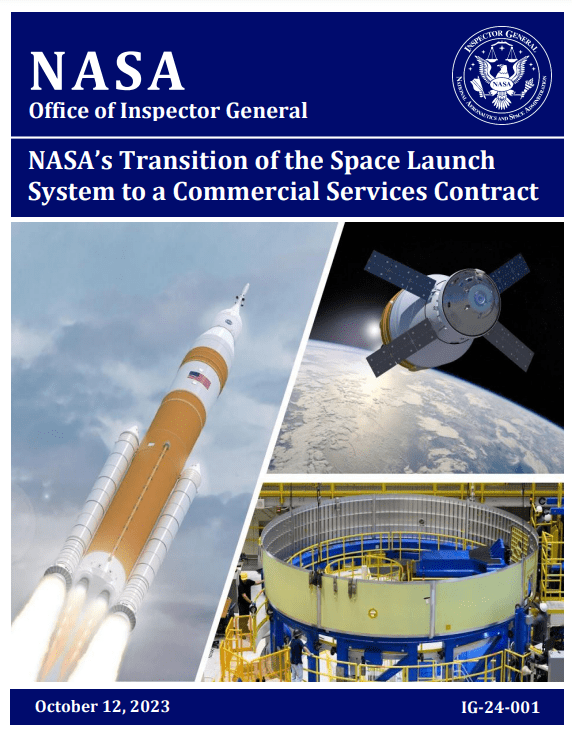
In its report, NASA’s Transition of the Space Launch System to a Commercial Services Contract, NASA OIG concludes:

Our analysis shows a single SLS Block 1B will cost at least $2.5 billion to produce—not including Systems Engineering and Integration costs—and NASA’s aspirational goal to achieve a cost savings of 50 percent is highly unrealistic. Specifically, our review determined that cost saving initiatives in several SLS production contracts such as reducing workforce within Boeing’s Stages contract and gaining manufacturing efficiencies with Aerojet Rocketdyne’s RS-25 Restart and Production Contract were not significant and, as a result, a single SLS will cost more than $2 billion through the first 10 SLS rockets produced under [the Exploration Production and Operations Contract].

NASA OIG concludes that maybe other contractors needs to be considered, stating:

Although Congress directed NASA in 2010 to build a heavy-lift rocket and crew capsule using existing contracts from the canceled Constellation effort to meet its space exploration goals, the Agency may soon have more affordable commercial options to carry humans to the Moon and beyond. In our judgment, the Agency should continue to monitor the commercial development of heavy-lift space flight systems and begin discussions of whether it makes financial and strategic sense to consider these options as part of the Agency’s longer-term plans to support its ambitious space exploration goals.

Where are these “more affordable commercial options”? Could it be SpaceX? Blue Origin? If so, let’s start the transition ASAP so that the Moon and Mars remain a realistic goal in the near future. We have plenty of talent in this country and a race to the top is what we need, not a space agency stuck with an Edsel rocket system.