Audit Results: SLS Program is Unaffordable

Image (Credit): Artist’s rendering of the SLS. (NASA)

The Government Accountability Office (GAO) recently completed a review of NASA’s Space Launch System (SLS), which is the cornerstone of the Artemis program. GAO assessed the extent to which (1) NASA has established plans to measure the SLS program costs post-Artemis I, and (2) the program has made progress with its plans to reduce projected SLS costs.

The GAO report, Space Launch System: Cost Transparency Needed to Monitor Program Affordability, highlights a number of continuing issues related to project costs and budgeting.

So what is the bottom line? This quote is most concerning: “Senior NASA officials told GAO that at current cost levels, the SLS program is unaffordable.”

The SLS is the vehicle that is supposed to demonstrate our ability to return to the Moon as well as our readiness for a Mars mission. But all of this is contingent on continued funding from Congress, and the congressional auditors have raised a red flag.

I expect you could find similar audit issues with the earlier Apollo missions as well as other space missions, yet NASA does not need to give Congress a reason to put money elsewhere. Let’s hope NASA’s leaders take the audit seriously and show some progress to keep all of the parties happy and the funding alive.

The Pragyan Rover is Sleeping on the Moon

Image (Credit): Photo of the Vikram lander, which put the Pragyan rover on the Moon. (ISRO via AP/Alamy)

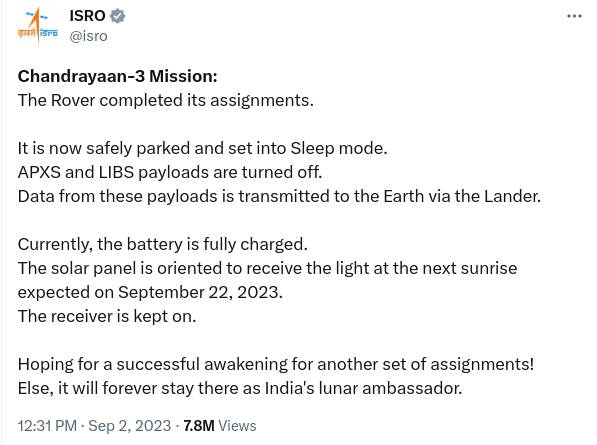
After a few weeks of work, India’s Pragyan rover on the Moon’s south pole was put to sleep last weekend to sit out the long lunar evening. It accomplished all of its goals, according to a Tweet from the Indian Space Research Organisation (ISRO):

We shall know in a few weeks whether the little lander is ready for more work.

Nature magazine noted some of the findings from the rover’s primary mission, including:

  • ions and electrons swirling near the lunar pole;
  • variations in soil temperature;
  • a moonquake; and
  • presence of sulfur and other elements.

Whatever happens, the Indian rover has been a great success.

The Moon Has One More Crater

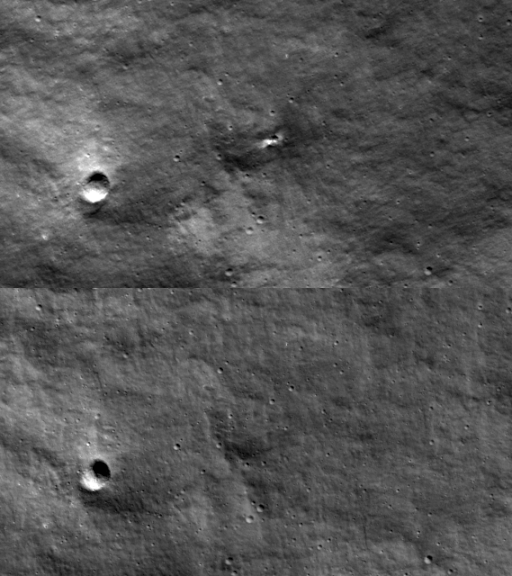
Image (Credit): Contrast between two views of the lunar surface from June 27, 2020, and Aug. 24, 2023, which is before and after the crash of Russia’s Luna-25 spacecraft. (NASA’s Goddard Space Flight Center/Arizona State University)

If President Putin wanted to leave a mark, he has done so on the Moon. NASA’s Lunar Reconnaissance Orbiter (LRO) has apparently located the spot where the Luna-25 spacecraft crashed, as shown in the before and after shot above.

Given that craters can last for billions of years on the Moon’s surface, we can rest assured that the Russians have made an indelible mark on a distant land.

Russia, let’s call it a win and recall those troops from Ukraine.

By the way, maybe we should call the new crater Putin’s Sunset.

Space Quote: The Changing Competition in Space and Elsewhere

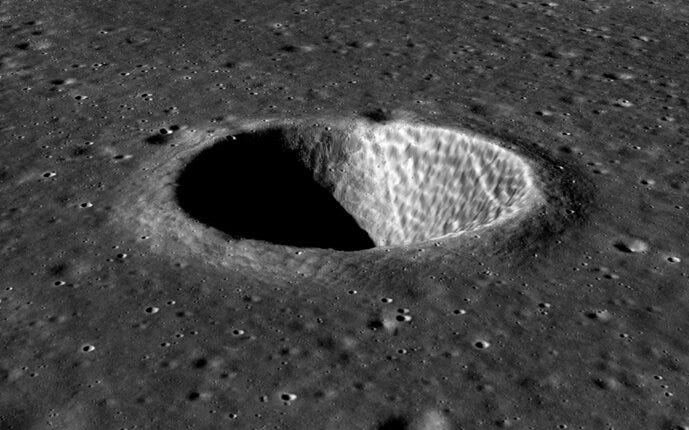
Image (Credit): 3D view of a crater on the Moon generated from images captured by Chandrayaan 2 orbiter’s Terrain Mapping Camera in 2019. (ISRO)

“…a comparison with India is illuminating: India’s economy was about half the size of Russia’s when the Berlin Wall came down in 1989. Today, India’s economy is 50 percent bigger than Russia’s. Forget about keeping pace with the United States: Russia can’t keep up with India.”

-Editorial in The Washington Post by David Von Drehle titled “India’s Brilliant Moon Landing Illuminates Russia’s Drastic Decline.” India’s steady progress on space missions, including Chandrayaan 2 back in 2019 (shown above), has occurred during Russia’s slow decline and current situation. This cannot be lost on Russia as its cosmonaut traveled to the International Space Station this weekend aboard an American rocket. Around the world, space programs are moving on without Russia, which was the leading nation at the start of the Space Age.

Pic of the Week: Another View of the Far Side of the Moon

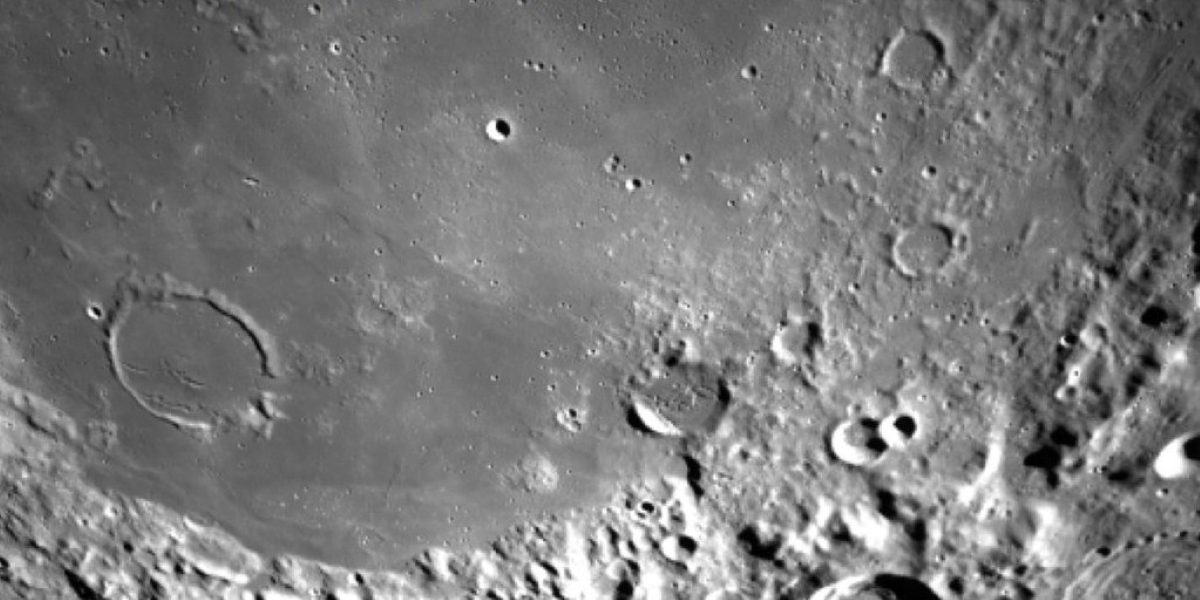
Image (Credit): Lunar surface as captured by India’s Chandrayaan-3 spacecraft. (ISRO)

This week’s image is an shot of the far side of the Moon captured by India’s Chandrayaan-3 spacecraft, which landed on the Moon yesterday. This was part of a set of photos posted to Twitter by the Indian Space Research Organization (ISRO). The various images were used by the spacecraft as it attempted to find a safe landing spot, which it fortunately found.