Is the U.S. Falling Behind in the Space Race?

Source/Credit: Yutu 2 rover on the dark side of the moon from the China National Space Administration.

As much as we talk about cooperation in space, it is always nice to be the first nation to pass a milestone, be it the first man on the Moon or the first probe of Pluto. The U.S. has plenty of great stories about space travel, as do the Russians, and now the Chinese are creating their own stories. For instance, China’s Yutu 2 rover was the first rover to explore the dark side of the Moon.

Now Politico magazine is worried about China taking the lead in some areas, as well as militarizing space. A recent article, “‘We’re falling behind’: 2022 seen as a pivotal lap in the space race with China,” discussed the race for the moon as well as delays in the U.S. spacecraft to get us there:

A linchpin of the NASA moon effort is the Space Launch System, the Boeing-built mega-rocket that has been beset by years of delay and cost overruns that is finally set to make its maiden test flight in 2022.

The U.S., Russia, and China all have designs on the moon:

The U.S. moon program has been enlisting international partners in the form of the Artemis Accords, which now includes more than a dozen countries. But Russia and China, which are pursuing a lunar research station, are also seeking partners.

We already know that the U.S. hopes to have astronauts on the Moon in 2024, so what are the Russian and Chinese schedules for their projects? It appears the two nations are working on a joint lunar research base scheduled for the 2030s. However, not everyone is convinced this will happen. A Foreign Policy article, “A Chinese-Russian Moon Base? Not So Fast,”voiced skepticism that the two nations can generate sufficient funding, technological know-how, and political unity to pull off such a mission, citing earlier joint attempts, including a Martian mission:

In 2007, China and Russia signed an agreement for “joint Chinese-Russian exploration of Mars,” culminating in a 2011 launch of a Mars orbiter and landing craft. However, the Russian rocket malfunctioned, causing Russian and Chinese spacecraft to come crashing back down to Earth, an embarrassing conclusion to both countries’ first attempt to reach the red planet.

The two nations seems to be even more unified against the U.S. since this Foreign Policy article was published, so anything is possible. However, the U.S. did pretty well in the 1960s and 1970s after initially trailing the Russians, so my money is still on the U.S. in this latest race.
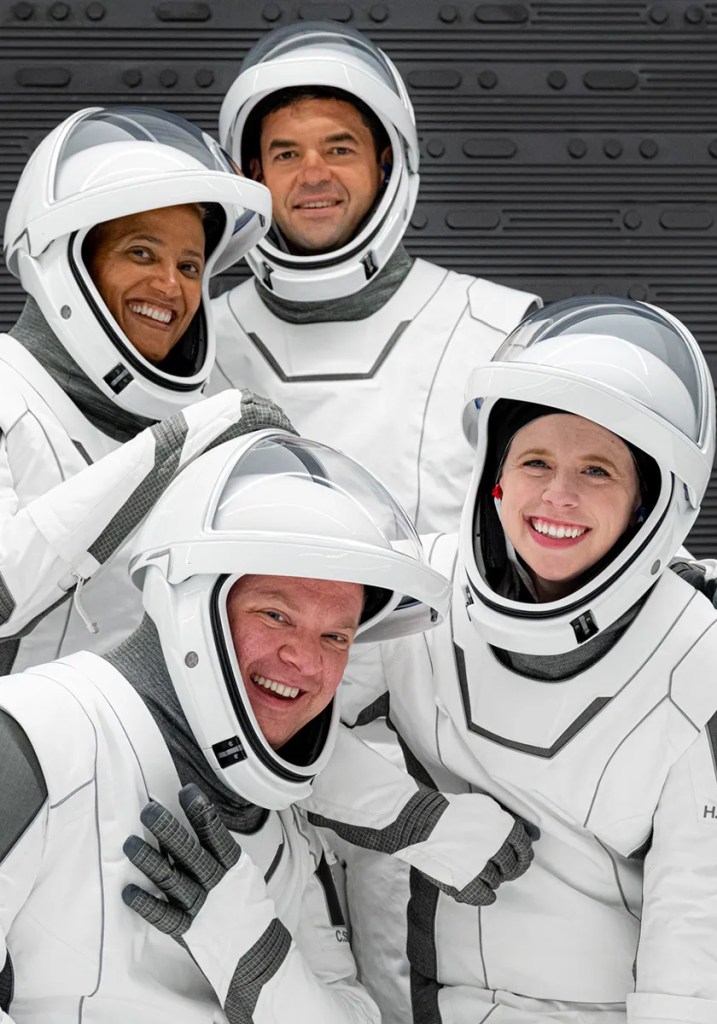

SpaceX Junkets?

Source/Credit: Inspiration 4 crew from SpaceX.

I guess once was not enough. Billionaire Jared Isaacman wants to spend even more money sending private citizens into space aboard SpaceX spacecraft. He funded his first private flight last September, called Inspiration 4, and now wants to do three more of these flights. The first one raised funds for St. Jude Children’s Research Hospital, whereas it is not clear whether these other voyages also relate to charitable causes.

Space tourism is all the rage these days, with Captain Kirk going up on Blue Origin’s capsule and Virgin Galactic sending Sir Richard Branson into space in preparation of paying customers in the near future. SpaceX always seemed to have more serious goals, but I suppose a buck is a buck.

The first of these three new flights is planned for later this year and will include a spacewalk and science experiments. The second will involve SpaceX’s Dragon, which is currently used for trips to the International Space Station (ISS). The third will involve SpaceX’s Starship created for lunar missions under NASA’s Artemis program.

Apparently, these new missions are expected to “…serve a bigger purpose of opening up space for everyone and making humankind a multiplanetary species, and ideally, have a benefit for the things we’re trying to accomplish back here on Earth.” Once might ask whether this bigger purpose, such as space walks and science experiments, can already be performed by professional astronauts aboard the ISS. It is hard to believe these new vanity missions are critical. And maybe dangerous stunts on such missions should only be performed by a professional team, but Mr. Isaacman wants to command the mission. I cannot see how having an accident on one of these flights will benefit SpaceX. I can still remember the blow-back after sending (and losing) the first teacher to space.

Space is still a dangerous place. Maybe money should not trump everything, including common sense. This seems more like a bored corporate executive spending $500,000 on a new fire truck, setting a few old buildings on fire, and then going in with an inexperienced crew to have fun putting out the blaze while claiming he is advancing the science of firefighting. I am not convinced.

Source/Credit: Walmart.

Television: Space Force, the TV Show

Source/Credit: Netflix.

It did not take long for the newly-created U.S. Space Force to be the butt of jokes, but its mission is critical, as has already been noted in earlier postings on this site. Even so, a little bit of humor goes a long way, and the Netflix series Space Force has plenty of humor to go around. Season two starts Friday, February 18th. Here are trailers for season one and two.

Steve Carell is perfect as the leader of U.S. Space Force as it bungles along and eventually faces an international crisis on the moon. Mimicking reality, the U.S. and China have designs on the Moon and it may not be big enough for both nations. Given the accompanying cast, such as John Malkovich, Lisa Kudrow, and Ben Schwartz, you know this will be one strange space ride. Patton Oswalt will join the cast in season two as a bumbling astronaut, so things can only get more insane. Think of it as a combination of The Office and The Right Stuff giving birth to “The Wrong Stuff.”

We all need a laugh at the moment, so tune in and lighten up. After that, you can look into the work of the official U.S. Space Force and start worrying again.

Note: Here is the mission statement of the real U.S. Space Force (that word “Guardians” is really in there):

The USSF is responsible for organizing, training, and equipping Guardians to conduct global space operations that enhance the way our joint and coalition forces fight, while also offering decision makers military options to achieve national objectives.

Source/Credit: Official flag of the official U.S. Space Force.

Note: The real Space Force is protecting our satellites rather than running missions to the Moon, Mars, and Europa. TV shows have more latitude on such things.

Television: The Silent Sea

Source/Credit: Netflix.

Netflix’s new series from South Korea, The Silent Sea, was released right before Christmas and did not get a lot of attention. It may not deserve a lot of attention, and would have probably been better as a short film (which is how it started) rather than an 8-part series, but it was passable as entertainment.

The year is 2075 and Earth has become a dust bowl where water is rationed and civilization is dying. We seem to have the ability to maintain manned stations on the Moon and Mars, but water conservation is beyond our abilities. It seems we did not have a Planet B ready to go. With this background, the series is about a special team sent back to the Moon to visit a failed station and retrieve critical scientific samples. I will not give you too many hints, but it relates back to the water shortage on Earth.

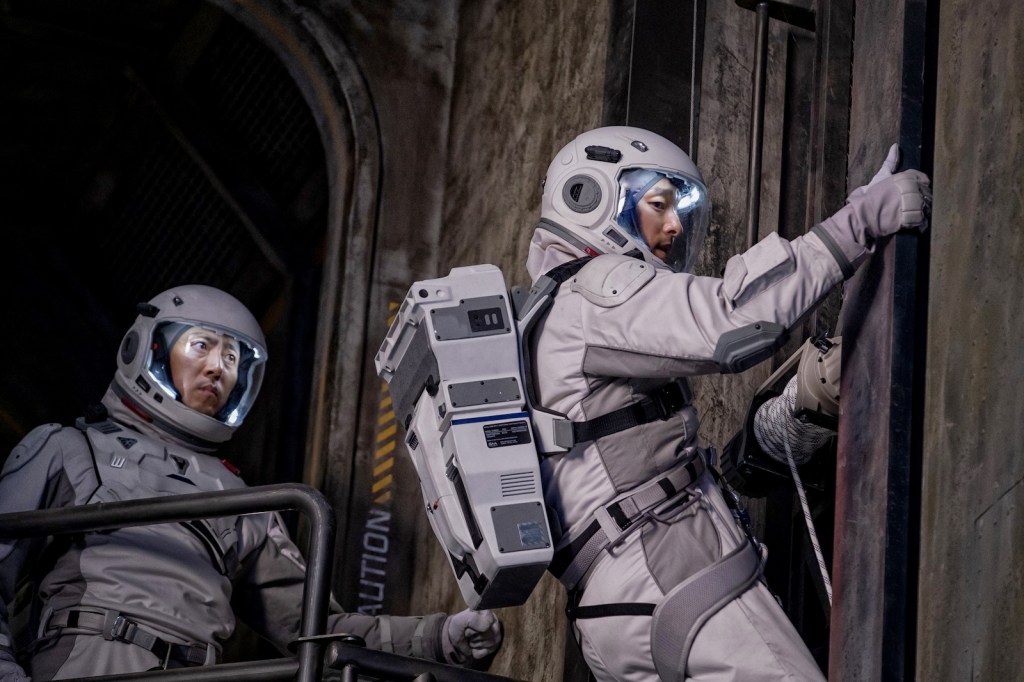
The trip to the Moon seemed more like a Southwest flight than a space mission, and the Moon base itself is a ridiculously gigantic facility at the edge of a chasm, yet the action mainly takes place within the Moon base at a good pace. Throughout the series there are mysterious deaths, unknown figures running around the station, and corporate espionage, so it does not lack a fair amount of drama. Sadly, the last episode unravels quickly with a somewhat dumb (and certainly unbelievable) ending.

I cannot recommend it after seeing much better series, such as The Expanse and National Geographic’s Mars. However, if you need to satisfy your science fiction fix before other space series are available, give it a try. You have been warned.

Source/Credit: Scene from The Silent Sea from Netflix.

Space Quote: We Have Come A Long Way

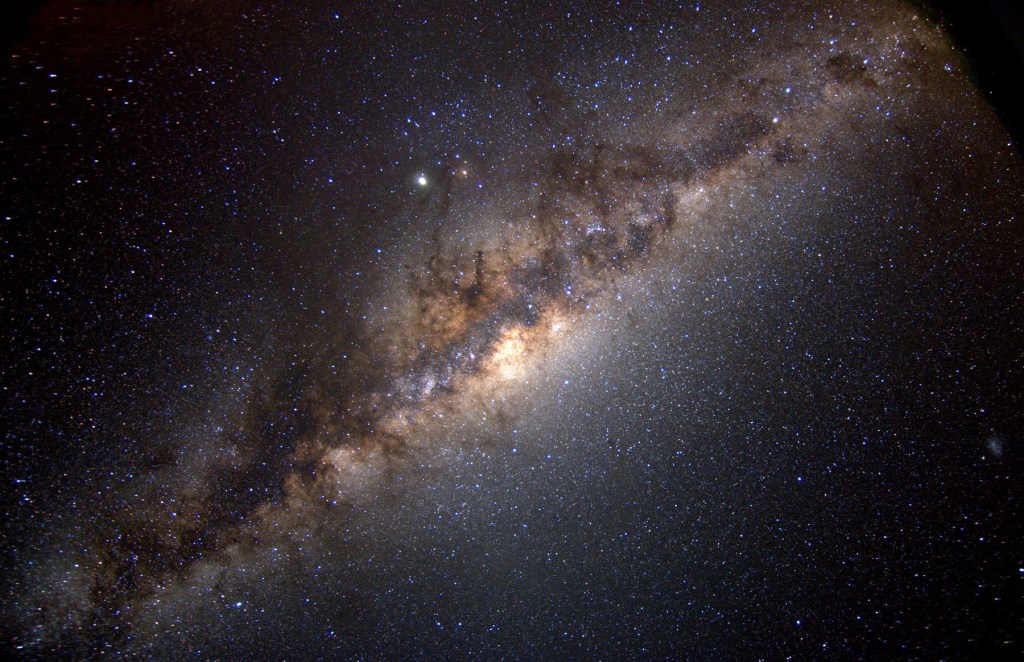
Source/Credit: Milky Way Galaxy from NASA.

“No competent thinker [can] maintain any single nebula to be a star system of coordinate rank with the Milky Way.”

–Agnes Mary Clerke, Irish astronomer, founding member of the  British Astronomical Association, and honorary member of the Royal Astronomical Society, commenting in 1890 on the likelihood that other galaxies existed beyond the Milky Way. This comment was captured in an excellent article from the July 31, 2021 Science News, “A Century of New Worlds,” which discusses discoveries in astronomy over the last 100 years. The article also notes that it was the work of another female astronomer, Henrietta Leavitt, that helped to eventually prove the existence of other galaxies.

Extra: A crater on the Moon is named after astronomer Agnes Mary Clerke (shown below).

Source/Credit: Clerke crater from NASA’s Apollo 17.