Voyager 2 is Still Talking to Us

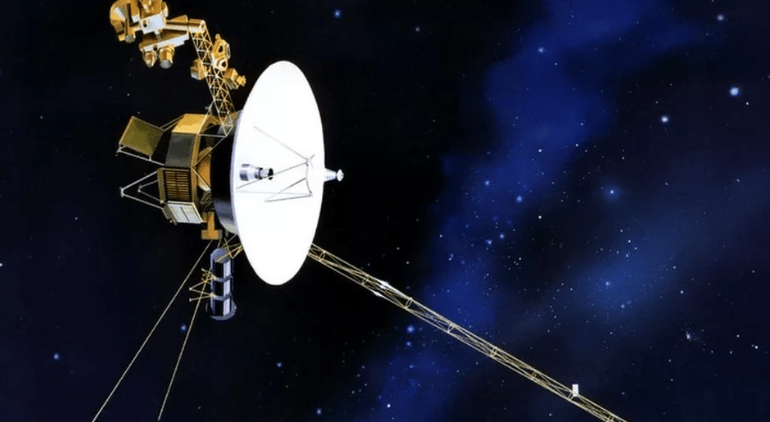
After two weeks with no word, Voyager 2 is back to communicating with us as it continues its journey beyond our solar system. The whole incident started when NASA sent a bad command, but all is well.

Voyager 2 first left Earth back in August 1977 and exited the solar system in December 2018. Like Voyager 1, which is also outside the solar system now, Voyager 2 had the initial task of studying the planets. Voyager 2 focused on Jupiter, Saturn, Uranus and Neptune. It has shown it was capable of much more as it dragged the human race to the bleeding edge of space.

You can read all about Voyager 2’s accomplishments at this NASA site, including:

  • Voyager 2 is the only spacecraft to study all four of the solar system’s giant planets at close range.
  • Voyager 2 discovered a 14th moon at Jupiter.
  • Voyager 2 was the first human-made object to fly past Uranus.
  • At Uranus, Voyager 2 discovered 10 new moons and two new rings.
  • Voyager 2 was the first human-made object to fly by Neptune.
  • At Neptune, Voyager 2 discovered five moons, four rings, and a “Great Dark Spot.”

An impressive list of accomplishments, and the spacecraft is still ticking as it goes into the great unknown.

We need to keep these achievements in mind as we battle over this year’s NASA budget. We also need to remember that there was supposed to be four Voyager-like spacecraft rather than two, but budget cuts nixed the second set. Meaning we can still get some great things done even if we don’t have the budget to fund every piece of a grand vision.
A Day in Astronomy: Launch of the Phoenix Mars Lander

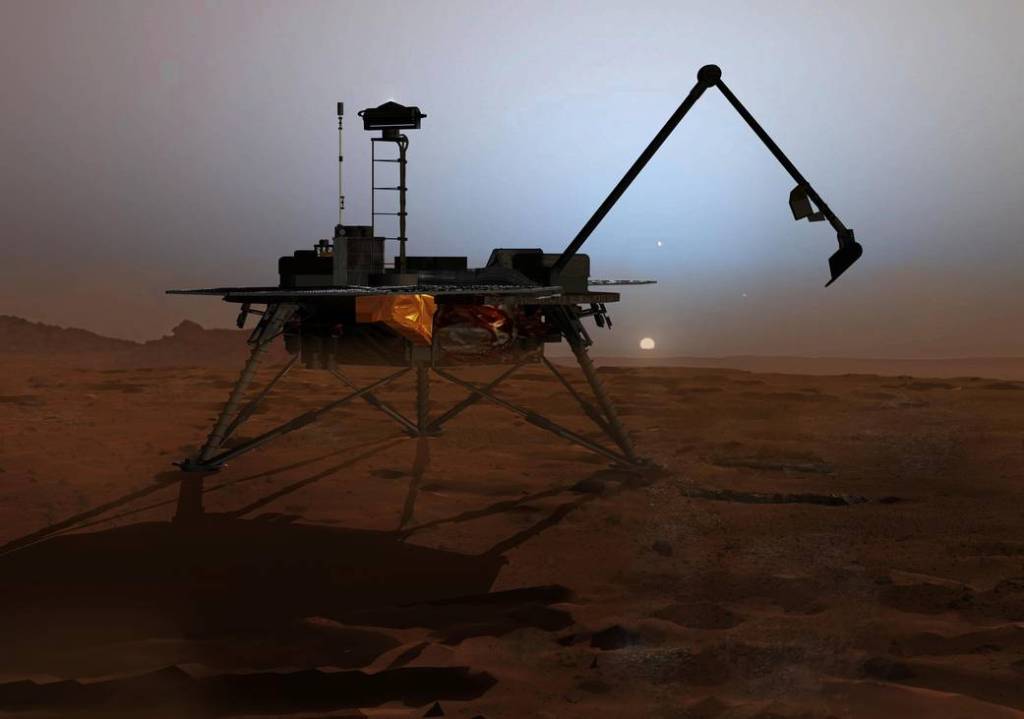
Image (Credit): Artist’s rendering of the Phoenix Mars Lander on the surface of Mars. (NASA/JPL-Calech/University of Arizona)

On this day in 2007, NASA launched the Phoenix Mars Lander from Cape Canaveral towards the Red Planet. The lander had two key objectives: (1) to study the history of water in the Martian arctic and (2) to search for evidence of a habitable zone and assess the biological potential of the ice-soil boundary.

The lander set down on Mars on May 25, 2008 and continued with its mission until November of that same year. The lander performed numerous tests on the Martian surface, confirmed the presence of water, and even discovered water ice right below where it landed. The lander also found perchlorate in the soil, which could be a source of oxygen for future missions.

The mission ended when the Martian winter diminished the sunlight needed to run the solar panels. The Phoenix Mars Lander did not survive the winter, but it successfully accomplished its mission.

Image (Credit): Phoenix Mars Lander mission patch. (NASA)

Pic of the Week: Herbig-Haro 46/47

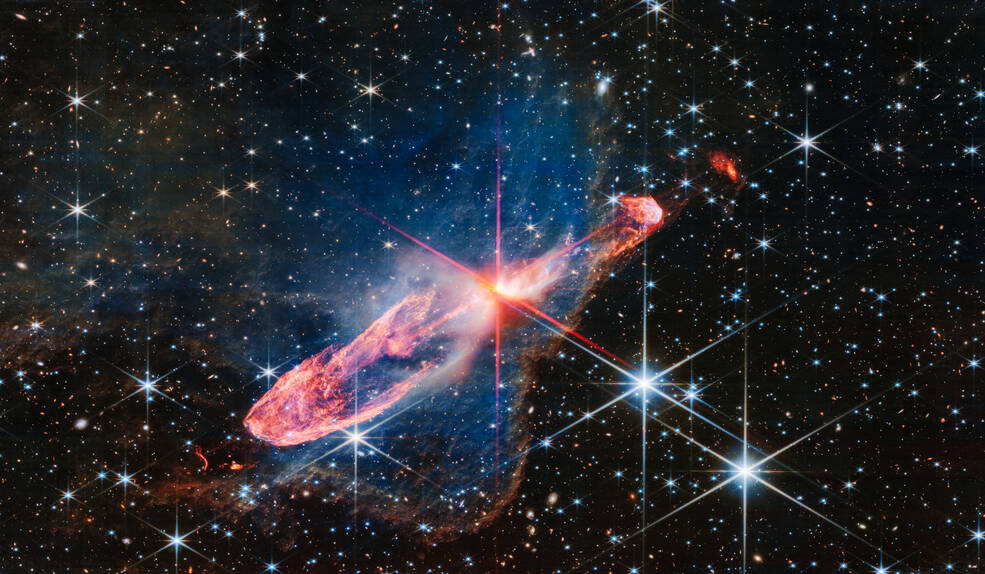
Image (Credit): JWST image showing the formation of a pair of new stars. (NASA, ESA, CSA. Image Processing: Joseph DePasquale (STScI))

This week’s image is from the James Webb Space Telescope (JWST). It shows the formation of new stars 1,470 light-years away that will take millions of years to form.

Here is a partial description of what you are seeing from NASA (visit the link for the full desciption):

NASA’s James Webb Space Telescope has captured the “antics” of a pair of actively forming young stars, known as Herbig-Haro 46/47, in high-resolution near-infrared light. To find them, trace the bright pink and red diffraction spikes until you hit the center: The stars are within the orange-white splotch. They are buried deeply in a disk of gas and dust that feeds their growth as they continue to gain mass. The disk is not visible, but its shadow can be seen in the two dark, conical regions surrounding the central stars.

The most striking details are the two-sided lobes that fan out from the actively forming central stars, represented in fiery orange. Much of this material was shot out from those stars as they repeatedly ingest and eject the gas and dust that immediately surround them over thousands of years.

When material from more recent ejections runs into older material, it changes the shape of these lobes. This activity is like a large fountain being turned on and off in rapid, but random succession, leading to billowing patterns in the pool below it. Some jets send out more material and others launch at faster speeds. Why? It’s likely related to how much material fell onto the stars at a particular point in time.

Space Stories: Mars Ascent Vehicle, Dark Matter Stars, and a New Russian Space Station

Image (Credit): Artist’s rendering of the Mars Ascent Vehicle. (NASA)

Here are some recent stories of interest.

NASA/JPJ.com : “NASA Mars Ascent Vehicle Continues Progress Toward Mars Sample Return

NASA’s Mars Ascent Vehicle (MAV) recently reached some major milestones in support of the Mars Sample Return program. The Mars Ascent Vehicle would be the first launch of a rocket from the surface of another planet. The team developing MAV conducted successful tests of the first and second stage solid rocket motors needed for the launch. Mars Sample Return will bring scientifically selected samples to Earth for study using the most sophisticated instrumentation around the world. This strategic partnership with ESA (European Space Agency) features the first mission to return samples from another planet. The samples currently being collected by NASA’s Perseverance Rover during its exploration of an ancient river delta have the potential to reveal the early evolution of Mars, including the potential for ancient life.

ScienceNews : “The James Webb Telescope May Have Spotted Stars Powered by Dark Matter

The James Webb Space Telescope has spotted objects in the early universe that might be a new kind of star — one powered by dark matter. These “dark stars” are still hypothetical. Their identification in JWST images is far from certain. But if any of the three candidates — reported in the July 25 Proceedings of the National Academy of Sciences — turn out to be this new type of star, they could offer a glimpse of star formation in the early universe, hint at the nature of dark matter and possibly explain the origins of supermassive black holes.

CNN : “Russia Proposes Joint Research Module on Space Station for China, India, Brazil and South Africa

The head of Russia’s space agency has extended an offer to Moscow’s partners in the BRICS group – Brazil, IndiaChina and South Africa – to participate in the construction of a joint module for its planned orbital space station, state media reported Monday. Construction of the planned space station follows Moscow’s decision last year to end its decades-long partnership with NASA and withdraw from the aging International Space Station – one of the last remaining channels of cooperation between Russia and the United States.

DRACO: A New Approach for Traveling to Mars

Image (Credit): Artist’s rendering of the DRACO spacecraft. (DARPA)

When you hear the word DRACO, you may think of the Harry Potter series or even severe Athenians, but NASA wants you to think of speedy travel to Mars. DRACO, or Demonstration for Rocket to Agile Cislunar Operations, is NASA’s plan to develop a nuclear thermal rocket engine with the Defense Advanced Research Projects Agency (DARPA). Defense contractor Lockheed Martin was recently tapped to lead this effort.

Such an engine would shorten the journey to Mars, thereby exposing astronauts to less risk from solar energetic particles and galactic cosmic rays as well as lessening the amount of supplies needed for the trip. The rocket engine could also be used initially for shorter trips to the Moon.

Dr. Stefanie Tompkins, director, DARPA, stated earlier:

The space domain is critical to modern commerce, scientific discovery, and national security. The ability to accomplish leap-ahead advances in space technology through the DRACO nuclear thermal rocket program will be essential for more efficiently and quickly transporting material to the Moon and eventually, people to Mars.

You can read more about this new rocket approach and the parties involved at this NASA link.