Asteroid Sample Coming to Earth This Weekend

Image (Credit): Asteroid Bennu as seen by the OSIRIS-REx as it begins its return to Earth back in May 2021. (NASA/Goddard/University of Arizona; Writer Daniel Stolte, University of Arizona)

This weekend will should see the safe landing of a asteroid sample from far away. On Sunday, NASA’s Origins, Spectral Interpretation, Resource Identification, Security, Regolith Explorer (OSIRIS-REx) spacecraft will return to Earth with sample material from asteroid Bennu, which it encountered two years ago.

Launched on Sept. 8, 2016, the spacecraft spent about two years getting to Bennu and then more than two years studying the asteroid and collecting a 250-gram sample that should be in the hands of NASA scientists shortly. The graphic below shows the return path of the sample as it heads for the Utah desert. You can also watch this NASA video for more information on the overall mission and keep abreast of mission highlights via this mission blog. NASA also has a recent podcast discussing the spacecraft’s adventures and trip back to Earth.

And what about OSIRIS-REx after it makes this deposit? It will become OSIRIS-APEX (APEX for “Apophis Explorer”) and go back into the inner solar system before encountering asteroid Apophis in 2029.

We talk about rocket reuse, but this is a terrific example of spacecraft reuse.

The timing could not be better as NASA awaits 2024 budget decisions from Congress and further discussions about another sample return, this one from Mars.

Credit: NASA

Space Stories: New Lunar Water Estimates, Coronal Mass Ejection, and Oxygen on Mars

Image (Credit): Shadows on the Moon’s south pole. (NASA)

Here are some recent stories of interest.

Southwest Research Institute: “New Findings Suggest Moon May Have Less Water Than Previously Thought

A team recently calculated that most of the Moon’s permanently shadowed regions (PSRs) are at most around 3.4 billion years old and can contain relatively young deposits of water ice. Water resources are considered key for sustainable exploration of the Moon and beyond, but these findings suggest that current estimates for cold-trapped ices are too high.

Scientific American: “Massive Sun Outburst Smacks NASA Spacecraft

NASA’s Parker Solar Probe was built to withstand the ravages of the environment near our sun—and with good reason. The car-size spacecraft has now flown through a giant solar outburst of charged particles called a coronal mass ejection (CME). If that CME had it hit Earth instead, it may have caused vast, continent-wide blackouts, scientists say. Some of those searing particles whipped through space at about three million miles per hour.

BGR: “NASA Successfully Generated Oxygen on Mars

NASA’s Perseverance rover has done the unthinkable. Or, at least, a small device on the rover has. According to a tweet and article shared by NASA’s Perseverance team on Twitter, a device known only as MOXIE has proven that we can generate oxygen on Mars using the planet’s CO2-concentrated atmosphere. This tech is a huge boon, and the success of this story could help pave the way for future oxygen generation on the Red Planet, something that would make long-term exploration of the planet far more feasible.

Audit Results: SLS Program is Unaffordable

Image (Credit): Artist’s rendering of the SLS. (NASA)

The Government Accountability Office (GAO) recently completed a review of NASA’s Space Launch System (SLS), which is the cornerstone of the Artemis program. GAO assessed the extent to which (1) NASA has established plans to measure the SLS program costs post-Artemis I, and (2) the program has made progress with its plans to reduce projected SLS costs.

The GAO report, Space Launch System: Cost Transparency Needed to Monitor Program Affordability, highlights a number of continuing issues related to project costs and budgeting.

So what is the bottom line? This quote is most concerning: “Senior NASA officials told GAO that at current cost levels, the SLS program is unaffordable.”

The SLS is the vehicle that is supposed to demonstrate our ability to return to the Moon as well as our readiness for a Mars mission. But all of this is contingent on continued funding from Congress, and the congressional auditors have raised a red flag.

I expect you could find similar audit issues with the earlier Apollo missions as well as other space missions, yet NASA does not need to give Congress a reason to put money elsewhere. Let’s hope NASA’s leaders take the audit seriously and show some progress to keep all of the parties happy and the funding alive.

Another Crew Heads for the ISS

Image (Credit): The Soyuz MS-24 spacecraft blasts off to the ISS from the Baikonur Cosmodrome, Kazakhstan on September 15, 2023. (Maxim Shemetov/Reuters)

Earlier today, US astronaut astronaut Loral O’Hara as well as Roscosmos cosmonauts Oleg Kononenko and Nikolai Chub departed from Kazakhstan on a Soyuz rocket that will take them to the International Space Station (ISS). The space station will be crowded again until the three relieved crew members, including US astronaut Frank Rubio, can return to Earth.

You can watch today’s launch at this NASA site on YouTube. You can also follow the mission via NASA’s blog.

Pic of the Week: Astronaut Frank Rubio Still at Work on the ISS

Image (Credit): NASA astronauts Frank Rubio (left) and Josh Cassada (back to camera) working outside the ISS last November. (NASA TV)

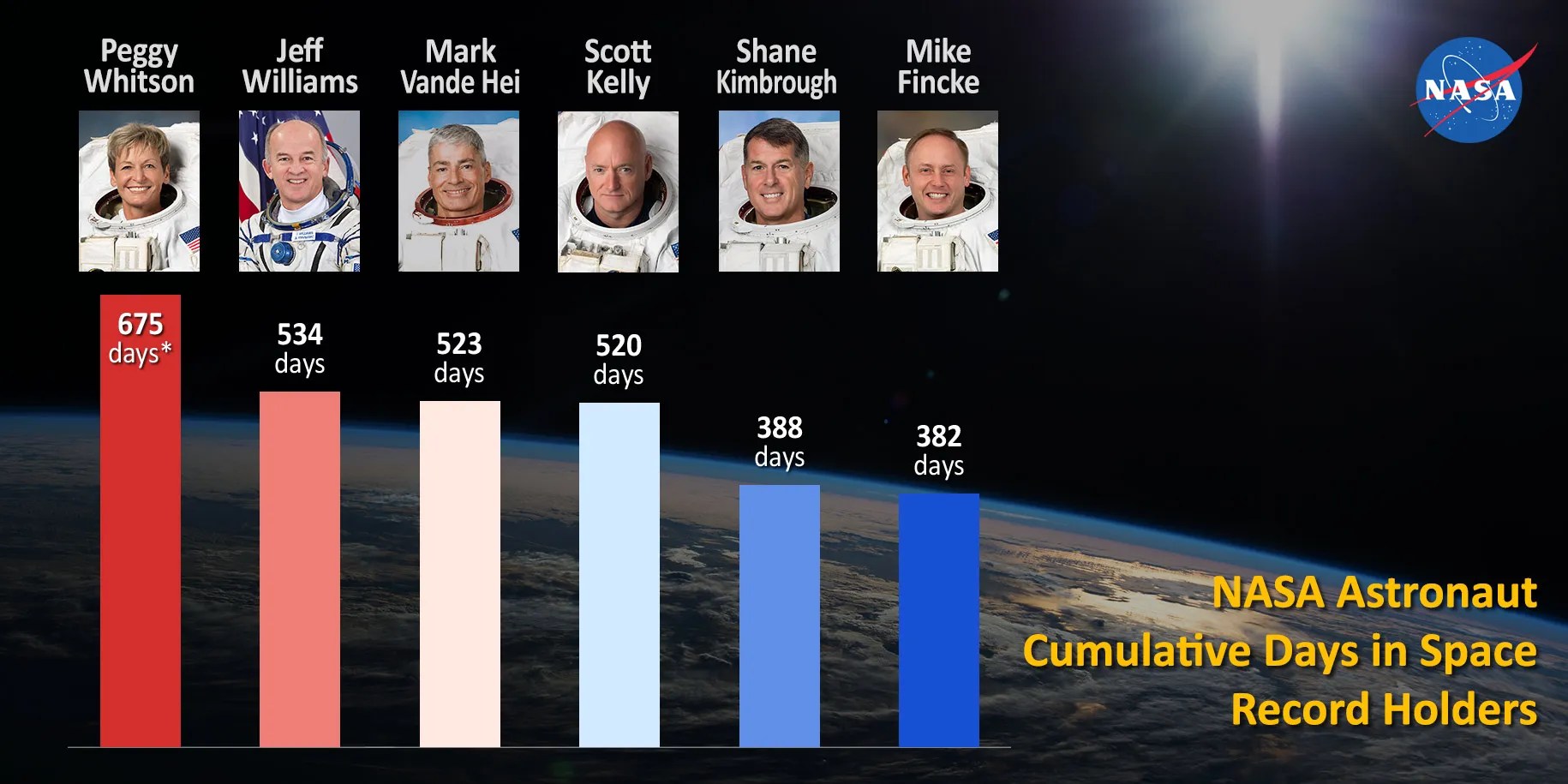
This week’s image shows astronaut Frank Rubio hard at work last year outside the International Space Station (ISS). He has now exceeded the U.S. space duration record, which was 355 days. All of this was unplanned, come as the result of a faulty Russian capsule that kept him on the station longer than his scheduled six month tour.

Mr. Rubio is set to return to Earth on September 27. At that point, he will have spent 371 days in space.

This CBS News segment discusses some of the risks related to a longer stay on the station.