Space Stories: Merging Galaxies, Anniversary for TESS, and Helicopter Flights on Mars

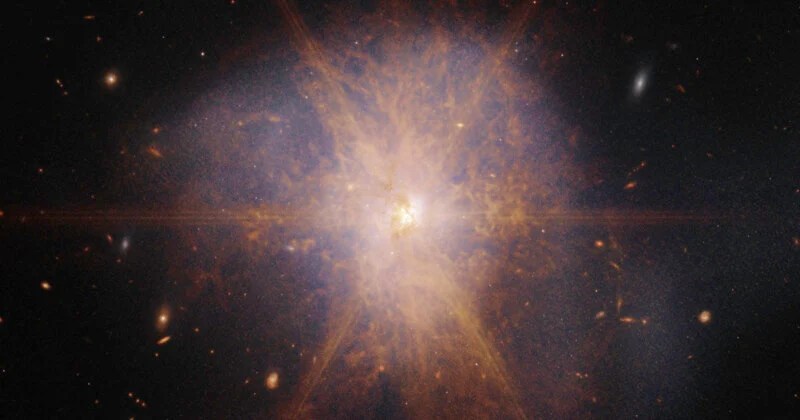
Image (Credit): Arp 220 as captured by NASA’s James Webb Space Telescope. (NASA, ESA, CSA, STScI, Alyssa Pagan)

Here are some recent stories of interest.

PetaPixel:Webb Captures Star-Forming Galactic Merger Brighter Than 1 Trillion Suns’”

NASA’s James Webb Space Telescope has captured a stunning “smash-up” of two spiral galaxies. Collectively called Arp 220, the collision of the pair of galaxies has facilitated massive star formation. Arp 220 is located within the constellation Serpens, about 250 million light-years from Earth. Arp 220 gets its namesake because it is the 220th object in Hallton Art’s Atlas of Peculiar Galaxies. Arp 220 is “peculiar” because it’s an ultra-luminous infrared galaxy (ULIRG), and the nearest ULIRG to Earth.

Phys.org:NASA’s TESS Celebrates Fifth Year Scanning the Sky for New Worlds’”

Now in its fifth year in space, NASA’s TESS (Transiting Exoplanet Survey Satellite) remains a rousing success. TESS’s cameras have mapped more than 93% of the entire sky, discovered 329 new worlds and thousands more candidates, and provided new insights into a wide array of cosmic phenomena, from stellar pulsations and exploding stars to supermassive black holes.

NASA:NASA’s Ingenuity Mars Helicopter Completes 50th Flight’”

NASA’s Ingenuity Mars Helicopter has completed its 50th flight on Mars. The first aircraft on another world reached the half-century mark on April 13, traveling over 1,057.09 feet (322.2 meters) in 145.7 seconds. The helicopter also achieved a new altitude record of 59 feet (18 meters) before alighting near the half-mile-wide (800-meter-wide) “Belva Crater.”

Space Stories: Sagan as Scripture, Chinese Lunar Plans, and Outer Space in NYC

Credit: Ballantine Books

Here are some recent stories of interest.

Gizmodo.com: “New NASA Official Took Her Oath of Office on Carl Sagan’s ‘Pale Blue Dot’”

When Dr. Makenzie Lystrup was sworn in as the new director of NASA’s Goddard Space Flight Center last week, she didn’t take her oath of office on the Bible or the U.S. Constitution, but rather on a tome revered by space enthusiasts everywhere: Carl Sagan’s Pale Blue Dot. The book, published in 1994, is named after an iconic image of Earth, snapped by the Voyager I probe, that depicts the planet as a small speck smothered by the emptiness of space. That photo inspired astronomer Carl Sagan to write: “Look again at that dot. That’s here. That’s home. That’s us.” For many, the book serves as a reminder of humanity’s place in the universe and the need to preserve our home planet, which makes it similar to holy scripture for a newly appointed NASA director.

Time: “In Five Years, China Will Start Building a Lunar Base With Bricks Made From Moon Soil

China plans to start building a lunar base in about five years, kicking off with bricks made of moon soil, according to scientists with ties to the project, the South China Morning Post reported. Ding Lieyun, a top scientist at Huazhong University of Science and Technology, told local media that the first brick would be made from moon soil during the Chang’e 8 mission around 2028.

AFAR: “NASA Teams With NYC Museum on New Immersive Outer Space Exhibit

With its blazing city lights, New York is one of the worst places to go stargazing. But space aficionados will want to visit lower Manhattan this spring—dark skies or not—thanks to a new digital art exhibit created with participation from NASA and CNES (the French space agency) that opened April 7 at Hall des Lumières, the city’s first permanent immersive art center. An earlier iteration of this show premiered at Hall des Lumières’ sister museum in Paris, Atelier des Lumières, in 2021. Destination Cosmos: The Immersive Space Experiencewill run for eight weeks through June 4, 2023, at Hall des Lumières, which opened in 2022 in the former Emigrant Savings Bank across from City Hall.

Space Quote: The Value of the ISS

Image (Credit): Components of the International Space Station (ISS). (NASA)

“An attempt to do a cost-benefit analysis on ISS science would be rather difficult. Science research rarely conforms to that kind of examination while it’s being done. Only after the fact, when an entrepreneur rolls out some new product or service, can one point to something done in a laboratory as having helped to make it happen. The best bet for ISS science is the technology for 3D printing human organs for transplant patients. The number of lives that would be saved might make the $100 billion spent on the ISS worth it.”

-Statement in a recent editorial from The Hill titled, “Has the science on NASA’s International Space Station been worth the money?” In addition to 3D printing of human organs, you might want to view the other ISS achievements (also mentioned in the editorial) and decide for yourself:

Artemis Mission Astronauts Announced

Image (Credit): Newly-announced Artemis astronauts Commander Reid Wisemam, Pilot Victor Glover, Mission Specialist Jeremy Hansen, and Mission Specialist Christina Hammock Koch. (NASA)

Another step was taken today to get us closer to a Moon landing. Earlier today NASA announced the names of the four astronauts on the next Artemis II mission:

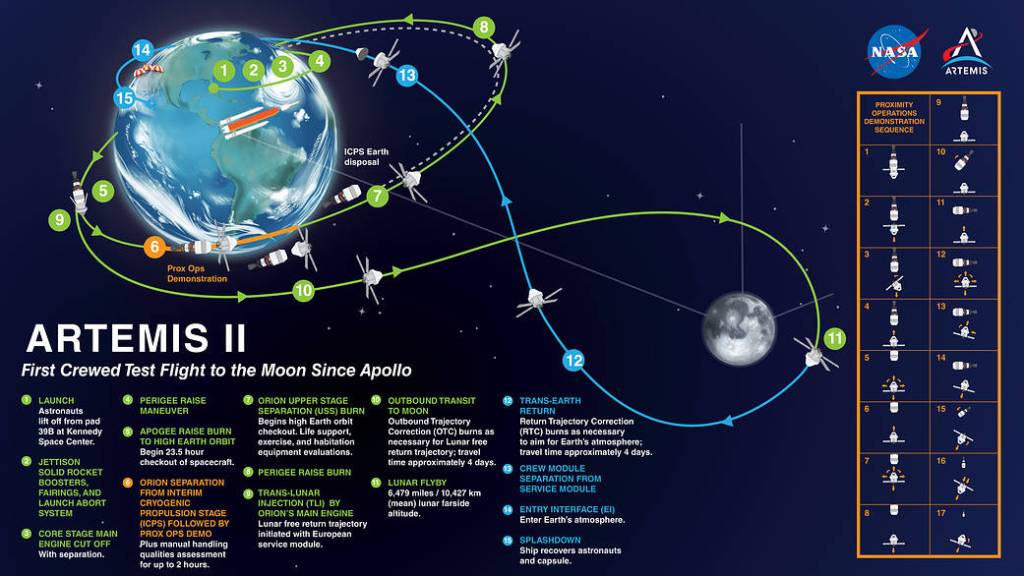
The Artemis II mission will require the four astronauts to take an Orion capsule around the Moon to test a variety of systems and ensure the safety of a later Moon landing as part of Artemis III. You can see a graphic of the Artemis II mission below.

At today’s ceremony announcing the crew, NASA Administrator Bill Nelson stated:

The Artemis II crew represents thousands of people working tirelessly to bring us to the stars. This is their crew, this is our crew, this is humanity’s crew…NASA astronauts Reid Wiseman, Victor Glover, and Christina Hammock Koch, and CSA astronaut Jeremy Hansen, each has their own story, but, together, they represent our creed: E pluribus unum – out of many, one. Together, we are ushering in a new era of exploration for a new generation of star sailors and dreamers – the Artemis Generation.

You can also watch NASA’s full announcement of the new crew here.

Credit: NASA

NASA OIG: Artemis Partnerships with International Space Agencies

I was looking through audit reports from the Government Accountability Office and NASA’s Office of Inspector General (OIG) to see what was being said about NASA’s programs. The only report of interest so far pertained to the Artemis mission and the need for greater coordination among the various partners. Audit reports often make these same recommendations over and over again, yet it does make sense that NASA’s largest outreach program since the International Space Station (ISS) should have all the pieces in place, yet it does not.

Here is the first finding in the OIG report:

Interest in the Artemis campaign is high across the international space community, as evidenced by NASA’s 54 Artemis-related international instruments and the 23 signatories to the Artemis Accords. However, the Agency lacks an overarching strategy to coordinate Artemis contributions from international space agencies and entities. Except for the Gateway Program, the Artemis campaign does not have comprehensive forums—boards, panels, and working groups— for its international partners to routinely discuss topics such as flight and mission planning, safety, and research integration. In contrast, the ISS Program–seen as a model of long-term international space cooperation–employs these forums as well as on-site representation from partner agencies.

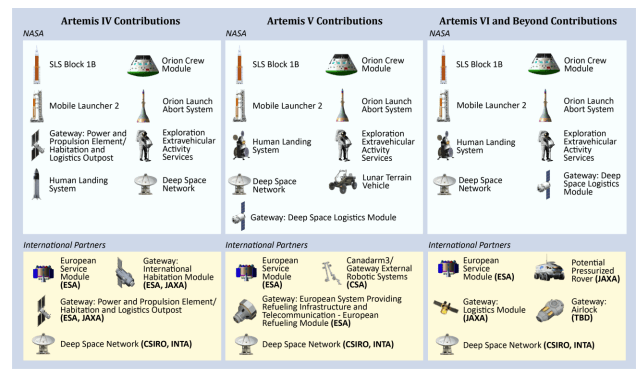
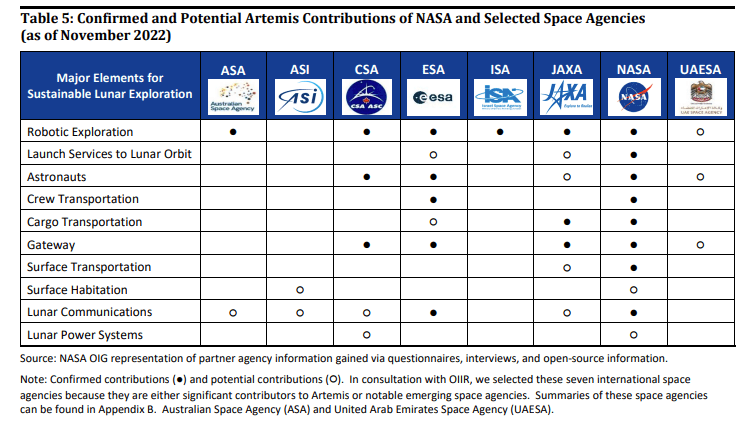
The OIG report makes a number of recommendations related to this issue and other identified by auditors. The report also includes some helpful graphics and tables that illustrate all of the pieces going into the three Artemis missions as well as the parties contributing those pieces. This looks significantly more complex than the ISS, so I would think good coordination would be even more critical.

Image (Credit): Contributions to the Artemis Program by NASA and partners. (NASA OIG)
Image (Credit): A table from the NASA OIG report IG-23-004. (NASA OIG)