Supernova: One Ring to Rule Them All?

Image (Credit): Supernova Remnant J0624–6948. (NASA/CXC/A. Hobart)

Astronomers recently reported that a strange ring just outside of the Milky Way galaxy that may be an intergalactic supernova remnant. SciTechDaily had a story on the discovery first reported in the journal Monthly Notices of the Royal Astronomical Society.

Initially detected by the Australian Square Kilometre Array Pathfinder (ASKAP), the object (later named J0624–6948) is believed to be located in the Large Magellanic Cloud, which is a satellite galaxy of the Milky Way.

Professor Miroslav Filipovic from Western Sydney University stated:

The most plausible explanation is that the object is an intergalactic Supernova Remnant due to an exploded star that resided in the Large Magellanic Cloud outskirts that had undergone a single-degenerate type Ia supernova which involves the explosion of two stars orbiting each other.

If you are a fan of The Lord of the Rings films, the image may remind you of another ring and accompanying poem:

Three Rings for the Elven-kings under the sky,
Seven for the Dwarf-lords in their halls of stone,
Nine for Mortal Men doomed to die,
One for the Dark Lord on his dark throne
In the Land of Mordor where the Shadows lie.
One Ring to rule them all, One Ring to find them,
One Ring to bring them all, and in the darkness bind them,
In the Land of Mordor where the Shadows lie.

I have not sought comments from NASA on this connection just yet.

Image (Credit): Ring from the Fellowship of the Ring movie. (Warner Bros. Entertainment)

The Little Martian Helicopter that Could

Image (Credit): The Martian Ingenuity helicopter. (NASA)

The Washington Post recently posted a story about the great success and potential demise of NASA’s Ingenuity helicopter that accompanied the Perseverance Rover to the surface of Mars last year. It has already lasted for more than a year flying multiple missions, yet it may not make it through the Martian winter given the accumulation of dust on its solar panels.

The article, “NASA’s Mars helicopter was supposed to fly five times. It’s flown 28,” quotes Lori Glaze, the director of NASA’s planetary science division, who states, “We built it as an experiment…So it didn’t necessarily have the flight-qualified parts that we use on the big missions like Perseverance.” What an experiment it has been, setting the stage for bigger and bolder missions in the future to help us better understand the Martian surface.

You will also read about one symbolic piece of material that is part of the little helicopter – a postage-size piece of fabric from the Wright Brothers’ aircraft the Flyer (see below). I wonder what the Wright Brothers would think of this first flight on a distant planet?

You can read much more about Ingenuity’s adventures here

Image (Credit): 1903 Wright Flyer at the Smithsonian Institution National Air and Space Museum. (Smithsonian photo by Eric Long)

KSC: Upcoming Launch Schedule & More

Image (Credit): The John F. Kennedy Space Center in Florida. (NASA)

If you are interested in what is being launched from the Kennedy Space Center (KSC), you can easily view this information at this website. For example, on May 19th, the Boeing CST-100 Starliner will be tested in orbit as it becomes another candidate to resupply the International Space Station. The site also highlights other interesting events and anniversaries, such as the December 7th 50th anniversary of the Apollo 17th launch.

One place holder on the KSC schedule with no clear date is the inaugural launch of NASA’s Space Launch System (SLS) rocket, the first phase of the Artemis Program. In a recent press release, NASA outlined the parameters for such a launch as well as the remaining days in 2022 that would satisfy these parameters. The four parameters are:

  1. The Moon’s position in its lunar cycle;
  2. A trajectory so Orion is not in darkness for more than 90 minutes at a time so that the solar array wings can receive and convert sunlight to electricity and the spacecraft can maintain an optimal temperature range;
  3. A trajectory that allows for the skip entry technique planned during Orion’s return to Earth; and
  4. Daylight conditions for Orion’s splashdown to initially assist recovery personnel when they locate, secure, and retrieve the spacecraft from the Pacific Ocean.  

The calendar still has plenty of possible dates. The question now is whether NASA can get all of the pieces together in time to make this happen in 2022.

Credit: NASA

Growing Options in Moon Dust

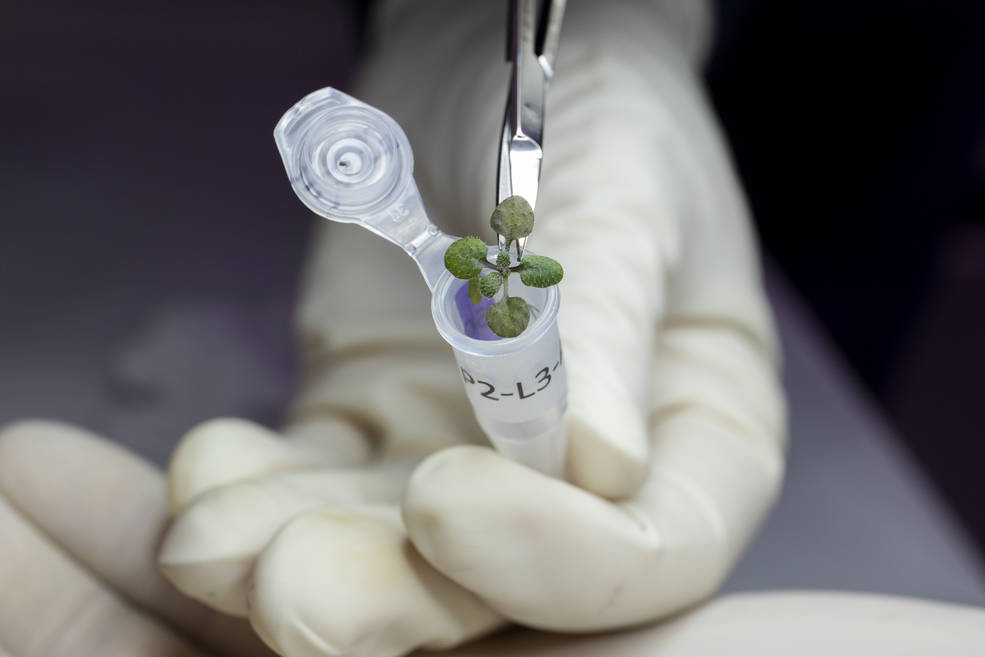
Image (Credit): Placing a plant grown during the experiment in a vial for eventual genetic analysis. (UF/IFAS photo by Tyler Jones)

Speaking of moon dust, it seems scientists have found that they can grow plants in lunar soil. This is quite a surprise given the nature of moon dust. It would seem to be an even greater feat than growing plants in Martian soil.

NASA has reported that scientists at the University of Florida have successfully grown plants in actual lunar soil from the Apollo 11, 12, and 17 missions. Only water and a nutrient solution were added to the soil before seeds were planted. Plants started to sprout in two days. After 20 days the plants were harvested and studied before they had started to flower. While the lunar soil plants were somewhat stunted and stressed, the experiment was a success.

NASA noted:

This research opens the door not only to someday growing plants in habitats on the Moon, but to a wide range of additional questions. Can understanding which genes plants need to adjust to growing in regolith help us understand how to reduce the stressful nature of lunar soil? Are materials from different areas of the Moon more conducive to growing plants than others? Could studying lunar regolith help us understand more about the Mars regolith and potentially growing plants in that material as well? All of these are questions that the team hopes to study next, in support of the future astronauts traveling to the Moon.

This is a fascinating finding if it will allow us to use the lunar surface to feed astronauts rather than bringing more material from the Earth. It is also very timely as NASA is preparing the way for human habitation on the Moon under the Artemis Program.

We wanted to learn from the Moon before pushing onto Mars. This is a clear sign that we are doing so.

Space Quote: A Mature Rocket Market?

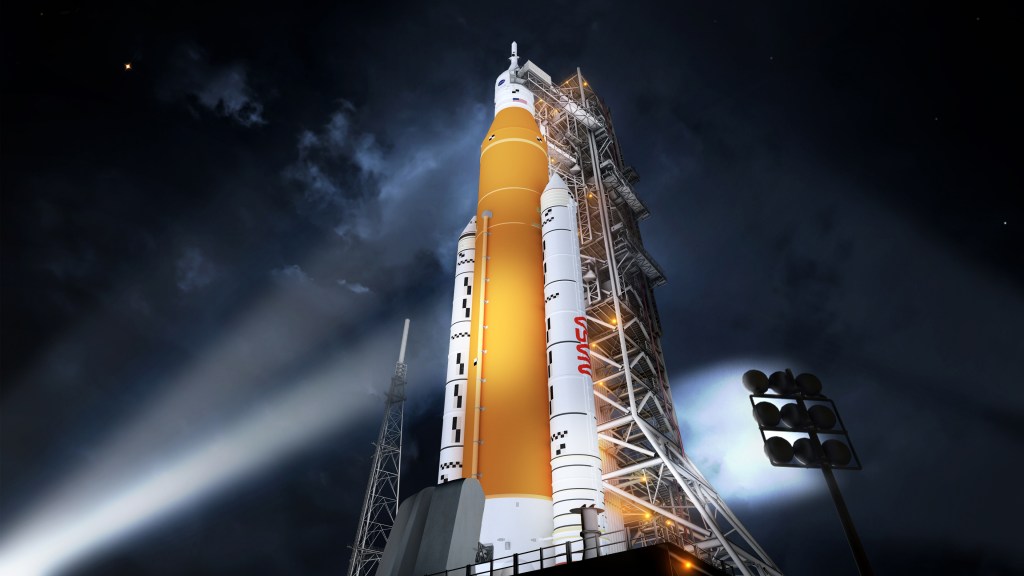
Image (Credit): Space Launch System rocket. (NASA)

“The launch industry is at a point where the technology is so mature that it may not be necessary to have the U.S. government invest in it… It may be we’re at a tipping point with this rocket.”

-Statement by Dan Goldin, a former NASA administrator, regarding NASA’s expenditures on the Space Launch System (SLS) in a Wall Street Journal article, “NASA Is Building Moon Rockets, Maybe for the Last Time.” The SLS and Orion spacecraft are part of NASA’s Artemis Program to return astronauts to the Moon.