Local Black Hole: False Alarm

Source/Credit: MPG/ESO 2.2-metre telescope at ESO’s La Silla Observatory in Chile.

You may have remembered this NASA tweet from September 2020:

HR 6819 is the closest black hole we’ve detected so far, and it lies about 1,000 light-years away. ⚫️ Statistics say there should be one as close as 65 light-years, though we may never detect it unless it lights up!

The original European Space Agency (ESA) press release noted that an invisible object has two companion stars, one of which orbits the unseen object every 40 days. The data for this finding used the MPG/ESO 2.2-metre telescope at ESO’s La Silla Observatory in Chile.

Well, you can relax. The ESA announced last week that HR 6819 is not a black hole based on new data from ESO’s Very Large Telescope (VLT) and Very Large Telescope Interferometer (VLTI):

Our best interpretation so far is that we caught this binary system in a moment shortly after one of the stars had sucked the atmosphere off its companion star. This is a common phenomenon in close binary systems, sometimes referred to as “stellar vampirism” in the press,explains Bodensteiner, now a fellow at ESO in Germany and an author on the new study. “While the donor star was stripped of some of its material, the recipient star began to spin more rapidly.

So, mystery solved. Now we need to talk about local vampires!

Another Russian Casualty: Mars

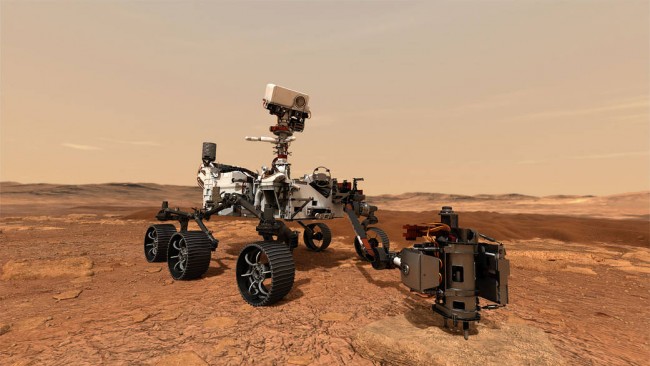
Source/Credit: The Exomars rover from the ESA.

Yesterday, the European Space Agency (ESA) announced that another space program has been impacted by the Russia’s invasion of Ukraine:

Regarding the ExoMars programme continuation, the sanctions and the wider context make a launch in 2022 very unlikely. ESA’s Director General will analyse all the options and prepare a formal decision on the way forward by ESA Member States.

The ESA website on the Exomars program notes that it is a two part mission searching for life on Mars: the Trace Gas Orbiter launched in 2016 and the Exomars rover and surface platform planned for launch in 2022. NASA also contributed to this latest mission:

NASA’s participation in the 2022 ExoMars Rover mission includes providing critical elements to the premier astrobiology instrument on the rover, the Mars Organic Molecule Analyzer (MOMA). By studying organic molecules, the chemical building blocks of life, MOMA is designed to help answer questions about whether life ever existed on Mars, along with its potential origin, evolution and distribution on the Red Planet.

The list of impacted space missions will only grow.

Space Quote: Sanctions and the ISS

Source/Credit: International Space Station (ISS) from NASA.

“If you block cooperation with us, who will save the ISS from uncontrolled deorbiting and falling on US or European territory?”

–Dmitry Olegovich Rogozin, Director General of Roscosmos, commenting on US sanctions against Russia’s aerospace industry resulting from that country’s invasion of Ukraine this week. The ISS is expected to stay aloft until 2031, assuming everyone cooperates.

Pic of the Week: Giant Star on the Edge of Destruction

Source/Credit: NASA/ESA Hubble Space Telescope

This week’s image from the Hubble Space Telescope shows an erupting star, as explained by the European Space Agency’s (ESA) Hubble site:

The giant star…is waging a tug-of-war between gravity and radiation to avoid self-destruction. The star, called AG Carinae, is surrounded by an expanding shell of gas and dust — a nebula — that is shaped by the powerful winds of the star. The nebula is about five light-years wide, which equals the distance from here to our nearest star, Alpha Centauri.

The huge structure was created from one or more giant eruptions several thousand years ago. The star’s outer layers were blown into space, the expelled material amounting to roughly 10 times the mass of our Sun. These outbursts are typical in the life of a rare breed of star called a Luminous Blue Variable (LBV), a brief unstable phase in the short life of an ultra-bright, glamorous star that lives fast and dies young. These stars are among the most massive and brightest stars known. They live for only a few million years, compared to the roughly 10-billion-year lifetime of our own Sun. AG Carinae is a few million years old and resides 20,000 light-years away inside our Milky Way galaxy. The star’s expected lifetime is between 5 million and 6 million years.

Should We Return to Uranus?

Source/Credit: A NASA composite image of Uranus taken from Voyager 2 and the Hubble Space Telescope.

In an earlier posting, I highlighted some scientific papers calling for a return to Neptune rather than Uranus, in part because of Neptune’s moon Triton. But what is the argument for a mission to Uranus? Below I highlight one of the papers submitted to the Planetary Science and Astrobiology Decadal Survey 2023-2032 arguing the merits of a NASA mission to Uranus.

The paper, “The Science Case for Spacecraft Exploration of the Uranian Satellites,” states:

The large moons of Uranus are possible ocean worlds that exhibit a variety of surface features, hinting at endogenic geologic activity in the recent past. These moons are rich in water ice, as well as carbon-bearing and likely nitrogen-bearing constituents, which represent some of the key components for life as we know it. However, our understanding of Uranus and its moons is severely limited by the absence of data collected by an orbiting spacecraft…

An orbiter would vastly improve our understanding of these possible ocean worlds and allow us to assess the nature of water and organics in the Uranian system, thereby improving our knowledge of these moons’ astrobiological potential. A Flagship mission to Uranus can be carried out with existing chemical propulsion technology by making use of a Jupiter gravity assist in the 2030 – 2034 timeframe, leading to a flight time of only ~11 years, arriving in the early to mid 2040’s (outlined in the Ice Giants Pre-Decadal Survey Mission Study Report: https://www.lpi.usra.edu/icegiants/mission_study/Full-Report.pdf).

The five large moons discussed in the paper are Miranda, Ariel, Umbriel, Titania, and Oberon. Titania and Oberon where the first to be discovered back in 1787, followed by the later discoveries of Ariel, Umbriel, and Miranda (in that order). Unlike the moons of other planets, the moons of Uranus are named after magical spirits in English literature.

All of these ocean worlds have gained greater interest as we learn about the dynamics of life on of our own planet. As noted in an article in the MIT Technology Review:

It was once thought the solar system was probably a barren wasteland apart from Earth. Rocky neighbors were too dry and cold like Mars, or too hot and hellish like Venus. The other planets were gas giants, and life on those worlds or their satellite moons was basically inconceivable. Earth seemed to be a miracle of a miracle.

But life isn’t that simple. We now know that life on Earth is able to thrive in even the harshest, most brutal environments, in super cold and super dry conditions, depths of unimaginable pressures, and without the need to use sunlight as a source of energy. At the same time, our cursory understanding of these obscure worlds has expanded tremendously. 

We have plenty of worlds to explore in our own solar system as other scientists continue their search for exoplanets and exomoons. The only question now is which local worlds will we visit in our next round of space missions.