Space Quote: Happy Labor Day, NASA

Credit: Image by Mohamed Hassan from Pixabay.

“The agencies and agency subdivisions set forth in section 2 of this order are hereby determined to have as a primary function intelligence, counterintelligence, investigative, or national security work. It is also hereby determined that Chapter 71 of title 5, United States Code, cannot be applied to these agencies and agency subdivisions in a manner consistent with national security requirements and considerations.”

-Wording in an executive order, signed on Thursday, that eliminates the workers’ union at NASA. While NASA was set up as a civilian agency completely separate from the U.S. Air Force and U.S. Space Command, which have national security functions, that was not enough to protect it from expansive White House interpretations targeting federal workers. Other federal agencies had their unions removed earlier this year, and other joined NASA in this latest executive order, such as the National Weather Service. One might wonder why these civilian agencies are being decimated by the same White House given that they are so critical to national security, but logic has little to do with government operations these days.

The Few, The Proud, The Moon Watchers

Image (Credit): Artemis II mission crew patch. (NASA)

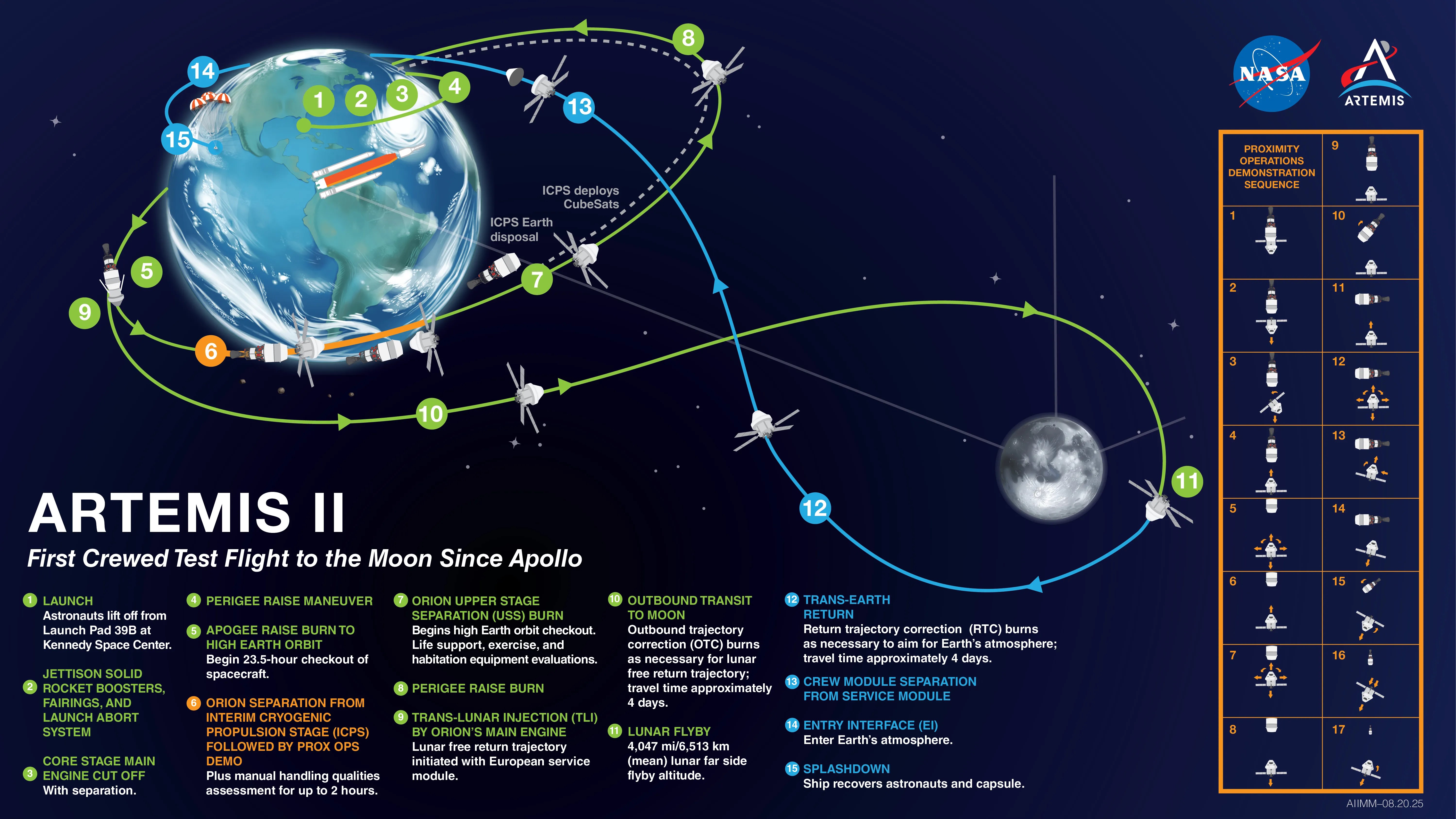
NASA is looking for volunteers to assist next year’s Artemis II mission, which is expected to take place in April 2026. The volunteers will help track of the Artemis II Orion crewed spacecraft as it travels around the Moon.

The volunteers will monitor Orion’s signal using their respective ground antennas to help track and measure changes in the radio waves transmitted by the spacecraft. Volunteers similarly assisted with uncrewed Orion tracking during Artemis I.

This is a unique opportunity for international space agencies, academic institutions, commercial companies, nonprofit entities, and even private citizens to be part of the Artemis II mission.

Give it some thought and, if you are interested, read through NASA’s Artemis II Orion One-Way Doppler Measurements Tracking solicitation. You have until October 27th to apply.

Note: Below is a list of the 18 volunteers that assisted with the Artemis I mission:

Government Space Agencies

  • Canadian Space Agency, Canada
  • Centre National d’Etudes Spatiales (CNES), France
  • German Aerospace Center (Deutsches Zentrum für Luft- und Raumfahrt), Germany
  • Korea Aerospace Research Institute (KARI), Republic of Korea
  • National Space Centre, Elfordstown Earthstation, Ireland

Commercial Companies

  • Clearbox Systems Pty Ltd., Australia
  • Goonhilly Earth Station Ltd., United Kingdom
  • Intuitive Machines, USA
  • Kongsberg Satellite Services (U.S. office), USA
  • Leaf Space LLC, USA
  • Swedish Space Corporation (U.S. office), USA
  • Telespazio, Italy
  • Vambrace Inc., USA
  • Viasat, USA

Non-profit

  • CAMRAS, Netherlands

Academic Institutions

  • Space Systems Design Laboratory, Georgia Tech Research Institute, USA

Private Citizens

  • Scott Chapman, USA
  • Scott Tilley, Canada

Starship: The 10th Try Was a Success

Image (Credit): Artist’s rendering of a Starship human lander to the Moon’s surface. (SpaceX)

On Tuesday, Starlink finally launched its 10th test flight after a rough patch of three bad launches. Regarding this tenth test, SpaceX stated:

Every major objective was met, providing critical data to inform designs of the next generation Starship and Super Heavy.

Everything from the booster splash landing in the Gulf of Mexico shortly after ascending from Starbase, Texas, to the rocket itself splash landing in the Indian Ocean was a positive sign that things are back on track for the company and its rocket.

Now maybe talk can begin again about NASA’s Artemis program and the role of the Starship to bring humans back to the Moon. It is not clear how many tests will be required before the rocket is ready, but the Artemis program is already suffering from delays.

Hopefully, this successful test is a sign that things are getting back on track.

Space Stories: Dragon Docks with ISS, a Braille Astronomy Book, and an Exoplanet with No Atmosphere

Image (Credit): The Dragon cargo capsule approaching the ISS. (NASA)

Here are some recent space-related stories of interest.

NASA: SpaceX Dragon Docks to Station Delivering New Science, Supplies

At 7:05 a.m. EDT, the SpaceX Dragon spacecraft docked to the forward port of the International Space Station’s Harmony module.  The spacecraft carried over 5,000 pounds of scientific investigations and cargo to the orbiting laboratory on SpaceX’s 33rd commercial resupply services mission for NASA. The mission launched at 2:45 a.m. on Aug. 24 atop a SpaceX Falcon 9 rocket from Space Launch Complex 40 at Cape Canaveral Space Force Station in Florida. 

Cincinnati Enquirer: New Braille Book from Cincinnati Astronomer Lets You See Constellations Without Your Eyes

Longtime readers will recognize the name Dean Regas, astronomy contributor to The Enquirer and former cohost of the PBS series “Star Gazers,” but they may not know that Regas is also the author of seven books about astronomy. His latest foray into the world of writing, “All About Orion,” is a children’s book focused on its namesake, Orion, with a twist: the book features braille writing and textile constellations as well as large print for blind and visually impaired children.

Universe Today: “Another Earth-like Exoplanet Crossed Off the List: JWST Shows that GJ 3929b Has No Atmosphere

The JWST’s latest exoplanet atmosphere target is GJ 3929 b. Astronomers discovered it in TESS data in 2022. “Our analysis confirms the planetary nature of the transiting planet GJ 3929 b,” the authors of the 2022 paper wrote. “Its mass and radius (~ 0.43 Earth masses and ~1.15 Earth radii) put it into the regime of small Earth-sized planets.” Earth-like planets attract attention for obvious reasons. Now the JWST’s results are in, and the once-promising planet appears to be barren.

Space Quote: Understanding NASA Interplanetary Transmissions and Applying it to SETI

Image (Credit): Artist’s rending of the Perseverance Mars rover on the Martian surface. (NASA/JPL-Caltech)

”Based on data from the last 20 years, we found that if an extraterrestrial intelligence were in a location that could observe the alignment of Earth and Mars, there’s a 77% chance that they would be in the path of one of our transmissions — orders of magnitude more likely than being in a random position at a random time.”

Statement by Penn State graduate student Pinchen Fan, one of the authors of a recent study, Detecting Extraterrestrial Civilizations that Employ an Earth-level Deep Space Network. The study looked at NASA transmissions from Earth to space missions in the the solar system to determine if it could assist with the search for extraterrestrial intelligence (SETI).