Space Stories: Mars MAVEN Hits 10 Years, a Martian Algorithm Helps Earth, and Enormous Black Hole Jets

Image (Credit): Artist’s rendering of the MAVEN spacecraft above Mars. (NASA)

Here are some recent stories of interest.

—NASA: “Celebrating 10 Years at Mars with NASA’s MAVEN Mission“

A decade ago, on Sept. 21, 2014, NASA’s MAVEN (Mars Atmospheric and Volatile EvolutioN) spacecraft entered orbit around Mars, beginning its ongoing exploration of the Red Planet’s upper atmosphere. The mission has produced a wealth of data about how Mars’ atmosphere responds to the Sun and solar wind, and how these interactions can explain the loss of the Martian atmosphere to space. Today, MAVEN continues to make exciting new discoveries about the Red Planet that increase our understanding of how atmospheric evolution affected Mars’ climate and the previous presence of liquid water on its surface, potentially determining its prior habitability.

—Georgia Tech: “Award-Winning Algorithm Used on Mars Rover Helps Scientists on Earth See Data in a New Way“

A new algorithm tested on NASA’s Perseverance Rover on Mars may lead to better forecasting of hurricanes, wildfires, and other extreme weather events that impact millions globally. Georgia Tech Ph.D. student Austin P. Wright is first author of a paper that introduces Nested Fusion. The new algorithm improves scientists’ ability to search for past signs of life on the Martian surface. This innovation supports NASA’s Mars 2020 mission. In addition, scientists from other fields working with large, overlapping datasets can use Nested Fusion’s methods for their studies. Wright presented Nested Fusion at the 2024 International Conference on Knowledge Discovery and Data Mining (KDD 2024) where it was a runner-up for the best paper award. KDD is widely considered the most prestigious conference for knowledge discovery and data mining research.

—Times of India: “23 Million Light-Years-Wide Black Hole Jets Discovered“

Astronomers have made a breathtaking revelation: The most massive discovered black hole jets, extending on to incredibly 23 million light-years. To look at it through that lens, that’s approximately the length of 140 Milky Way galaxies positioned in a straight line. The immense jets, named ‘Porphyrion’ after a  Greek giant, emerge from a supermassive black hole at the center of a faraway galaxy that was in existence when the universe was only 6.3 billion years old – – close to half its existing age of 13.8 billion years.
ISS Crew Safely Back from ISS via Russian Spacecraft

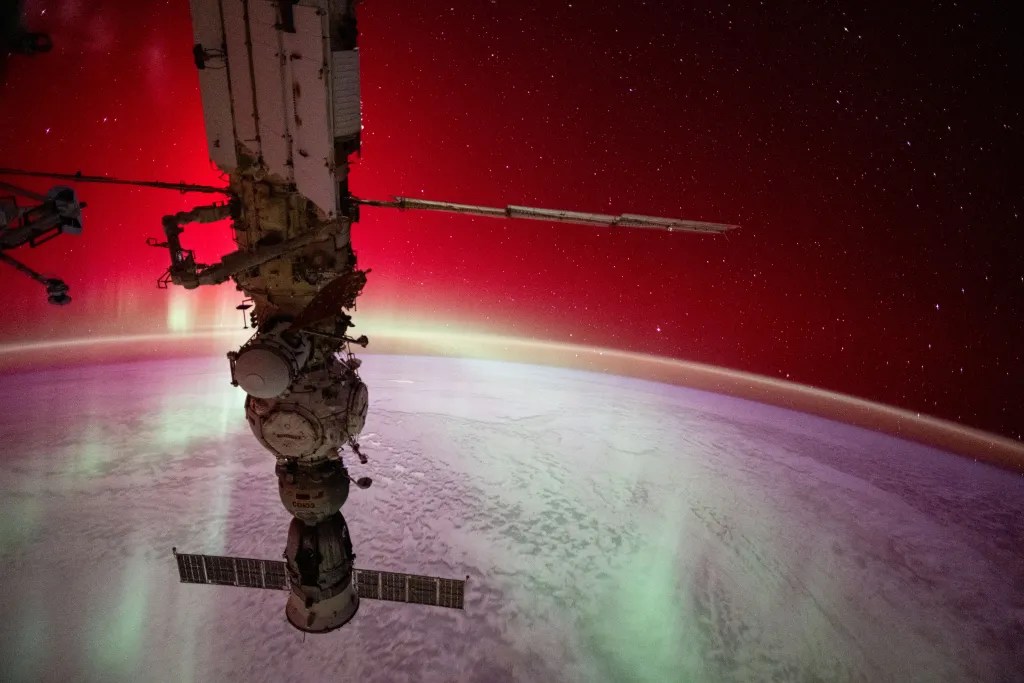
Image (Credit): The Soyuz MS-25 crew ship attached to the ISS as an aurora radiates brightly above the Indian Ocean. (NASA)

Astronaut Tracy C. Dyson is now safely back on Earth thanks to the Russian Soyuz MS-25 spacecraft, which also returned cosmonauts Oleg Kononenko and Nikolai Chub. The no drama return from the International Space Station (ISS) was very different from the recent Boeing Starliner return. The press barely paid attention, which is a good thing.

NASA highlighted Dyson’s six-month tour in this way:

Spanning 184 days in space, Dyson’s third spaceflight covered 2,944 orbits of the Earth and a journey of 78 million miles as an Expedition 70/71 flight engineer. Dyson also conducted one spacewalk of 31 minutes, bringing her career total to 23 hours, 20 minutes on four spacewalks.

I just hope that future Starliner’s can intentionally place astronauts in space for six-months or longer and then return to Earth with little attention. That type of clockwork will be success.

NASA is Looking for Help with its Upcoming Moon Mission

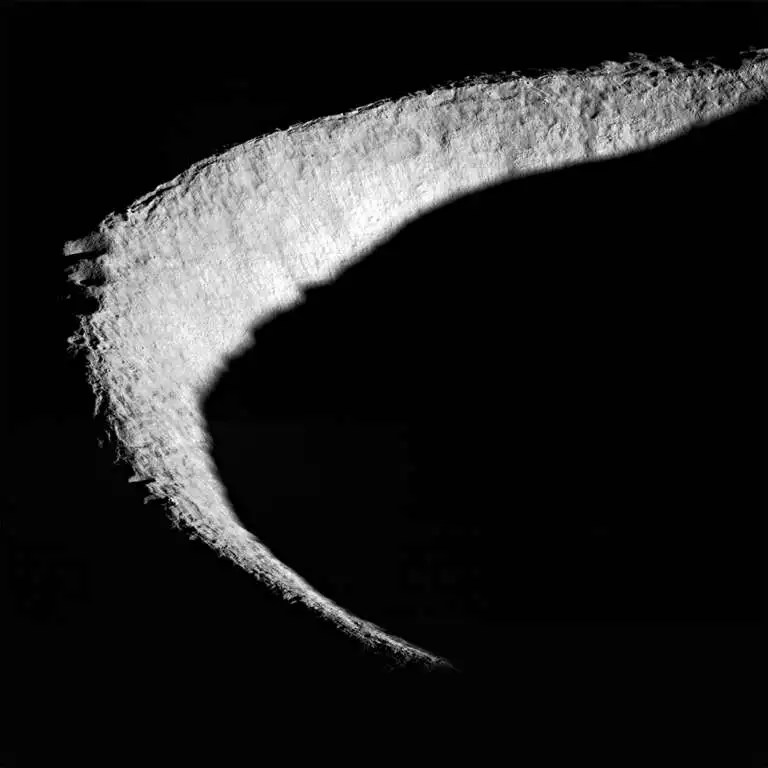
Image (Credit): Shackleton crater at the Moon’s south pole. (NASA/GSFC/Arizona State University)

With NASA planning to return to the Moon shortly as part of the Artemis mission, it is tying up loose end and figuring out what else it may need. It seems that one of the needed items is a better way to conduct its work at the lunar south pole. This comes down to two challenges, both of which have a payout to the winner.

Here’s NASA’s description of the two challenges:

Challenge 1: NASA is seeking an orienteering aid that will help the astronauts navigate on traverses away from the lunar lander and return back. While there were similar devices available to the Apollo astronauts, NASA is looking for new and unique solutions. Among other considerations, devices must be accurate, easy to use, able to be used on the moon’s surface by an astronaut wearing pressurized gloves. If your solution is one of the best, you could be eligible for a share of the $15,000 prize purse.

Challenge 2: NASA is looking for assistance in getting to and mapping the bottom of Shackleton Crater. The design must work in the extreme conditions of the lunar south pole and Shackleton Crater, map the crater, characterize and quantify what is in the crater, and send the data back to be used for future missions. If you can solve this challenge by describing your design concept in detail, you could be eligible for a share of the $30,000 prize purse.

You might wonder why NASA is only thinking of these needs now. I am hoping NASA has some less refined solutions and is only seeking for a better way.

If you have an idea or two, be sure to share it with NASA by November 25, 2024.

Good luck!

Space Quote: Maryland Delegation Wants NASA to Explain Canceling the OSAM-1 Mission

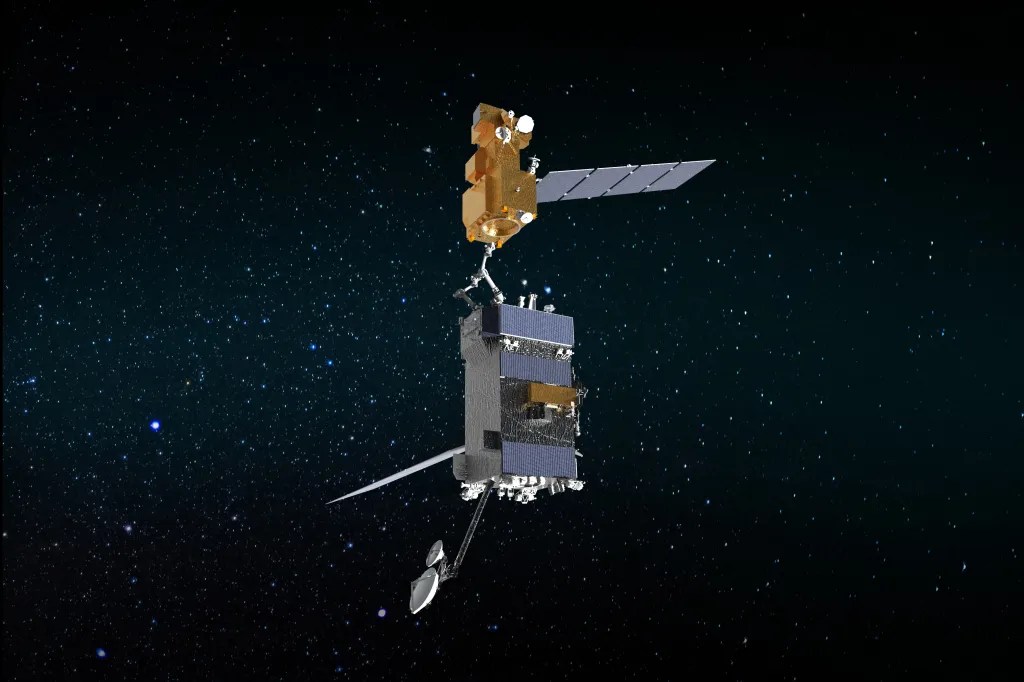
Image (Credit): Artist’s rendering of the OSAM-1 (bottom) docking with a satellite. (NASA)

“As members of the Maryland Delegation, we write to request information regarding NASA’s decision to cancel the On-Orbit Servicing, Assembly, and Manufacturing 1 (OSAM-1) mission on September 4, 2024. OSAM-1 is a space technology mission developed to demonstrate NASA’s capabilities to extend the lifespans of government-owned satellites and other satellites that were not originally built or intended to be serviced in space…On September 4, 2024, members of the Maryland delegation were notified of NASA’s intent to proceed with canceling the OSAM-1 mission. NASA officials cited feasibility of the 2026 launch plan, risk tolerance, lack of interest from potential partners per verbal communication, return on investment, and interest in expanding other Space Technology Mission Directorate (STMD) priorities. The Delegation wishes to note that return on investment and other STMD priorities are extraneous factors that Congress did not include in its direction. Furthermore, we have concerns regarding the Agency’s decision-making process.”

-Statement by Maryland Democratic Senators and Congress members in a September 16, 2024 letter to NASA regarding the status of the OSAM-1 mission. NASA explained on its website that it re-evaluated its earlier decision to cancel the mission and found it was still proper to cancel the mission, noting “factors that informed the decision were cost, schedule, and technical risk associated with the 2026 launch plan, the return on investment of flying OSAM-1 technology, uncertain technology infusion path to industry, and impacts on other NASA technology development efforts.” While these are serious reservations, the growing level of space debris in orbit is also a serious concern. Hopefully, NASA has a back-up plan if it does not move forward with this specific mission.

Space Stories: Axiom Space Struggling Financially, Intuitive Machines Gets $4.8 billion NASA Contract, and Water and Hydroxyl Widespread on Moon

Credit: Axiom Space

Here are some recent stories of interest.

—ARS Technica: “A Key NASA Commercial Partner Faces Severe Financial Challenges“

Axiom Space is facing significant financial headwinds as the company attempts to deliver on two key commercial programs for NASA—the development of a private space station in low-Earth orbit and spacesuits that could one day be worn by astronauts on the Moon. Forbes reports that Axiom Space, which was founded by billionaire Kam Ghaffarian and NASA executive Mike Suffredini in 2016, has been struggling to raise money to keep its doors open and has had difficulties meeting its payroll dating back to at least early 2023. In addition, the Houston-based company has fallen behind on payments to key suppliers, including Thales Alenia Space for its space station and SpaceX for crewed launches.

—Reuters: “Intuitive Machines Clinches $4.8 billion Navigation Services Contract from NASA“

Intuitive Machines said on Tuesday it has bagged a navigation and communication services contract of up to $4.82 billion from NASA for missions in the near space region. As part of the contract, which has a base period of five years with an additional five-year option period, Intuitive will deploy lunar relay satellites and provide communication and navigation services to aid NASA’s Artemis campaign.

—Planetary Science Institute: “Sources of Water and Hydroxyl are Widespread on the Moon“

A new analysis of maps of the near and far sides of the Moon shows that there are multiple sources of water and hydroxyl in the sunlit rocks and soils, including water-rich rocks excavated by meteor impacts at all latitudes. “Future astronauts may be able to find water even near the equator by exploiting these water-rich areas. Previously, it was thought that only the polar region, and in particular, the deeply shadowed craters at the poles were where water could be found in abundance,” said Roger Clark, Senior Scientist at the Planetary Science Institute and lead author of “The Global Distribution of Water and Hydroxyl on the Moon as Seen by the Moon Mineralogy Mapper (M3)” that appears in the Planetary Science Journal. “