Pic of the Week: Spiral Galaxy LEDA 2046648

Image (Credit): Spiral glaxy LEDA 2046648 as captured by the JSWT. (ESA/Webb, NASA & CSA, A. Martel)

This week’s image is from the James Webb Space Telescope (JWST). It shows a spiral galaxy that appears much like our own (bottom center), though this one is a billion light-years away. Do occupants of that galaxy also see us? Good luck communicating when it will take 2 billion years to receive a response to a message you just sent out.

Here is the full story from the European Space Agency (ESA), which posted this as its Picture of the Month just last month:

A crowded field of galaxies throngs this Picture of the Month from the NASA/ESA/CSA James Webb Space Telescope, along with bright stars crowned with Webb’s signature six-pointed diffraction spikes. The large spiral galaxy at the base of this image is accompanied by a profusion of smaller, more distant galaxies which range from fully-fledged spirals to mere bright smudges. Named LEDA 2046648, it is situated a little over a billion light-years from Earth, in the constellation Hercules.

One of Webb’s principle science goals is to observe distant galaxies in the early universe to understand the details of their formation, evolution, and composition. Webb’s keen infrared vision helps the telescope peer back in time, as the light from these distant galaxies is redshifted towards infrared wavelengths. Comparing these systems with galaxies in the local universe will help astronomers understand how galaxies grew to form the structure we see today. Webb will also probe the chemical composition of thousands of galaxies to shed light on how heavy elements were formed and built up as galaxies evolved.

Pic of the Week: The Green Comet

Image (Credit): Comet 2022 E3 (ZTF). (NASA and Dan Bartlett)

The so-called Green Comet that is garnering much attention in the media is captured in this image from last year. The comet was first discovered early last year.

Here is the full story from NASA:

Comet C/2022 E3 (ZTF) was discovered by astronomers using the wide-field survey camera at the Zwicky Transient Facility this year in early March. Since then the new long-period comet has brightened substantially and is now sweeping across the northern constellation Corona Borealis in predawn skies. It’s still too dim to see without a telescope though. But this fine telescopic image from December 19 does show the comet’s brighter greenish coma, short broad dust tail, and long faint ion tail stretching across a 2.5 degree wide field-of-view. On a voyage through the inner Solar System comet 2022 E3 will be at perihelion, its closest to the Sun, in the new year on January 12 and at perigee, its closest to our fair planet, on February 1. The brightness of comets is notoriously unpredictable, but by then C/2022 E3 (ZTF) could become only just visible to the eye in dark night skies.

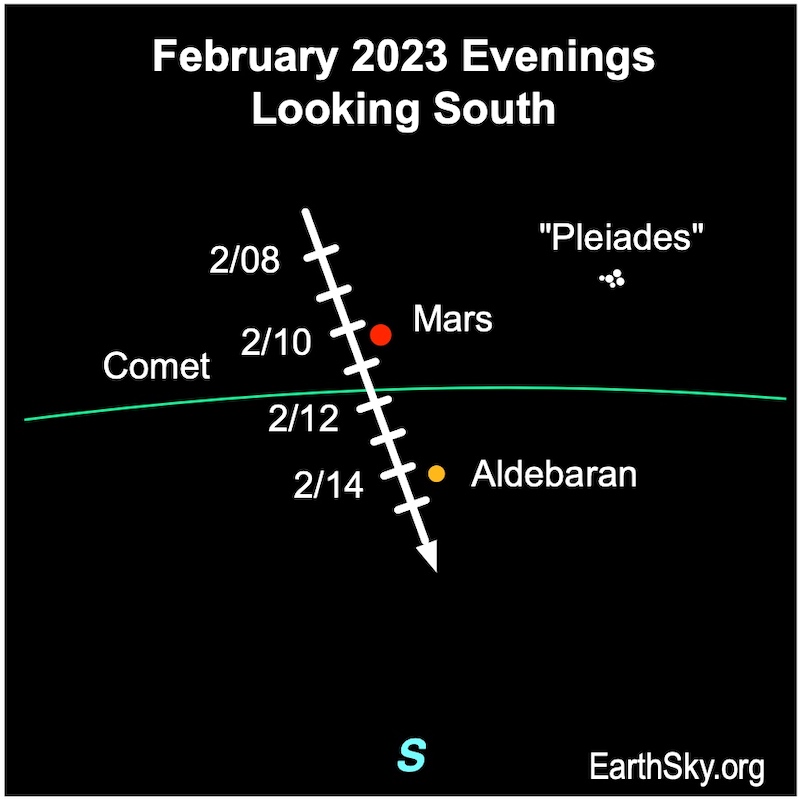
If you grab your binoculars, you can still see the comet over the next week by looking south. Check out the graphic below from EarthSky.org if you need a sky map to find it.

Credit: EarthSky.org

Pic of the Week: ISS Space Junk

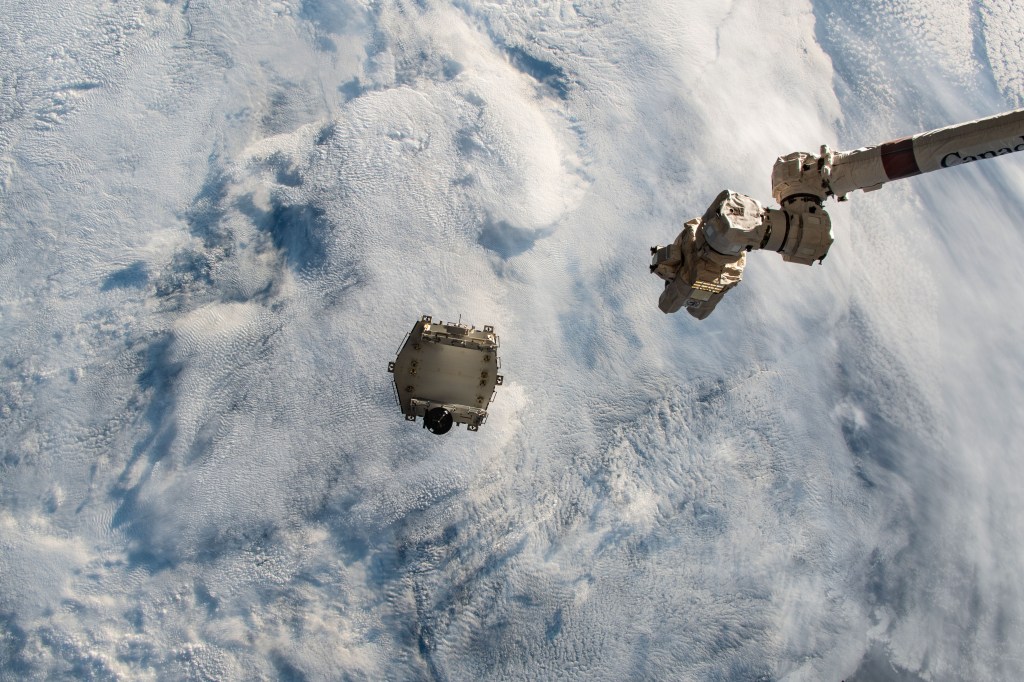
Image (Credit): Canadarm2 robotic arm jettisoning flight support equipment toward the Earth’s atmosphere. (NASA)

This week’s image is a recent shot from the International Space Station (ISS) showing how it deals with unneeded equipment. Fortunately, this “space junk” will quickly burn up in the Earth’s atmosphere rather than remain a threat to the ISS. Given the size of that junk, I hope nothing else bumps into it on the way down.

Here is the story from NASA:

The Canadarm2 robotic arm is pictured extending away from the International Space Station after jettisoning flight support equipment toward the Earth’s atmosphere. The flight hardware secured a pair of roll-out solar arrays inside the SpaceX Dragon cargo ship’s trunk during its ascent to orbit and rendezvous with the space station in November 2022. The jettisoned support equipment drifted safely away from the station and will eventually harmlessly burn up in the atmosphere with no chance for recontacting the space station.

Note: As this story illustrates, NASA has a habit of tossing out the trash from orbit.

Pic of the Week: Yogi Bear Spotted on Mars

Image (Credit): Picture of the Martian surface captured by the orbiting Mars Reconnaissance Orbiter. (NASA/JPL-Caltech/UArizona)

This week’s image comes from the High Resolution Imaging Science Experiment (HiRISE) onboard the Mars Reconnaissance Orbiter. You don’t need to look too hard to see a bear in this photo.

Here is a summary of what you are seeing from the Lunar and Planetary Laboratory at the University of Arizona, which operates HiRISE:

There’s a hill with a V-shaped collapse structure (the nose), two craters (the eyes), and a circular fracture pattern (the head). The circular fracture pattern might be due to the settling of a deposit over a buried impact crater. Maybe the nose is a volcanic or mud vent and the deposit could be lava or mud flows?

Pic of the Week: Solar Plasma Jet

Image (Credit): The Sun’s coronal mass ejection. (Andrew McCarthy/@cosmic_background)

This week’s image is from LiveScience’s 10 most jaw-dropping space images of 2022.” It is described as a “false-color composite image of a coronal mass ejection measuring around 1 million miles firing away from the sun.” The image, attributed to photographer Andrew McCarthy, was created from hundreds of thousands of individual shots taken over six hours.