In Case You Missed It/Podcast: Retelling the Story of the Mission to the Moon

Image: Chesley Bonestell art printed in “The Conquest of the Moon” (1953). Mr. Bonestell’s art is mentioned in the Moonrise podcast.

If you are looking for a good story that you to listen to during your next car trip, you cannot do better than the Washington Post’s Moonrise podcast. It has a bit of everything, including science fiction stories, Nazi war machines, Russian persecution, American post-WWII politics, and a bit of astronomy as well.

Here is how the program sells itself:

Want to uncover the real origin story behind the United States’ decision to go to the moon? In the 50 years since the moon landing, as presidential documents have been declassified and secret programs revealed, a wild story has begun to emerge. “Moonrise,” a Washington Post audio miniseries hosted by Lillian Cunningham, digs into the nuclear arms race of the Cold War, the transformation of American society and politics ⁠— and even the birth of science fiction ⁠— to unearth what really drove us to the moon. Come along with us on a fascinating journey from Earth to the moon.

You can learn how President Kennedy tried to get the Soviet Union to join the Apollo program – twice. You can also hear about the Apollo 11 mission competing with a Soviet spacecraft trying to land on the Moon at the same time. And have you heard about the civil rights protests at the Apollo 11 launch site?

The podcast is a well crafted story trying to weave together many threads in a mostly successful way. It is still astonishing that the early Space Race was really lead by a former Nazi representing the United States and a former political prisoner representing the Soviets. Today the Apollo story is mostly a warm blur from the past, but I believe it is worth your time to listen to the full story. It is the foundation of our space exploration efforts, for better or worse.

Podcast: Should We Search for Extraterrestrial Life?

Here is a podcast if you like the debate format so you can listen to both sides before settling on your own position. Intelligence Squared has great discussions involving experts on a multitude of topics, but few touch upon astronomy. Hence, this is an episode worth sharing.

Here is the set up for this debate:

For decades, scientists around the world have dedicated their lives — and research dollars — to one question: Is there anyone else out there? In the early 1970s, NASA joined the hunt with its own program to search for extraterrestrial life, or SETI for short. When that was defunded by Congress, private efforts took hold. But just what have decades of SETI brought us? And how should we approach the search in those to come? For SETI’s supporters, finding other intelligent life in the cosmos is a fundamentally human endeavor. It probes our understanding of the cosmos, what it means to live and survive on Earth and beyond, and just where our species fits into the greater universe. But others warn that SETI is a distraction from other scientific endeavors that, at best, diverts critical resources and, at worst, will open a can of worms humanity isn’t ready to deal with. Just what would happen if we actually find other beings? Are we mature enough as a society to respond? In this episode, we ask the essential extraterrestrial question: to search or not to search? 

The two experts debating this topic are:

  • Jill Cornell Tarter is an American astronomer best known for her work on the search for extraterrestrial intelligence. Tarter is the former director of the Center for SETI Research, holding the Bernard M. Oliver Chair for SETI at the SETI Institute.
  • Paul M. Sutter is a cosmologist and community outreach coordinator with the Department of Astronomy at Ohio State University. Sutter is also the chief scientist at the Center of Science and Industry in Columbus, Ohio.

I expect most of those visiting this page already have a strong opinion on this topic, but it is worth listening to the debate among these two experts anyway. Enjoy.
Podcast: Astronomy in a Nutshell

Image (Credit): “How to Terraform Venus (Quickly)” video. (Kurzgesagt)

In a recent Clear+Vivid podcast episode, Alan Alda interviewed Philipp Dettmer, who is the CEO of the online science channel Kurzgesagt (German for “in a nutshell”). Mr. Dettmer discussed his difficulties with school as a child, his eventual love of learning, and his desire to help others to learn.

I recommend you listen to his story on the podcast, but also explore the various videos on his Youtube site, including a number of them that deal with astronomy, such as:

It is science as well as scientific speculation, but it is all good for the brain.

Podcast/Book Review: The Mission: A True Story

Credit: NASA

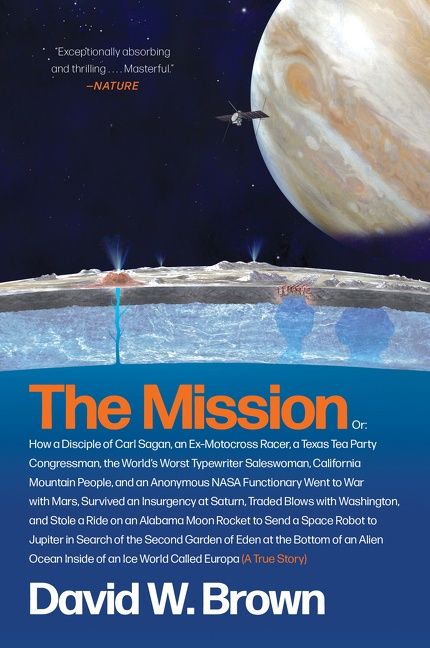
A recent episode of the Astronomy Cast podcast recommended a number of books to read this summer, including David W. Brown’s book The Mission: A True Story. It highlights all the efforts to make the soon-to-be-launched Europa Clipper mission a reality. Below is the book blurb by Harper Collins:

In the spirit of Tom Wolfe and John McPhee, The Mission is an exuberant master class of creative nonfiction that reveals how a motley, determined few expanded the horizon of human achievement.

When scientists discovered the first ocean beyond Earth, they had two big questions: “Is it habitable?” and “How do we get there?” To answer the first, they had to solve the second, and so began a vivacious team’s twenty-year odyssey to mount a mission to Europa, the ocean moon of Jupiter.

Standing in their way: NASA, fanatically consumed with landing robots on Mars; the White House, which never saw a science budget it couldn’t cut; Congress, fixated on going to the moon or Mars—anywhere, really, to give astronauts something to do; rivals in academia, who wanted instead to go to Saturn; and even Jupiter itself, which guards Europa in a pulsing, rippling radi­ation belt—a halo of death whose conditions are like those that follow a detonated thermonuclear bomb.

The Mission is the Homeric, never-before-told story of modern space exploration, and a magnificent portrait of the inner lives of scientists who study the solar system’s mysterious outer planets. David W. Brown chronicles the remarkable saga of how Europa was won, and what it takes to get things done—both down here, and up there.

I think it is safe to say that every space mission goes through a gauntlet these days and is lucky to remain intact at the other end. The James Webb Space Telescope started in the 1990s and only saw the light of day (on a distant exoplanet) earlier this year. Not everyone may have the stomach for the sausage-making behind these missions, but you may want to read this tale if you are looking for modern-day drama in the halls of government and academia that can lead to something meaningful.

Credit: Harper Collins

Podcast: Scientists Discuss the JWST

It is worth checking out the BBC’s Sky at Night podcast if you want to follow the stars or just listen to astronomers discussing the night sky. Two recent episodes in particular, both related to the James Webb Space Telescope (JWST), should be on your podcast list.

  • How James Webb Space Telescope Observes the Universe (broadcast on August 26, 2022): Dr Pamela Klaassen, an instrument scientist, reveals the science behind how JWST studies the cosmos, what its images show us, and the secrets it might uncover. She also discusses her work studying very large stars. Finally, the discussion covers the Square Kilometre Array Organization and how this brand new ground-based observatory will work in tandem with the JWST to unlock the secrets of the Universe.
  • Exploring Exoplanets with JWST (broadcast on August 22, 2022): Dr Hannah Wakeford from the University of Bristol is part of an international collaboration of exoplanet hunters looking to see how the JWST can reveal the secrets of worlds orbiting stars beyond our solar system. One exoplanet priority for the JWST discussed during the episode is WASP-39b, the results of which were recently shared with the public.