A Day in Astronomy: Visit to Asteroid Gaspra

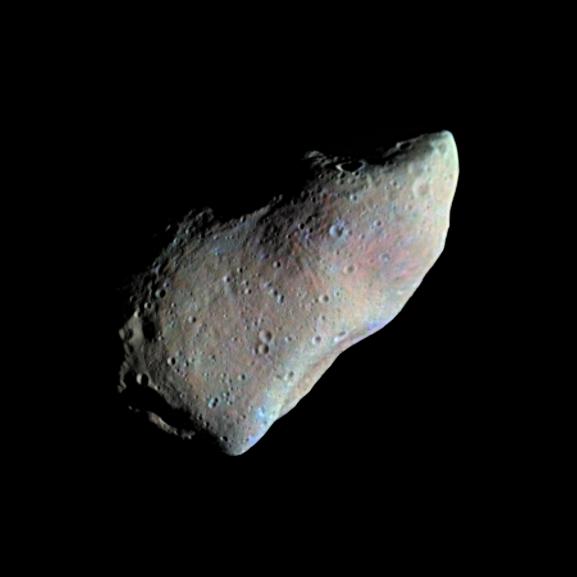
Image (Credit): Asteroid Gaspra in the asteroid belt, visited by the Galileo spacecraft on its way to Jupiter. (NASA/JPL/USGS)

On this day in 1991, NASA’s Galileo spacecraft flew by asteroid Gaspra, which is located in the asteroid belt between Mars and Jupiter. Galileo conducted a quick fly-by while flying towards Jupiter and its moons. The spacecraft also visited the asteroid Ida.

Asteroid Gasprawas first discovered back in 1916 by Russian astronomer G. N. Neujmin, who decided to name it after the Black Sea retreat of Gaspra, a Ukrainian spa town currently occupied by the Russians.

Here is some additional information from NASA about the asteroid, which has similar features to the asteroids now serving as moons to Mars (Phobos and Deimos):

A striking feature of Gaspra’s surface is the abundance of small craters. More than 600 craters, 100-500 meters (330-1650 feet) in diameter are visible here. The number of such small craters compared to larger ones is much greater for Gaspra than for previously studied bodies of comparable size such as the satellites of Mars. Gaspra’s very irregular shape suggests that the asteroid was derived from a larger body by nearly catastrophic collisions. Consistent with such a history is the prominence of groove-like linear features, believed to be related to fractures. These linear depressions, 100-300 meters wide and tens of meters deep, are in two crossing groups with slightly different morphology, one group wider and more pitted than the other. Grooves had previously been seen only on Mars’s moon Phobos, but were predicted for asteroids as well.

You car read more about the overall Galileo mission here.

Image (Credit): Artist’s rendering of the Galileo spacecraft arriving at Jupiter. (NASA)

Space Quote: Starlink Threatened by the Russians

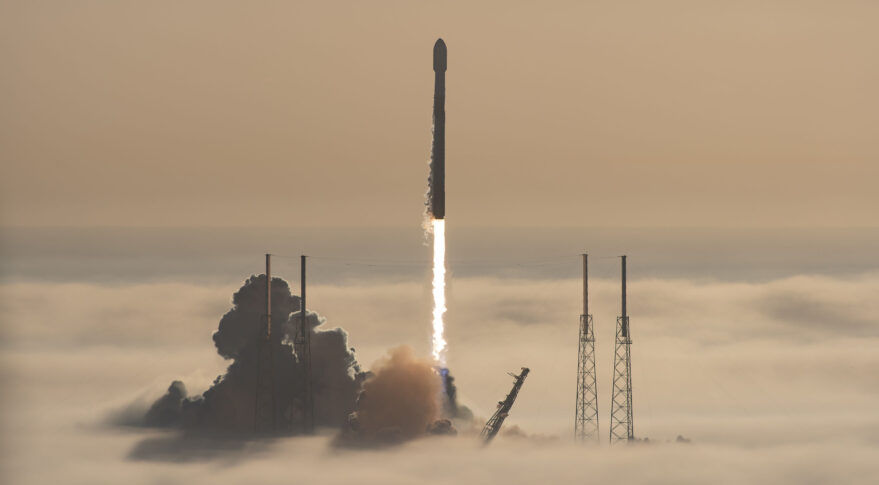
Image (Credit): November 13, 2021 SpaceX launch of 53 Starlink satellites. (SpaceX)

“Quasi-civilian infrastructure may be a legitimate target for a retaliatory strike.”

-Statement to the United Nations by Russian senior foreign ministry official Konstantin Vorontsov in reference to attacking SpaceX’s Starlink satellites being used by the Ukrainian military as it pushes back the Russian invasion. In a Reuters article, “Russia’s Anti-satellite Threat Tests Laws of War in Space,” Iridium chief executive Matt Desch stated, “If somebody starts shooting satellites in space, I’d imagine it would quickly make space unusable.”

Iranian Astronomy Collaboration, Anyone?

Image (Credit): The Iranian National Observatory at night. (Shia News Association)

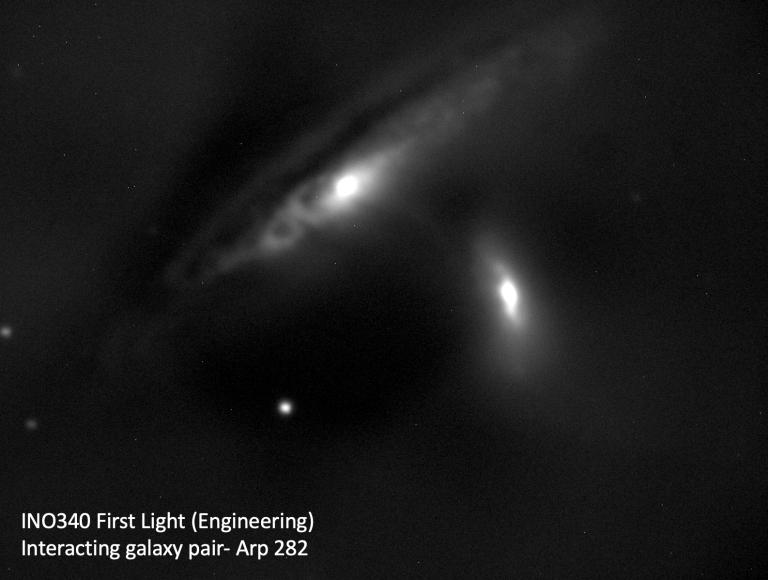
The Iranian National Observatory (INO) is now operational, with its first images now available (see sample below). After 20 years and $25 million, Iranian astronomers now have their own view of the heavens. Fine tuning of the telescope is underway, but it should soon be ready for its initial focus on the evolution of galaxies and stars as well as the study of exoplanets.

Sadly, this positive scientific news is overshadowed by international sanctions, riots in Iran, and the nation’s involvement in the sale of drones to Russia now being used to bomb Ukrainian cities.

Even with all of these problems, INO Project Director Habib Khosroshahi, an astronomer at the Institute for Research in Fundamental Sciences in Tehran, recently stated in Tehran Times, “The door is open from our side…” for collaboration with other science teams around the world.

It would be great if collaborative science could continue in this time of strife, as demonstrated by work on the International Space Stations, but it will be very difficult.

Image (Credit): First images of the INO showing to interacting galaxies. (INO)

In Case You Missed It/Podcast: Retelling the Story of the Mission to the Moon

Image: Chesley Bonestell art printed in “The Conquest of the Moon” (1953). Mr. Bonestell’s art is mentioned in the Moonrise podcast.

If you are looking for a good story that you to listen to during your next car trip, you cannot do better than the Washington Post’s Moonrise podcast. It has a bit of everything, including science fiction stories, Nazi war machines, Russian persecution, American post-WWII politics, and a bit of astronomy as well.

Here is how the program sells itself:

Want to uncover the real origin story behind the United States’ decision to go to the moon? In the 50 years since the moon landing, as presidential documents have been declassified and secret programs revealed, a wild story has begun to emerge. “Moonrise,” a Washington Post audio miniseries hosted by Lillian Cunningham, digs into the nuclear arms race of the Cold War, the transformation of American society and politics ⁠— and even the birth of science fiction ⁠— to unearth what really drove us to the moon. Come along with us on a fascinating journey from Earth to the moon.

You can learn how President Kennedy tried to get the Soviet Union to join the Apollo program – twice. You can also hear about the Apollo 11 mission competing with a Soviet spacecraft trying to land on the Moon at the same time. And have you heard about the civil rights protests at the Apollo 11 launch site?

The podcast is a well crafted story trying to weave together many threads in a mostly successful way. It is still astonishing that the early Space Race was really lead by a former Nazi representing the United States and a former political prisoner representing the Soviets. Today the Apollo story is mostly a warm blur from the past, but I believe it is worth your time to listen to the full story. It is the foundation of our space exploration efforts, for better or worse.

Television: Debating Putin’s Nukes

Astrophysicist Neil deGrasse Tyson was a guest on HBO’s Real Time with Bill Maher last Friday. During the broadcast he discussed his new book, Starry Messenger: Cosmic Perspectives on Civilization, which I commented on in an earlier post.

The odd part of the discussion came when Mr. Tyson was trying to explain that hydrogen bombs are not as bad as atomic bombs because they give off less lethal radiation. Bill Maher had earlier expressed his concerns about Russia’s Putin using a nuclear weapon and was surprised to learn that a hydrogen bomb was less dangerous in terms of radiation. He asked about this again, but Mr. Tyson went onto a different topic about the power of conventional arms and never did get back to Mr. Maher’s main concern.

Sadly, Mr. Tyson missed a chance to inform the audience about the dangers of nuclear weapons, be they hydrogen or atomic. As I had noted in an earlier post about nuclear risks, scientists have found that even a limited nuclear exchange can do great damage to the world because of the soot it throws into the upper atmosphere. A Columbia Climate School study on this issue, “Even a Limited India-Pakistan Nuclear War Would Bring Global Famine, Says Study,” found that even 50 Hiroshima-size explosions, which are quite small by today’s standards, would “…launch some 5 million tons of soot toward the stratosphere.” This soot would “…cause production of the world’s four main cereal crops—maize, wheat, soybeans and rice—to plummet an average 11 percent over that period, with tapering effects lasting another five to 10 years.” The impact of famine would lead to the loss of countless lives around the world.

The real risk today is a nuclear winter, which Mr. Tyson never explained. Instead, the audience was left with the impression that a nuclear explosion is not all that serious. Apparently, he was more interested in sharing all of his knowledge about World War II than addressing the question on the table. Mr. Tyson is supposed to be a good science communicator, so he really needs to correct the record. This is no time to be sloppy about nuclear war.