Space Stories: Chinese Space Partnerships, Approaching Comet, and European Rocket Shortage

Image (Credit): Chinese space program poster. (Asia Times)

Here are some recent stories of interest.

SpaceNews.com: “China Looks to Build Space Partnerships with Gulf Nations

China is aiming to grow cooperation with emerging space nations including Saudi Arabia and the United Arab Emirates. Space was named as one of a number of priority areas for the next three to five years during the first China-Gulf Cooperation Council (GCC) Summit held in Riyadh earlier this month. “China stands ready to work with GCC countries on remote sensing and communications satellite, space utilization, aerospace infrastructure, and the selection and training of astronauts,” according to the text of the keynote speech made by Chinese President Xi Jinping at the summit, Dec. 9. The GCC intergovernmental group comprises Saudi Arabia, the United Arab Emirates, Bahrain, Kuwait, Oman and Qatar.

Newsweek: “Once-in-a-Lifetime Cosmic Event Could Be Visible to the Naked Eye

A comet zooming through the solar system could soon be visible to the naked eye from Earth in what will be a once-in-a-lifetime event. And some astronomical predictions indicate that the object may never return to our cosmic neighborhood. C/2022 E3 (ZTF) is currently located around 100 million miles away from Earth and will make a close approach to our planet in early February 2023.

Atalayar.com: Europe Runs out of Rockets for Autonomous Access to Space

Overnight, the European Space Agency (ESA) headed by Austrian Josef Aschbacher has been left without any capacity to position its own satellites in outer space. Neither Aschbacher nor his director of space transport, the Swiss Daniel Neuenschwander, have any space vector model to fulfil their commitments to the European Union to renew the Copernicus constellation and place their Sentinel environmental monitoring satellites in orbit. Much less is ESA in a position to meet the growing global demand for launch services that is knocking on its doors, those of the United States, China and India.

More Musk Clutter in the Sky

Image (Credit): Artist’s drawing of spacecraft and debris circling the Earth. (Taken from Scientific American’s article, “Relentless Rise of Space Junk Threatens Satellites and Earth.”)

I have written about satellite pollution a few times on this site, and now I need to address it one more time by citing even more bad news. As noted in the news, the Federal Communications Commission (FCC) is allowing SpaceX to place another 7,500 satellites into orbit. SpaceX wanted permission for about 30,000 new satellites, so stay tuned for whining and more pressure on the FCC.

In making its decision, the FCC acknowledged and addressed concerns related to orbital debris and space safety, and required SpaceX to report back on mitigation efforts. You can read the full FCC decision here.

Given that Mr. Musk does not seem to believe in limitations on Twitter or satellite activities, we will need to rely on the regulators to keep an eye on him.

More Satellite Pollution Impacting Ground Telescopes

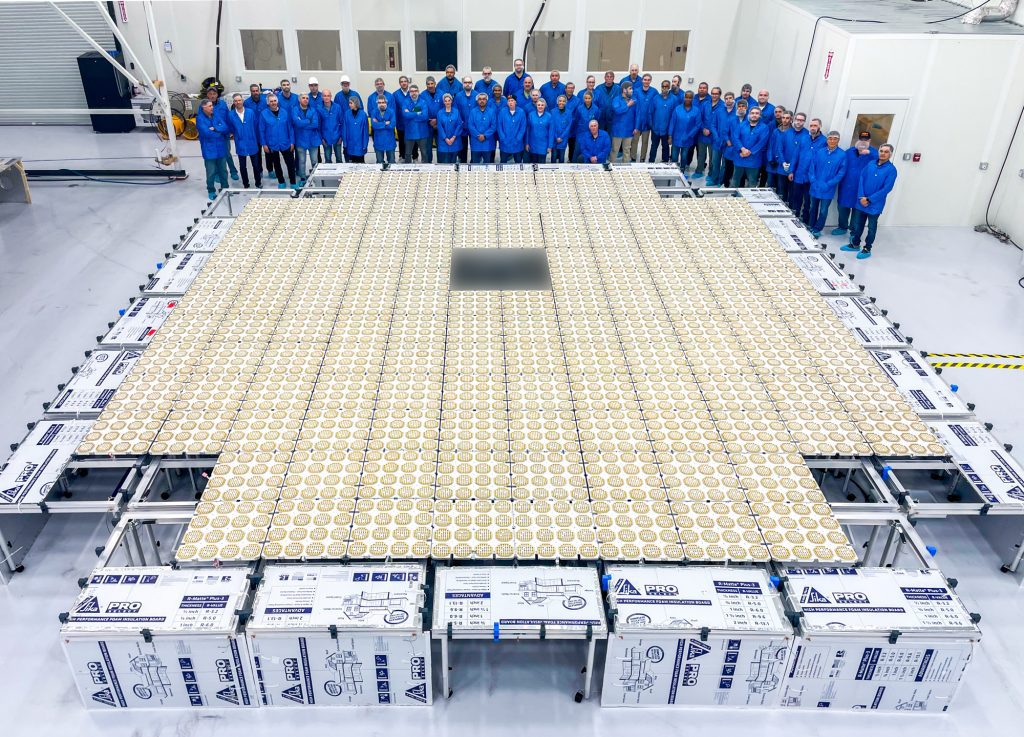
Image (Credit): AST SpaceMobile’s BlueWalker 3 test satellite, which is 693 square feet in size. (AST SpaceMobile)

It is called Bluewalker 3, and it may change the night sky for years to come. Launched in September 2022 aboard a SpaceX rocket, the Bluewalker3 prototype communications satellite from AST SpaceMobile spread its 693 square feet antenna array in low-Earth orbit. It has now become as bright as the brightest stars in the evening sky. And more of these satellites will soon be launched – 168 of them.

Needless to say, astronomers on the ground are perturbed. As noted in Science, astronomer Meredith Rawls of the University of Washington, Seattle, stated, “It’ll show up as a superbright streak in images and potentially saturate camera detectors at observatories.”

That is not to say it will be the brightest man-made object in the night sky. The International Space Station wins that battle being about 40 times brighter than the Bluewalker3, but there is only one ISS versus the 168 Bluewalker satellites being planned.

But wait, there’s more. The Bluewalker satellites direct-to-mobile cell service will also impact radio astronomers.

All of this has astronomers up in arms, leading to complaints against the use of such satellites. The Federal Communications Commission (FCC) is monitoring the matter.

As reported by NBC News, the FCC is also placing new restrictions on satellites at the end of their mission life, but this will not help with all of the new satellites going up today that will be crowding the night sky for many years to come.

If this continues, we may need that planned lunar base as a telescope collection point, at least until the objects orbiting the Moon become a problem.

The UK is in the Space Rocket Business

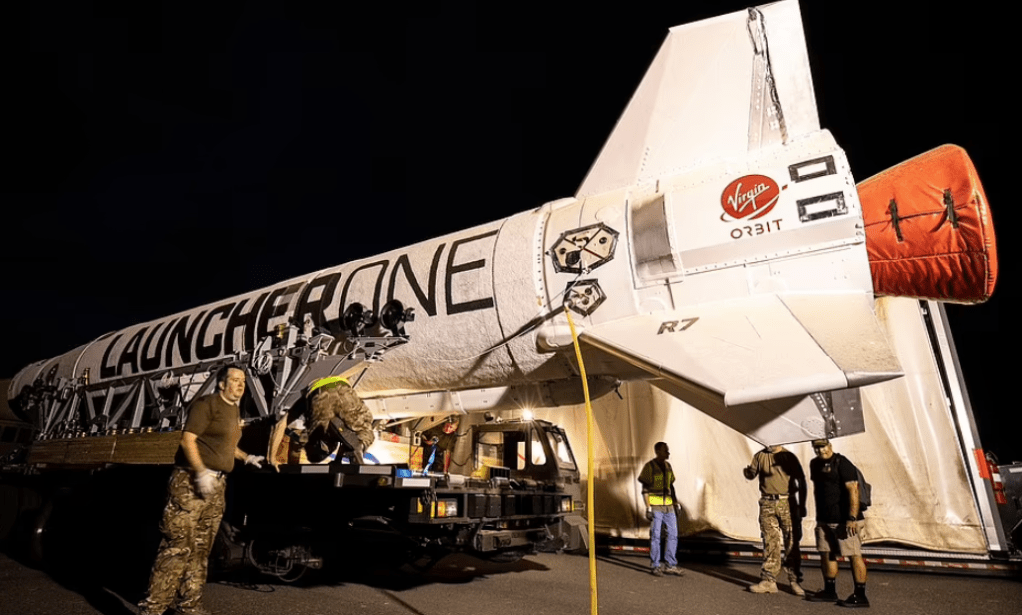
Image (Credit): LauncherOne rocket after arriving in Cornwall, England. (UK Space Command)

Later this year, the United Kingdom (UK) is getting into the commercial space business with Virgin Orbit’s launch of the LauncherOne rocket. The 70-foot long rocket stuffed with a satellites will be loaded onto Virgin Orbit’s Boeing 747 (called the “Cosmic Girl”) for a mid-air launch. It will be the first satellite launch from the UK.

While the launch was planned for earlier this year, Virgin Orbit is still dealing with some bureaucratic delays. Nonetheless, the use of Space Cornwall is an achievement for the UK and Europe as they plan more space missions from the continent.

Late last year, the Guardian wrote about planned space missions from the UK. The article, “The Great British Race to Space,” highlights plans for rocket launches from England, Wales, and Scotland. For instance, B2Space in Wales has plans to launch rockets from a helium balloon floating 20 miles up. The balloon could save about 70 percent of fuel and other costs related to a typical satellite launch.

It seems reusable rockets are just one of many innovations for lowering the cost of satellite launches. Watch out, SpaceX.

Image (Credit): A test flight for the B2Space balloon. Picture: (B2Space)

Has Russia Lost its Space Mojo?

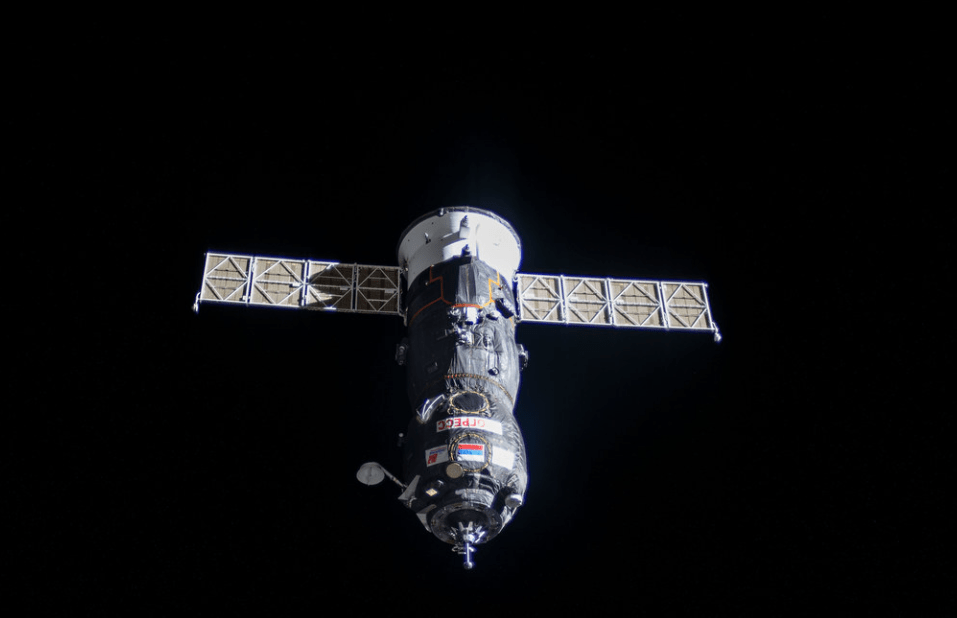
Image (Credit): Russia’s Progress 76 resupply ship approaching the ISS in July 2020. (NASA)

Marina Koren’s article in The Atlantic, titled “The Russian Space Program Is Falling Back to Earth,” has plenty to say about the state of Russia’s space program. Her assessment is pretty bleak outside of the continued collaboration related to the International Space Station (ISS).

She notes:

Beyond the ISS, though, Russia’s space portfolio isn’t all that grandiose these days. Although cosmonauts fly into orbit regularly, Russia does not have a rover on the far side of the moon, as China has, or orbiters around Mars, as India and the United Arab Emirates have. It does not have a fleet of space telescopes like the U.S has. The Soviet Union was the first to send a human being to space, decades ago, and its early accomplishments are a distinct point of national pride. But the Russian space program has stalled for years, plagued by sparse budgets. And that was before Vladimir Putin’s onslaught on Ukraine: Some of the space plans the country still had in the works are falling apart. Now the Russian space effort may be more adrift than ever.

The Russian invasion of Ukraine may be the last straw. It led to the cancellation of various collaborative space projects with other nations. For instance, back in March the European Space Agency (ESA) was forced to suspend its joint ESA/Roscosmos ExoMars Rover mission to Mars.

China seems to be pulling ahead of Russia in the space race, with Russia taking a back seat on future projects, such as a Moon base or new space station. On the ground, Russia has shown it is not up to a war with Ukraine, making its role as a military power questionable. The article notes that Russia’s status as a space power is now also in question.

And shooting down another nation’s satellites will not be seen as a sign of strength in either the military or space arena.