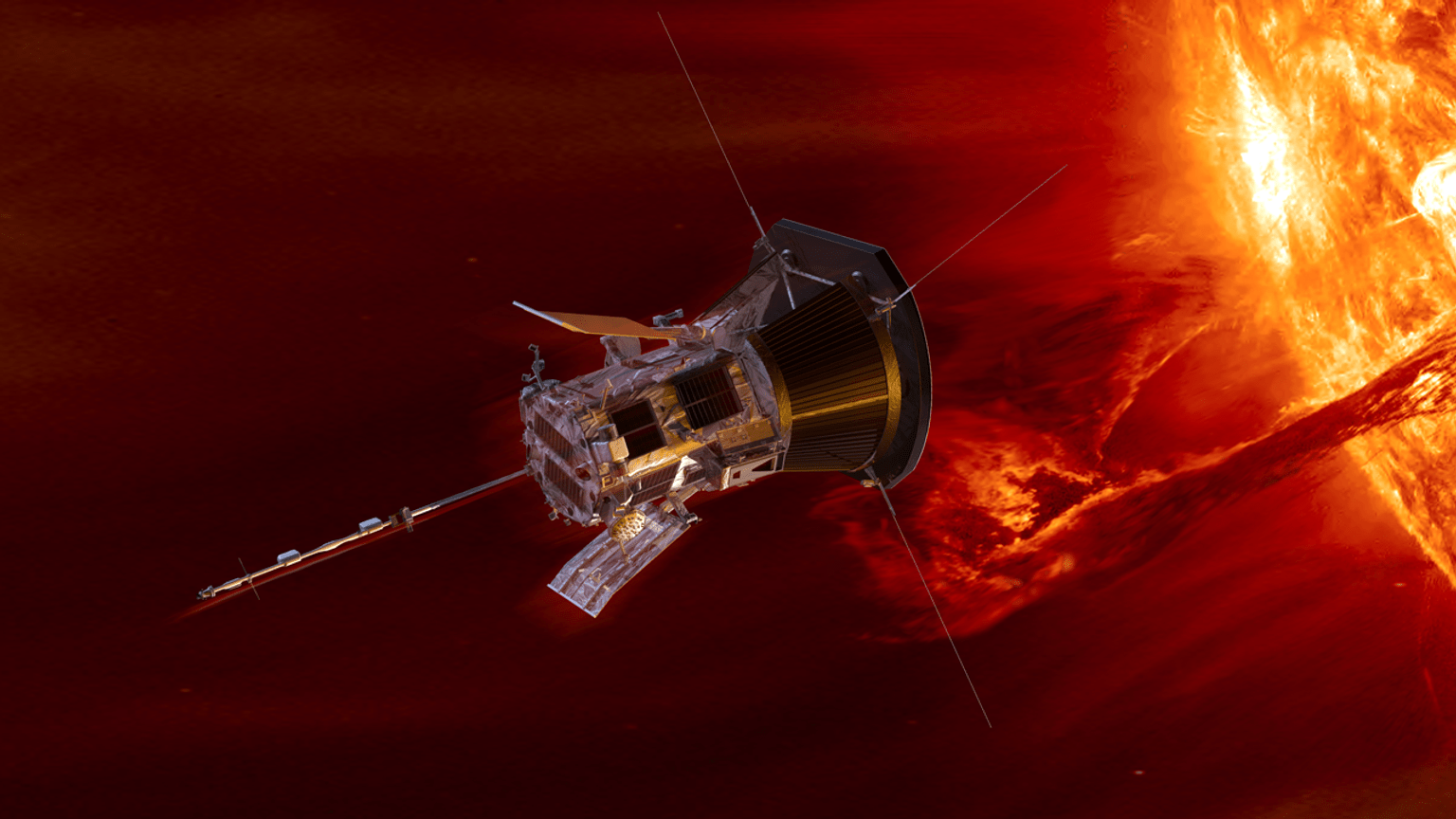
Image (Credit): Artist’s rendering of NASA’s Parker Solar Probe approaching the Sun. (NASA)
“Flying this close to the Sun is a historic moment in humanity’s first mission to a star…By studying the Sun up close, we can better understand its impacts throughout our solar system, including on the technology we use daily on Earth and in space, as well as learn about the workings of stars across the universe to aid in our search for habitable worlds beyond our home planet.”
–Statement by Nicky Fox, who leads the Science Mission Directorate at NASA Headquarters in Washington, in reference to NASA’s Parker Solar Probe recent flyby of the Sun.
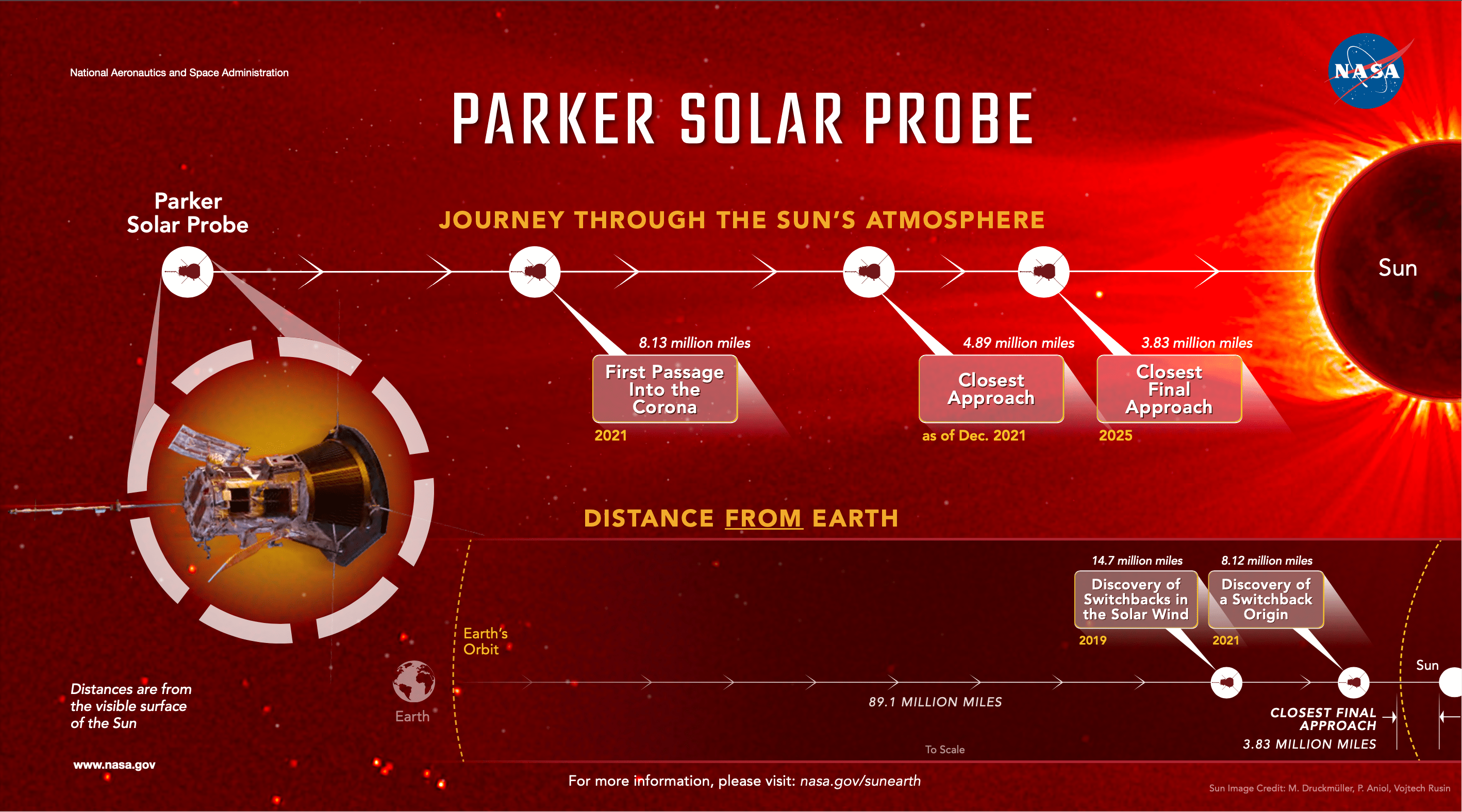
NASA’s Parker Solar Probe is about to go where no spacecraft has gone before. A final flyby of Venus last month has sped up Parker for the mission’s next solar perihelion, set to occur on December 24 at 6:40 EST / 11:40 UT. At just 6.2 million km (3.9 million miles) from the solar surface — about nine times the Sun’s radius — this perihelion will be the closest for the mission. Parker is breaking its own record to once again become the closest human-made object to ever approach the Sun…the mission is totally autonomous in taking measurements; it should start transmitting data back to Earth within a week after this pass, though it has the capability to carry out operations on its own for up to two months if needed.
Astronomers have made a startling discovery. Using data from the eRosita X-ray instrument, researchers say they’ve discovered a “cosmic tunnel” that connects our solar system to other stars. Scientists have long known that our solar system exists in a Local Hot Bubble. This bubble is believed to have formed following several supernovas over the past several million years and is estimated to be around 300 light-years across. Using data from the eRosita, researchers from the Max Planck Institute say they found evidence of a cosmic tunnel stretching from our solar system out toward the Centaurus constellation. The tunnel appears to move through the material that makes up the Local Hot Bubble
Just as some children physically resemble their parents, many scientists have long thought that developing planets should resemble the swirling disk of gas and dust that births them. But, in a new study, a Northwestern University-led team of astrophysicists discovered the resemblance might be looser than previously thought. By studying a still-forming exoplanet and its surrounding natal disk using new instrumentation at W.M. Keck Observatory, the researchers uncovered a mismatched composition of gases in the planet’s atmosphere compared to gases within the disk. The surprising finding potentially confirms long-held skepticism that scientists’ current model of planet formation is too simplified.
In February, the first Moon landing through the agency’s Commercial Lunar Payload Services initiative brought NASA science to the lunar surface on Intuitive Machines’ Nova-C lander successfully capturing data that will help us better understand the Moon’s environment and improve landing precision and safety.
After launching into space in February, NASA’s Plankton, Aerosol, Cloud, ocean Ecosystem (PACE) satellite mission is successfully transmitting first-of-their-kind measurements of ocean health, air quality, and the effects of a changing climate.
In June, NASA astronauts Butch Wilmore and Suni Williams safely arrived at the space station aboard Boeing’s Starliner spacecraft following launch of their flight test. With Starliner’s arrival, it was the first time in station history three different spacecraft that carried crew to station were docked at the same time. Starliner returned uncrewed in September following a decision by NASA. Wilmore and Williams, now serving as part of the agency’s Crew-9 mission, will return to Earth in February 2025.
Deployed NASA’s Advanced Composite Solar Sail System in space, marking a successful test of its composite boom technology.
Awarded nearly $45 million to 21 higher-education institutions to help build capacity for research, and announced the recipients of grants that will support scientific and technical research projects for more than 20 universities and organizations across the United States.
The long list from which this was taken is impressive. However, we also need to note a few of the problems this year. This includes troubled commercial missions to the Moon, a Boeing crew stranded on the International Space Station after a problematic Starliner test, delays in the SpaceX Starship rocket tests, a cancelled Moon rover, budget cuts at NASA as well as layoffs at JPL, cost overruns on the Mars Sample Return mission, and a delay in the Artemis II and III launch dates.
This does not override the accomplishments, but it puts them into context at a time of changing administrations in Washington. This will come with hard questions about the viability of current missions as well as the cost of future missions.
I agree 2024 has plenty of proud moments. That said, 2025 will be a very challenging year for NASA. The agency will need solid answers to hard questions, cost effective options for struggling missions, and plenty of public support to weather calls for additional budget cuts.
I have confidence NASA will come out of this even stronger, even if it is a bit bruised in the process.
Firefly Aerospace, Inc., the leader in end-to-end responsive space services, was awarded an approximately $179.6 million NASA contract to deliver and operate six NASA instruments in the Gruithuisen Domes on the Moon’s near side in 2028. As part of NASA’s Commercial Lunar Payload (CLPS) initiative, the mission will utilize Firefly’s Blue Ghost lunar lander, Elytra Dark orbital vehicle, and a rover from an industry provider to investigate the unique composition of the Gruithuisen Domes – a part of the Moon that has never been explored.
A NASA-funded commercial space station, Starlab, recently completed four key developmental milestones, marking substantial progress in the station’s design and operational readiness. The four milestones are part of a NASA Space Act Agreement awarded in 2021 and focused on reviews of the habitat structural test article preliminary design, systems integration, integrated operations, and a habitat structural test plan. “These milestone achievements are great indicators to reflect Starlab’s commitment to the continued efforts and advancements of their commercial destination,” said Angela Hart, program manager for NASA’s Commercial Low Earth Orbit Development Program. “As we look forward to the future of low Earth orbit, every successful milestone is one step closer to creating a dynamic and robust commercialized low Earth orbit.”
NASA’s two stuck astronauts just got their space mission extended again. That means they won’t be back on Earth until spring, 10 months after rocketing into orbit on Boeing’s Starliner capsule. NASA announced the latest delay in Butch Wilmore and Suni Williams’ homecoming on Tuesday. The two test pilots planned on being away just a week or so when they blasted off June 5 on Boeing’s first astronaut flight to the International Space Station. Their mission grew from eight days to eight months after NASA decided to send the company’s problem-plagued Starliner capsule back empty in September.
Image (Credit): JPL’s most likely scenario for the unsuccessful landing of NASAs Ingenuity Mars Helicopter on Jan. 18, 2024. (NASA/JPL-Caltech)
“When running an accident investigation from 100 million miles away, you don’t have any black boxes or eyewitnesses…While multiple scenarios are viable with the available data, we have one we believe is most likely: Lack of surface texture gave the navigation system too little information to work with.”
-Statement by Ingenuity’s first pilot, Håvard Grip of JPL, in a Jet Propulsion Laboratory (JPL) publication explaining the final flight of the Ingenuity Mars Helicopter on Jan. 18, 2024. The helicopter flew 72 times over the Martian surface, far surpassing NASA’s expectations.



 Our Awesome Universe