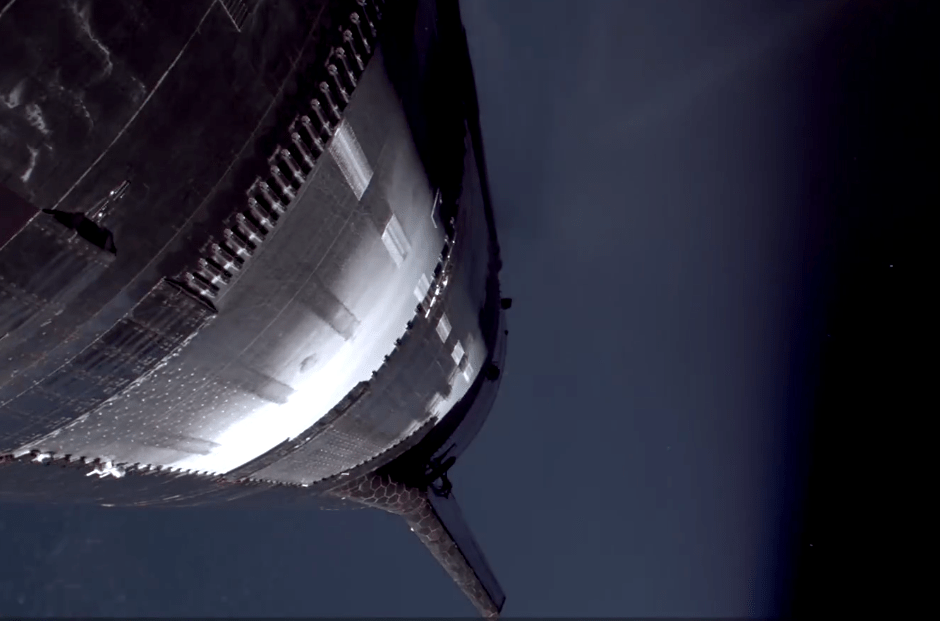
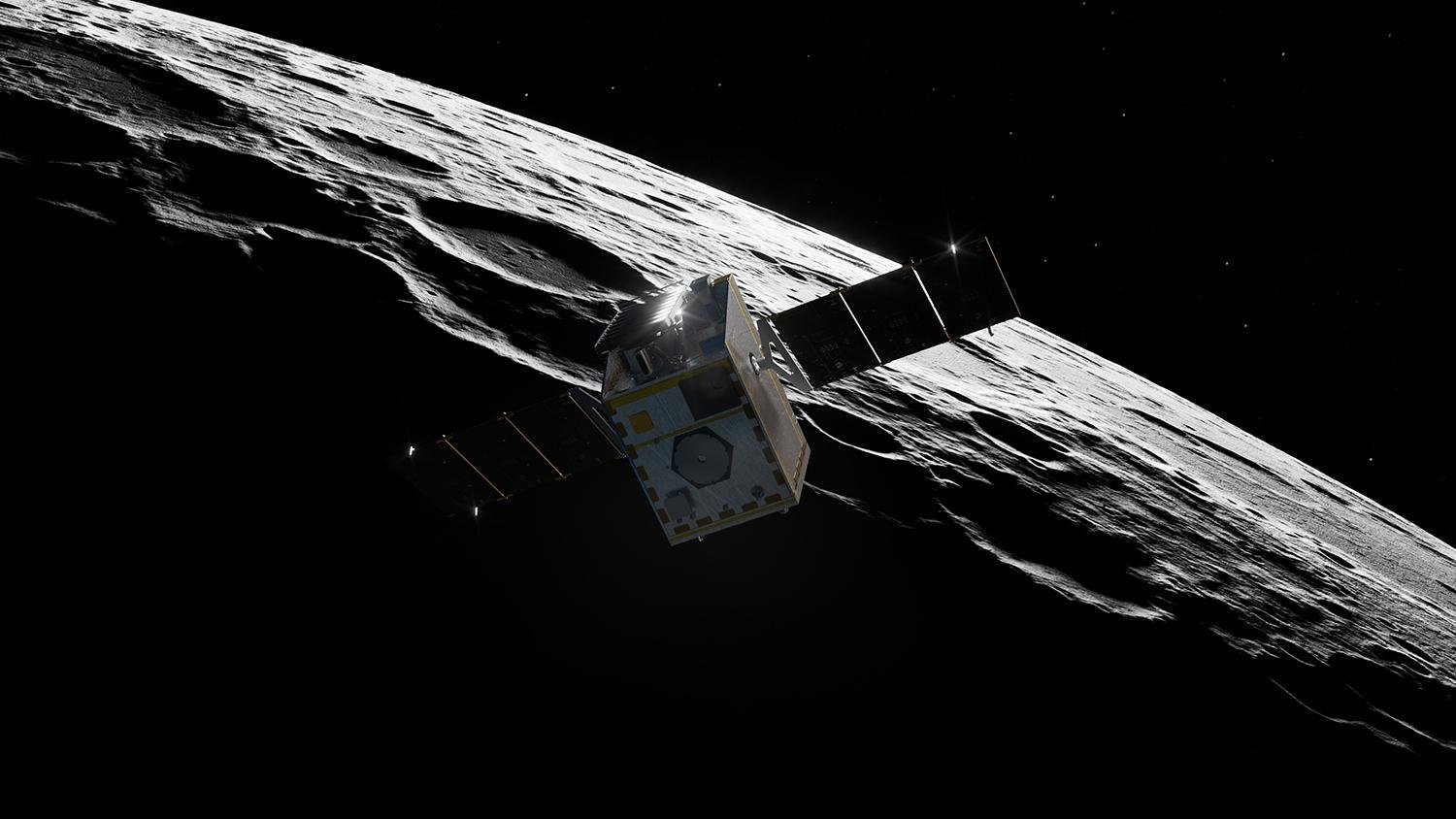
Image (Credit): The far side of the Moon captured by the Blue Ghost spacecraft. (Firefly Aerospace)
The image above is part of a video taken last week showing the far side of the Moon by Firefly Aerospace’s Blue Ghost spacecraft. The spacecraft is about 120 kilometers above the lunar surface. You can see the video here.
Regarding the video, the company noted:
In this orbit, the team will experience planned rolling comms blackouts as Blue Ghost goes around the far side of the Moon. When on the near side, the team will continue to downlink data and finalize the plan for our next maneuver that will get Blue Ghost even closer to the lunar surface and keep us right on track for landing on March 2.
You can learn more about the Blue Ghost’s mission here.
Blue Origin’s New Glenn rocket launch was pushed off again earlier today when ice was found building up on one of the lines related to the hydraulic systems.
We’re standing down on today’s launch attempt to troubleshoot a vehicle subsystem issue that will take us beyond our launch window. We’re reviewing opportunities for our next launch attempt.
As a result, the new launch date is set for Thursday, January 16.
In the meantime, watch for the launch on Wednesday of Firefly Aerospace’s Blue Ghost Mission One as part of NASA’s Commercial Lunar Payload Services (CLPS) program. This mission will deliver 10 science and technology payloads to the Moon, including
Blue Ghost will spend approximately 45 days in transit to the Moon, allowing ample time to conduct health checks on each subsystem and begin payload science. Blue Ghost will then land in Mare Crisium and operate payloads for a complete lunar day (about 14 Earth days). Following payload operations, Blue Ghost will capture imagery of the lunar sunset and provide critical data on how lunar regolith reacts to solar influences during lunar dusk conditions. The lander will then operate for several hours into the lunar night.
Image (Credit): Blue Ghost Mission One schedule. (Firefly Aerospace)
A new paper looks at another way we might be able to detect advanced civilizations, and at its center is the need for energy. The more advanced a civilization becomes, the greater their need for energy and one of the most efficient ways, according to current theories, is to harness the energy from an actively feeding black hole. The paper suggests a civilization feeding matter into a black hole could harvest energy from it; more excitingly perhaps, the process could be detectable within 17,000 light years.
Officials said they are making progress in protecting two key institutions from the Eaton fire. Don Fregulia, an operations section chief for the California Department of Forestry and Fire Protection, which has joined in the Eaton fire response, said that efforts to protect Mt. Wilson had proved successful and he expected that to remain the case. “We’re actively engaged there, and so far, no loss to any values at risk at Mt. Wilson,” Fregulia said. “We’re feeling good about what we have to do up there tonight to keep that site secure.” He said the fire had also spread close to NASA’s Jet Propulsion Laboratory, but he said that’s a priority and crews were “making good progress there as well.”
To maximize chances of successfully bringing the first Martian rock and sediment samples to Earth for the benefit of humanity, NASA announced Tuesday a new approach to its Mars Sample Return Program. The agency will simultaneously pursue two landing architectures, or strategic plans, during formulation, encouraging competition and innovation, as well as cost and schedule savings. NASA plans to later select a single path forward for the program, which aims to better understand the mysteries of the universe, and to help determine whether the Red Planet ever hosted life. NASA is expected to confirm the program – and its design – in the second half of 2026.
Image (Credit): Golden Record placed on Voyager I and II. (NASA)
“This Voyager spacecraft was constructed by the United States of America. We are a community of 240 million human beings among the more than 4 billion who inhabit the planet Earth. We human beings are still divided into nation states, but these states are rapidly becoming a single global civilization.
We cast this message into the cosmos. It is likely to survive a billion years into our future, when our civilization is profoundly altered and the surface of the Earth may be vastly changed. Of the 200 billion stars in the Milky Way galaxy, some–perhaps many–may have inhabited planets and spacefaring civilizations. If one such civilization intercepts Voyager and can understand these recorded contents, here is our message:
This is a present from a small distant world, a token of our sounds, our science, our images, our music, our thoughts, and our feelings. We are attempting to survive our time so we may live into yours. We hope someday, having solved the problems we face, to join a community of galactic civilizations. This record represents our hope and our determination, and our good will in a vast and awesome universe.”
–Statement by then President Jimmy Carter in July 29, 1977 that was placed in both Voyager I and II, both of which are now barreling beyond our solar system. Voyager II was launched on August 20, 1977 followed by Voyager I on September 5, 1977.