Trump Administration Proposes 25 Percent Cut to NASA’s Budget

It should come as no surprise at this point that NASA will fall victim to massive budget cuts like so many other civilian agencies. While it will not disappear like the US Agency for International Development, it will be severely wounded as the result of a proposed 25 percent cut to its budget.

The White House’s proposed 2026 budget is setting aside $7 billion for the Moon missions and $1 billion for Mars missions, but it seems just about everything else is up for grabs. For instance, we would see the show shutdown of the Space Launch System rocket and the Orion spacecraft so they could become fully commercial. In addition, the orbiting lunar Gateway will be cut completely.

Specifically, the budget summary states:

The Budget phases out the grossly expensive and delayed Space Launch System (SLS) rocket and Orion capsule after three flights. SLS alone costs $4 billion per launch and is 140 percent over budget. The Budget funds a program to replace SLS and Orion flights to the Moon with more cost-effective commercial systems that would support more ambitious subsequent lunar missions. The Budget also proposes to terminate the Gateway, a small lunar space station in development with international partners, which would have been used to support future SLS and Orion missions.

Moreover, the Mars funding would not cover the sample return mission. Hence, SpaceX might get a boost to head towards Mars while we are stranding samples that help us to understand why we might want to go to Mars. We will also see the end of the Nancy Grace Roman Space Telescope, pruning back the accomplishments we have made since the Hubble Space Telescope to make the universe more available to scientists and the public.

If we ignore the future of the Artemis mission for a moment, a NASA press release boasted about all the events over the past 100 days to prepare for the Artemis mission. This is a hopeful sign that the Moon mission is still vital and viable at the moment, even with the defunding efforts underway. However, given some of the recent failures of the private sector efforts to reach the Moon, and the continual delays in SpaceX’s Starship, the future for Moon missions after the SLS does not look too promising at the moment.

The future also looks somewhat bleak when you look at proposed cuts to NASA’s funding for space science, space technology, and STEM programs. The endless faith in the private sector forgets the benefits of a government supporting and nudging these efforts.

As Casey Dreier, Chief of Space Policy for The Planetary Society, clearly stated:

These cuts would cause irreparable losses, throwing away billions of dollars invested by the U.S. taxpayers in productive space hardware and infrastructure. Space science is a critical national investment that engages our cutting edge economic, scientific, and educational abilities across the country.

Blue Ghost: Mission Accomplished

Image (Credit): Blue Ghost’s shadow on the lunar surface with the Earth on the horizon.(Firefly Aerospace)

NASA and Firefly Aerospace plan to have a news conference tomorrow at 2pm to discuss the end of the Blue Ghost mission on the Moon. The lunar lander set down on March 2. It began its mission immediately, knowing the disappearance of the Sun on March 16 would mark the end its work.

Those speaking at tomorrow’s news conference are:

  • Joel Kearns, deputy associate administrator for exploration, Science Mission Directorate, NASA Headquarters in Washington;
  • Jason Kim, CEO, Firefly Aerospace;
  • Ray Allensworth, spacecraft program director, Firefly; and
  • Adam Schlesinger, Commercial Lunar Payload Services project manager, NASA Johnson.

In a press release earlier today, Firefly stated:

Firefly Aerospace…today announced it met 100 percent of its mission objectives for Blue Ghost Mission 1 after performing the first fully successful commercial Moon landing on March 2, completing more than 14 days of surface operations (346 hours of daylight), and operating just over 5 hours into the lunar night with the final data received around 6:15 pm CDT on March 16. This achievement marks the longest commercial operations on the Moon to date.

After a number of issues with the first commercial missions, this is very good news.

Weather Issues Impact SPHEREx Mission, But its Ready Now

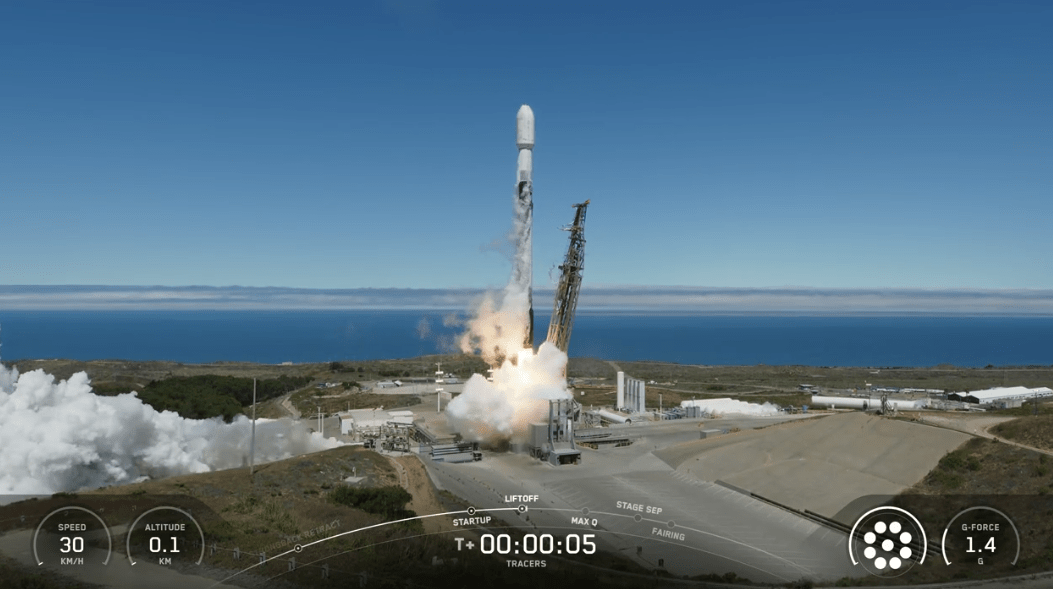
Image (Credit): NASA’s SPHEREx observatory and PUNCH satellites at Space Launch Complex 4 East from Vandenberg Space Force Base in California on March 8, 2025. (SpaceX)

One can expect weather issues in Florida, but California? It seems that the west coast also has its issues, per a tweet yesterday from SpaceX:

Due to unfavorable weather at the launch site and an issue with one of the @NASA spacecraft, we are standing down from tonight’s Falcon 9 launch of NASA’s SPHEREx and PUNCH missions. Next launch opportunity is Tuesday, March 11 at 8:10 p.m. PT

Given that the Spectro-Photometer for the History of the Universe, Epoch of Reionization and Ices Explorer (SPHEREx) observatory mission has gotten this far with all of the challenges along the way, I think a few extra days are okay. NASA is also keen to see the Polarimeter to Unify the Corona and Heliosphere (PUNCH) satellites aloft as well.

Everything is ready to go in less than an hour (8:10 p.m. PDT, 11:10 p.m EDT). If you would like to watch it, you can go to NASA+.

Update: The SPHEREx and PUNCH missions were successfully launched yesterday evening, March 11th.

A Very Mixed Week in Space

Image (Credit): One of the last images of the eighth Starship flight on Thursday right before the rocket exploded. (SpaceX)

Let’s start with the good news. This past week two U.S. commercial space companies put landers on the Moon. Both Firefly’s Blue Ghost and Intuitive Machines’ Athena are now residents of the Moon. This is a terrific accomplishment for these relatively new players.

Now the bad news. Athena landed incorrectly and cannot carry out its mission. In fact, it died after only one day on the lunar surface. In addition, the Lunar Trailblazer that accompanied Athena on this mission with plans to orbit and map the Moon also appears to be a lost cause. And finally, SpaceX’s eighth test of its Starship ended with a fiery explosion over the Caribbean, much like its seventh test.

Add to this the potential dismantling of NASA should rumors of a 50 percent cut be true, and you have a very mixed week with too little good news (much like the stock market).

One common element in at least two of the stories – Starship explosion and NASA cuts – relates to Mr. Musk. One wonders whether more attention to SpaceX and less time ransacking the federal government might have led to better outcomes this week. I’m not a rocket scientist, but that seems to make some sense to me.

Pic of the Week: Athena Lands on Moon

Image (Credit): Athena approaching the Moon on March 6, 2025. (NASA)

This week’s image is from earlier today when Intuitive Machines’ Athena lunar lander was approaching the Moon’s South Pole. The good news is that the lander made it safely to the surface. However, the lunar lander may have landed in an odd way, creating solar generating issues similar to the company’s first attempt at landing this time last year.

NASA and Intuitive Machines are still trying to determine the status of the lander as well as its exact location. The lander’s goal was to land in Mons Mouton, a lunar plateau near the Moon’s South Pole. NASA’s Lunar Reconnaissance Orbiter should help to pinpoint the lander’s location and orientation in the next few days.

Hopefully, some if not all of the planned experiments are still possible. But for now it’s just a matter of waiting for more news on the mission.