Space Stories: Congressional Space Medal, Asteroid Rings, and Dancing Exoplanets

Image (Credit): Former NASA astronauts Robert Behnken, left, and Douglas Hurley, right, and are seen after being awarded the Congressional Space Medal of Honor by Vice President Kamala Harris during a ceremony in the Eisenhower Executive Office Building. (NASA/Joel Kowsky)

Here are some recent stories of interest.

NASA: “VP Awards Former NASA Astronauts Congressional Space Medal of Honor

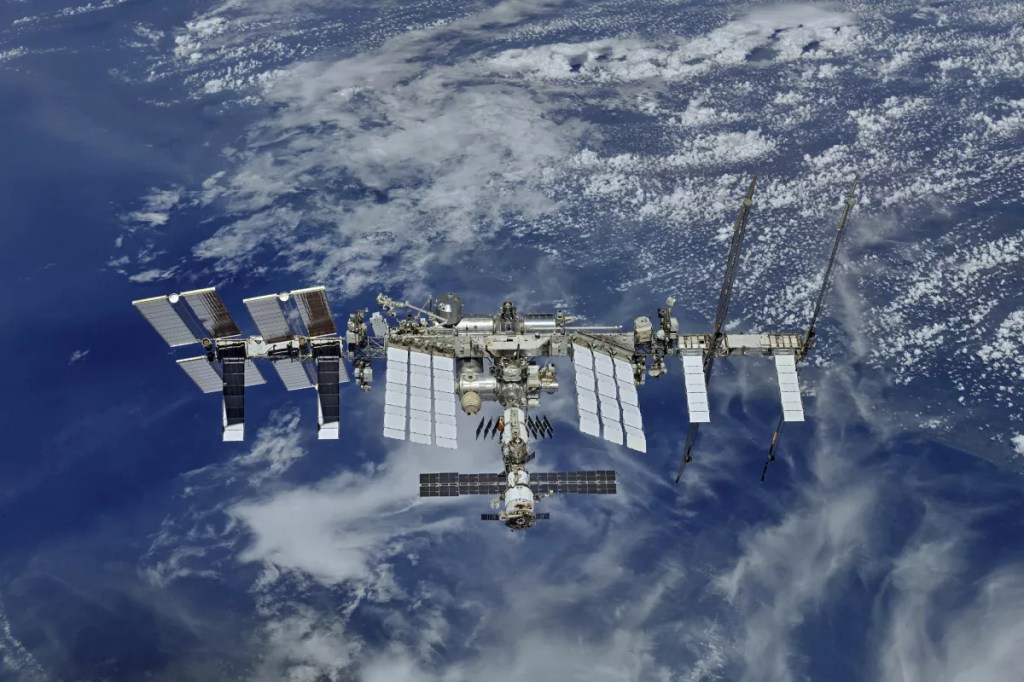
On behalf of President Joe Biden, Vice President Kamala Harris awarded former NASA astronauts Douglas Hurley and Robert Behnken the Congressional Space Medal of Honor Tuesday for their bravery in NASA’s SpaceX Demonstration Mission-2 (Demo-2) to the International Space Station in 2020. Hurley and Behnken are the first recipients of the honor since 2006 and accepted the awards during a televised event in Washington.

CNET: “NASA Webb Telescope Zooms in on One of Solar System’s Oddest Objects

Scientists using NASA’s new James Webb Space Telescope say they’ve been able to get a closer look at an asteroid that also hosts just the fifth ring system to be discovered in our solar system (the others circle Saturn, Jupiter, Uranus and Neptune).  Astronomers initially discovered the rings in 2013 while watching Chariklo occult, or pass in front of, a distant star. To their surprise, two other smaller objects also appeared to pass in front of the background star for an instant. These turned out to be two thin rings around Chariklo. 

Northwestern University: “Watch Distant Worlds Dance Around their Sun

In 2008, HR8799 was the first extrasolar planetary system ever directly imaged. Now, the famed system stars in its very own video. Using observations collected over the past 12 years, Northwestern University astrophysicist Jason Wang has assembled a stunning time lapse video of the family of four planets — each more massive than Jupiter — orbiting their star. The video gives viewers an unprecedented glimpse into planetary motion. 

Space Stories: Europeans Not Joining Chinese Space Station, the Milky Way is Odd, and Lucy has a New Target

Image (Credit): A computer rendering of China’s new Tiangong space station in orbit. (Alejandro Miranda/Alamy Stock Photo)

Here are some recent stories of interest.

Royal Astronomical Society: “European Space Agency Says it has No Plans to Send Astronauts to China’s Tiangong Space Station

A top official with the European Space Agency said it had no plans to send European astronauts to the newly completed Chinese space station, making it clear for the first time that the agency is no longer committed to working with China in human space flight in the near future. “We are very busy supporting and ensuring our commitments and activities on the International Space Station,” ESA director general Josef Aschbacher told a press conference in Paris on Monday.

Royal Astronomical Society: “Milky Way Found to be More Unique than Previously Thought

Is the Milky Way special, or, at least, is it in a special place in the Universe? An international team of astronomers has found that the answer to that question is yes, in a way not previously appreciated. A new study shows that the Milky Way is too big for its “cosmological wall”, something yet to be seen in other galaxies. The new research is published in Monthly Notices of the Royal Astronomical Society.

Southwest Research Institute: “SwRI-Led Lucy Team Announces New Asteroid Target

NASA’s Lucy spacecraft will add another asteroid encounter to its 4-billion-mile journey. On Nov. 1, 2023, the Southwest Research Institute-led Lucy mission will get a close-up view of a small main belt asteroid to conduct an engineering test of the spacecraft’s innovative asteroid-tracking navigation system. The Lucy mission was already on course to break records by its planned visit of nine asteroids during its 12-year mission to tour the Jupiter Trojan asteroids, which orbit the Sun at the same distance as Jupiter. Originally, Lucy was not expected to get a close-up view of any asteroids until 2025, when it will fly by the main belt asteroid (52246) Donaldjohanson. However, the SwRI-led Lucy team identified a small, as-yet unnamed asteroid in the inner main belt as a potential new and useful target for the Lucy spacecraft.

Space Stories: The End of Geotail, a Galactic Map, and Sweden Gets a Spaceport

Image (Credit): An artist’s rendering of the Geotail spacecraft. (NASA)

Here are some recent stories of interest.

NASA: “NASA’s Geotail Mission Operations Come to an End After 30 Years

After 30 years in orbit, mission operations for the joint NASA-JAXA Geotail spacecraft have ended, after the failure of the spacecraft’s remaining data recorder. Since its launch on July 24, 1992, Geotail orbited Earth, gathering an immense dataset on the structure and dynamics of the magnetosphere, Earth’s protective magnetic bubble. Geotail was originally slated for a four-year run, but the mission was extended several times due to its high-quality data return, which contributed to over a thousand scientific publications. While one of Geotail’s two data recorders failed in 2012, the second continued to work until experiencing an anomaly on June 28, 2022. After attempts to remotely repair the recorder failed, the mission operations were ended on November 28, 2022.

Phys.org: “Billions of Celestial Objects Revealed in Gargantuan Survey of the Milky Way

Astronomers have released a gargantuan survey of the galactic plane of the Milky Way. The new dataset contains a staggering 3.32 billion celestial objects—arguably the largest such catalog so far. The data for this unprecedented survey were taken with the Dark Energy Camera, built by the US Department of Energy, at the NSF’s Cerro Tololo Inter-American Observatory in Chile, a Program of NOIRLab.

Advanced Television: “Sweden Inaugurates Rocket Launch Site

While much of the world’s press recently focused on Virgin Orbit’s failed ‘horizontal’ aircraft launch of a batch of 9 small satellites from Spaceport Cornwall, other rivals are gearing up to tap into the growing demand for satellite launches. Sweden has claimed the crown as “mainland Europe’s first orbital launch site”. Ursula von der Leyen, President of the European Commission, helped cut the ribbon at Kiruna, Sweden, saying: “This spaceport offers an independent European gateway to space. It is exactly the infrastructure we need, not only to continue to innovate but also to further explore the final frontier.”

Space Stories: JWST Confirms Earth-Size Exoplanet, Russia Sending Rescue Mission to ISS, and IO Erupts

Image (Credit): James Webb Space Telescope (JWST) data associated with exoplanet LHS 475 b. (NASA, ESA, CSA, Leah Hustak (STScI))

Here are some recent stories of interest.

Webb Space Telescope: “NASA’s Webb Confirms Its First Exoplanet

Researchers confirmed an exoplanet, a planet that orbits another star, using NASA’s James Webb Space Telescope for the first time. Formally classified as LHS 475 b, the planet is almost exactly the same size as our own, clocking in at 99% of Earth’s diameter. The research team is led by Kevin Stevenson and Jacob Lustig-Yaeger, both of the Johns Hopkins University Applied Physics Laboratory in Laurel, Maryland.

ABC News: “Russia Will Launch New Capsule to Return Space Station Crew

Russia will send up a new capsule next month to bring back three space station crew members whose original ride home was damaged, officials said Wednesday. The two Russians and one American will stay several extra months at the International Space Station as a result of the capsule switch, possibly pushing their mission to close to a year, NASA and Russian space officials told reporters.

MSN Science Alert: “Massive Volcanic Outburst Detected on Jupiter’s Hellish Moon Io

In the space around Jupiter, a torus of plasma created and fed by Io’s volcanic emissions grew significantly richer between July and September of last year and persisted until December, showing the moon underwent a spate of volcanic activity that released a huge amount of material. For something that’s just a little bit bigger than Earth’s Moon, Io is an absolute beast of volcanism. It’s bristling with volcanoes, with around 150 of the 400 known volcanoes erupting at any given time, creating vast lakes of molten lava.

Space Stories: Passing of Apollo Astronaut Walter Cunningham, Opal on Mars, and Juno Recovers

Image (Credit): Walter Cunningham adjusts his pressure suit before the Apollo 7 launch on October 11, 1968. (NASA)

Here are some recent stories of interest.

NASA: “Apollo Astronaut Walter Cunningham Dies at 90

Former astronaut Walter Cunningham, who flew into space on Apollo 7, the first flight with crew in NASA’s Apollo Program, died early Tuesday morning in Houston. He was 90 years old. “Walt Cunningham was a fighter pilot, physicist, and an entrepreneur – but, above all, he was an explorer. On Apollo 7, the first launch of a crewed Apollo mission, Walt and his crewmates made history, paving the way for the Artemis Generation we see today,” said NASA Administrator Bill Nelson. “NASA will always remember his contributions to our nation’s space program and sends our condolences to the Cunningham family.”

New Atlas: “Curiosity Finds Opal on Mars – a Possible Water Source for Astronauts

NASA’s Curiosity rover has discovered opal on Mars. The deposits may prove to be valuable to future Martian explorers not as jewelry but as a potential source of water. Opal is formed when water weathers silica-rich rocks, forming a solution that settles into cracks and crevices in the rock. Over time, this solution hardens into a solid lump that can be cloudy and dull or a dazzling display of color. Most supplies come from either Australia or Ethiopia, but now a new source has been discovered – Mars.

Space.com: “Juno Spacecraft Recovering its Memory After Mind-blowing Jupiter Flyby, NASA Says

NASA’s Juno probe is continuing to recover its memory at Jupiter after a data disruption interrupted communications between the spacecraft and its operators on Earth following a flyby of the giant planet in December. The Juno spacecraft’s latest flyby of Jupiter, its 47th close pass of the planet, was completed on Dec. 14. But as its operators at NASA’s Jet Propulsion Laboratory were receiving science data from the flyby they found they could no longer directly access the spacecraft’s memory. The team successfully rebooted Juno’s computer and on Dec. 17 they placed the spacecraft into “safe mode” with only essential systems operating as a precaution.