Space Stories: JWST, a Galaxy Catalog, and a Stellar Graveyard

Image (Credit): JWST image of the Tarantula Nebula, which is about 160,000 light-years away. (NASA, ESA, CSA, STScI)

Here are some recent stories of interest.

Nature.com: “‘Bit of Panic’: Astronomers Forced to Rethink Early Webb Telescope Findings

Astronomers have been so keen to use the new James Webb Space Telescope (JWST) that some have got a little ahead of themselves. Many started analysing Webb data right after the first batch was released, on 14 July, and quickly posted their results on preprint servers — but are now having to revise them. The telescope’s detectors had not been calibrated thoroughly when the first data were made available, and that fact slipped past some astronomers in their excitement.

DailyScience.com: “‘Astronomers Map Distances to 56,000 Galaxies, Largest-ever Catalog

How old is our universe, and what is its size? A team of researchers led by University of Hawaii at Manoa astronomers Brent Tully and Ehsan Kourkchi from the Institute for Astronomy have assembled the largest-ever compilation of high-precision galaxy distances, called Cosmicflows-4. Using eight different methods, they measured the distances to a whopping 56,000 galaxies. The study has been published in the Astrophysical Journal.

University of Sydney: “Milky Way’s Graveyard of Dead Stars Found

The first map of the ‘galactic underworld’ – a chart of the corpses of once massive suns that have since collapsed into black holes and neutron stars – has revealed a graveyard that stretches three times the height of the Milky Way, and that almost a third of the objects have been flung out from the galaxy altogether.
Space Stories: Enceladus, Maarten Schmidt, and SpaceX

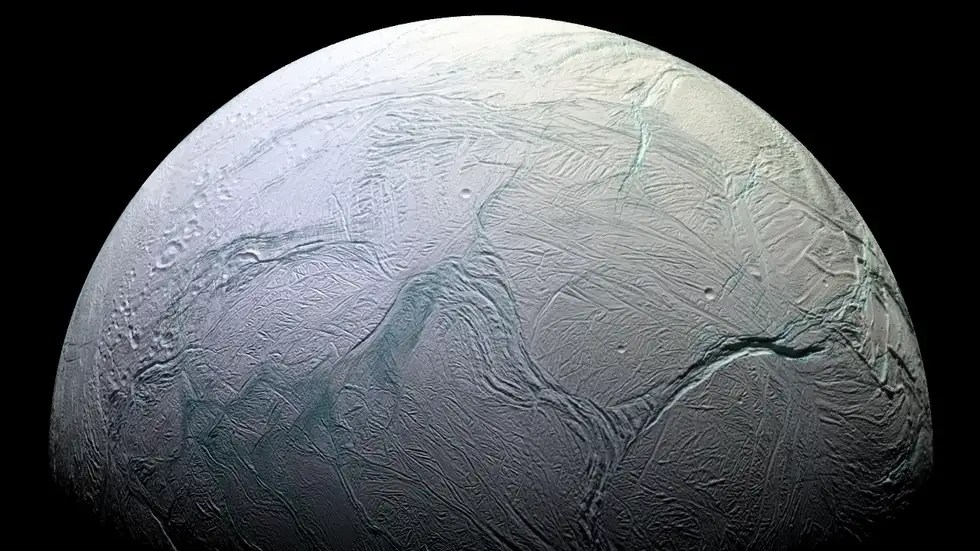
Image (Credit): Saturn’s moon Enceladus as seen by NASA’s Cassini spacecraft. (NASA/JPL/Space Science Institute)

Here are some recent stories of interest.

Weather.com: “A Habitable Ocean? Scientists Believe An Essential Life Component May be Abundant on Saturn’s Icy Moon, Enceladus!

Previously, NASA’s Saturn-studying Cassini spacecraft had discovered Enceladus’ subsurface liquid water as well as the plumes of ice grains and water vapour that erupted from cracks in the moon’s icy surface. Analysis of the plumes had revealed that they contain almost all the basic requirements of life as we know it. But while the bioessential element phosphorus is yet to be identified directly, scientists have now found evidence of its availability in the ocean beneath the moon’s icy crust.

WashingtonPost.com: “Maarten Schmidt, Astronomer Who Explained Quasars, Dies at 92

Maarten Schmidt, the Dutch-born American astronomer who explained the mysterious heavenly bodies known as quasars and in so doing helped create the modern picture of the universe, its structure and its history, died Sept. 17 at his home in Fresno, Calif. He was 92.

Space.com: “FCC Denies SpaceX $900 Million in Starlink Funding

The space launch services giant was recently rejected for nearly $900 million dollars in rural connectivity funding from the Wireline Competition Bureau (a branch of the Federal Communications Commission, or FCC). SpaceX characterized that decision(opens in new tab) as “grossly unfair” in its Sept. 9 appeal to the regulator, which is under review.

Space Stories: The Milky Way, Super-Earths, and Anti-Satellite Tests

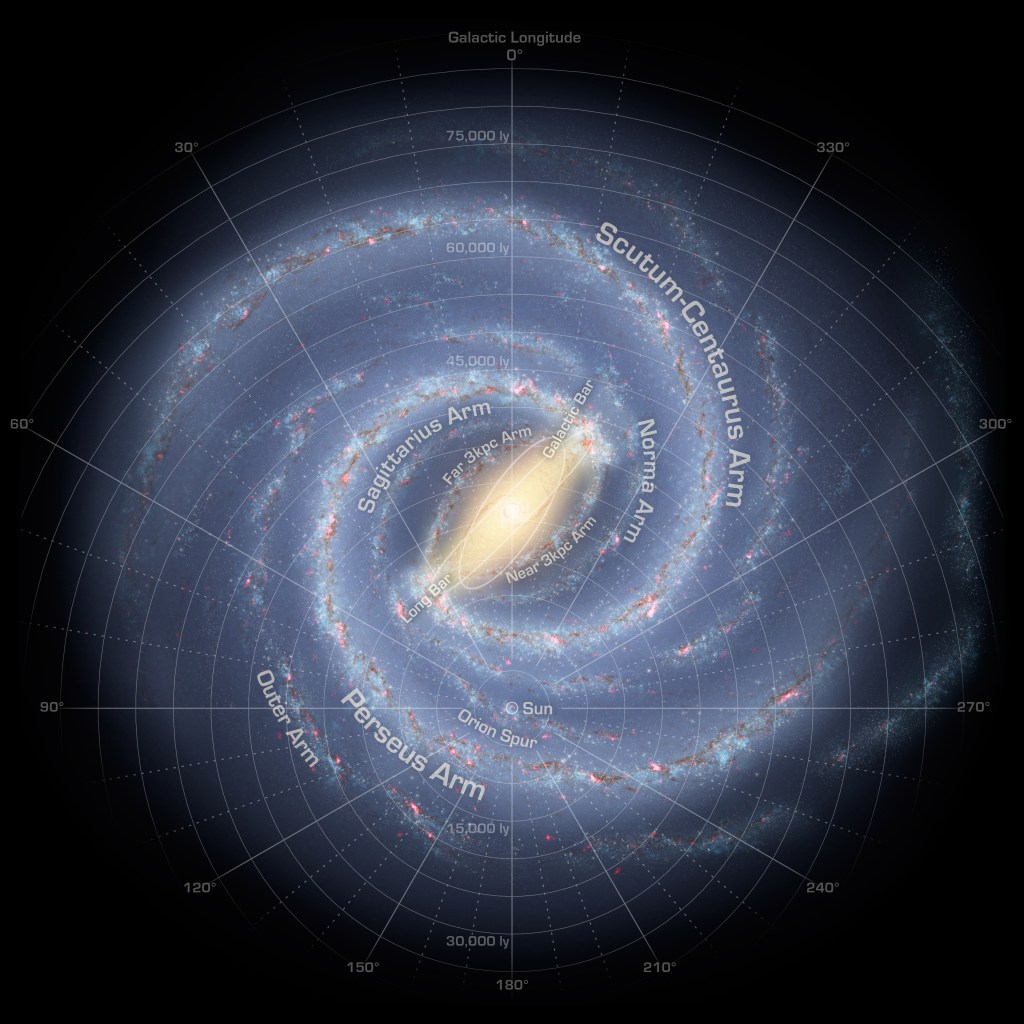
Image (Credit): This annotated artist’s concept illustrates the new view of the Milky Way, along with other findings presented at the 212th American Astronomical Society meeting in 2008 in St. Louis, Missouri. The galaxy’s two major arms (Scutum-Centaurus and Perseus) can be seen attached to the ends of a thick central bar, while the two now-demoted minor arms (Norma and Sagittarius) are less distinct and located between the major arms. The major arms consist of the highest densities of both young and old stars; the minor arms are primarily filled with gas and pockets of star-forming activity. The artist’s concept also includes a new spiral arm, called the “Far-3 kiloparsec arm,” discovered via a radio-telescope survey of gas in the Milky Way. This arm is shorter than the two major arms and lies along the bar of the galaxy. Our sun lies near a small, partial arm called the Orion Arm, or Orion Spur, located between the Sagittarius and Perseus arms. (NASA/JPL-Caltech/R. Hurt (SSC/Caltech))

Here are some recent stories of interest.

ScienceNews.org:Passing Through the Milky Way’s Arms May Have Helped Form Earth’s Solid Ground

Earth’s journey through the Milky Way might have helped create the planet’s first continents. Comets may have bombarded Earth every time the early solar system traveled through our galaxy’s spiral arms, a new study suggests. Those recurring barrages in turn helped trigger the formation of our planet’s continental crust, researchers propose August 23 in Geology.

Phys.org: “Astronomers Discover Two ‘Super-Earths’ Orbiting Nearby Star

An international team of astronomers reports the discovery of two new “super-Earth” exoplanets orbiting a nearby late-type M dwarf star. The newfound alien worlds, designated LP 890-9 b and LP 890-9 c, are slightly larger than the Earth. The finding has been published in Astronomy & Astrophysics.

Space.com: “Germany and Japan Pledge Not to Conduct Destructive Anti-satellite Tests

Germany and Japan have pledged not to conduct destructive anti-satellite tests that could create dangerous clouds of space debris in orbit. The announcements of these pledges were both made at the second session of the United Nations’ open-ended working group on reducing space threats, which is being held in Geneva from Sept. 12 to Sept. 16…Germany’s and Japan’s announcements follow similar pledges made by the United States, Canada and New Zealand in the wake of Russia’s irresponsible destruction of a satellite in November 2021 that created a massive cloud of space debris. 

Space Stories: Radioactive Ceres, Moon Clues, and Starlink’s Shine

Here are some recent stories of interest.

SkyandTelescope.org: “Asteroid Ceres Was Radioactive — And That Could Explain a Lot

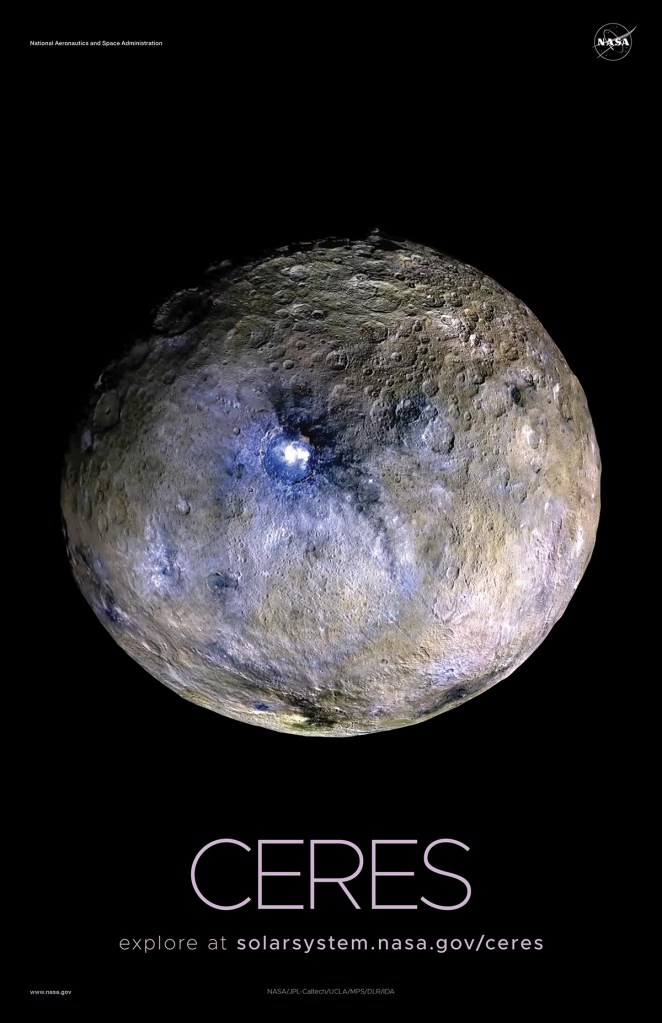
A team of U.S. planetary scientists has shown that unexpected surface features on the dwarf planet Ceres can be explained by radioactive decay in its interior long ago. If they are right, their model could explain features not just on other dwarf planets, but also on some of the icy moons in the outer solar system.

ScienceDaily.com: “One More Clue to the Moon’s Origin

Researchers discover the first definitive proof that the Moon inherited indigenous noble gases from the Earth’s mantle. The discovery represents a significant piece of the puzzle towards understanding how the Moon and, potentially, the Earth and other celestial bodies were formed.

UniverseToday.com: “Starlink Satellites Are Still Bright

The new generation of Starlink satellites remain above the accepted brightness threshold. It’s one of the stranger sights of the modern Space Age. Recently, we found ourselves under the relatively dark skies of southern Spain. Sure enough, within a few minutes, we caught sight of a chain of flashing ‘stars’ winking in and out of view in quick succession.

Space Stories: Stargazing Apps, Ringless Jupiter, and Detecting Exoplanets

Image (Credit): This enhanced color view of Jupiter’s south pole was created by citizen scientist Gabriel Fiset using data from the JunoCam instrument on NASA’s Juno spacecraft. (NASA/JPL-Caltech/SwRI/MSSS/Gabriel Fiset)

Here are some recent stories of interest.

Mashable.com:The Best Astronomy Apps for Stargazing This Summer

Thanks to these astronomy apps, you can use your phone to see which stars and constellations are above you in real time, day or night. Whether you’re planning on stargazing, are curious about which constellations are in your location, or simply want to flex on your family and friends around the campfire, the following apps can show you what you’re seeing in the sky.

Technology.org:Why Jupiter Doesn’t Have Rings Like Saturn

To understand the reason Jupiter currently looks the way it does, Kane and his graduate student Zhexing Li ran a dynamic computer simulation accounting for the orbits of Jupiter’s four main moons, as well as the orbit of the planet itself, and information about the time it takes for rings to form. Their results are detailed here, soon to be published in the Planetary Science journal.

ScienceDaily.com:A New Method to Detect Exoplanets

In recent years, a large number of exoplanets have been found around single ‘normal’ stars. New research shows that there may be exceptions to this trend. Researchers suggest a new way of detecting dim bodies, including planets, orbiting exotic binary stars known as Cataclysmic Variables (CVs).