Space Stories: Chinese Lunar Nuclear Station, Helium Exoplanets, and the UAE Lunar Rover

Image (Credit): Artist’s rendering of a lunar exploration base. (NASA/Dennis Davidson)

Here are some recent stories of interest.

Republic World: “China Plans Development Of New Nuclear System To Power Its Bases On Moon By 2028

China is developing a nuclear system that will be used to power its lunar station planned to be developed on the Moon’s South Pole. Wu Weiren, chief designer of the Chinese lunar exploration programme, told Chinese broadcaster CCTV that this new system will fulfill the ‘high-power energy demands’ of the station, the South China Morning Post (SCMP) reported. Notably, the station is being developed by the China National Space Administration (CNSA) and the Russian space agency Roscosmos and is expected to complete by 2028.

University of Chicago: “Many Planets Could Have Atmospheres Rich in Helium, Study Finds

For centuries, no one knew if we were alone in the universe—or if there were even other planets like ours. But thanks to new telescopes and methods in the past decades, we now know there are thousands and thousands of planets out there circling faraway stars, and they come in all sorts of shapes and sizes—large and small, rocky and gaseous, cloudy or icy or wet. A study by scientists with the University of Chicago, the University of Michigan and the University of Maryland suggests another for the list: planets with helium atmospheres. Moreover, the discovery may suggest a new step in our understanding of planet evolution. Their simulations found that it’s likely that helium would build up in the atmospheres of certain types of exoplanets over time. If confirmed, this would explain a decades-long puzzle about the sizes of these exoplanets.

Astronomy.com: “China and United Arab Emirates Plan Lunar Rover Mission

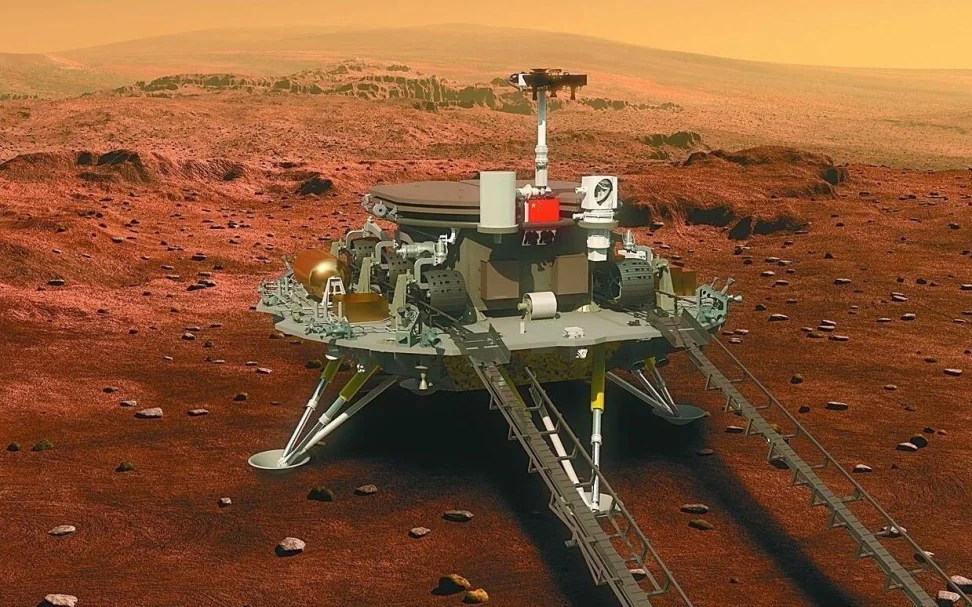
The United Arab Emirates’ fledgling space program took another step forward last month, securing an agreement to collaborate on China’s planned Chang’e 7 lunar mission, set to land near the Moon’s south pole in 2026. The Mohammed bin Rashid Space Center (MBRSC) in Dubai will build a small robotic rover, which will hitch a ride on the Chang’e 7 lander, according to the agreement signed Sept. 16 between MBRSC and the China National Space Administration (CNSA).

Space Stories: Early Galaxies, Early Life on Mars, and Gold-Rich Stars

Image (Credit): Two of the farthest galaxies seen to date are captured in these Webb Space Telescope pictures of the outer regions of the giant galaxy cluster Abell 2744. The galaxies are not inside the cluster, but many billions of light-years farther behind it. The galaxy labeled (1) existed only 450 million years after the big bang. The galaxy labeled (2) existed 350 million years after the big bang. Both are seen really close in time to the big bang which occurred 13.8 billion years ago. These galaxies are tiny compared to our Milky Way, being just a few percent of its size, even the unexpectedly elongated galaxy labeled (1). (NASA, ESA, CSA, Tommaso Treu (UCLA), Zolt G. Levay (STScI))

Here are some recent stories of interest.

NASA: “NASA’s Webb Draws Back Curtain on Universe’s Early Galaxies

With just four days of analysis, researchers found two exceptionally bright galaxies in the GLASS-JWST images. These galaxies existed approximately 450 and 350 million years after the big bang (with a redshift of approximately 10.5 and 12.5, respectively), though future spectroscopic measurements with Webb will help confirm…“These observations just make your head explode. This is a whole new chapter in astronomy. It’s like an archaeological dig, and suddenly you find a lost city or something you didn’t know about. It’s just staggering,” added Paola Santini, fourth author of the Castellano et al. GLASS-JWST paper.

University of Copenhagen: “The First Life in Our Solar System May Have Been on Mars

When Mars was a young planet, it was bombarded by ice asteroids delivering water and organic molecules necessary for life to emerge. According to the professor behind a new study, this means that the first life in our solar system may have been on Mars.

National Astronomical Observatory of Japan: “Gold-rich Stars Came from Ancient Galaxies

Recently, hundreds of gold-rich stars have been detected by state-of-the-art telescopes worldwide. New simulations of galaxy formation, with the highest resolution in both time and mass, show that these gold-rich stars formed in progenitor galaxies, small galaxies which merged to create the Milky Way…According to the research, most gold-rich stars formed over 10 billion years ago in small, building-block galaxies―known as progenitor galaxies. Some but not all progenitor galaxies experience a neutron star merger, where large amounts of heavy r-process elements are produced and released, enriching that particular small galaxy. The predicted abundance of gold-enriched stars in the final Milky-Way-sized galaxy matches what is actually observed.

Space Stories: Challenger Debris Located, Chinese Mars Engine, and Risky Trip to the Space Station

Image (Credit): Space shuttle Challenger landing at Edwards Air Force Base in California on Nov. 6, 1985. (NASA)

Here are some recent stories of interest.

NASA: “NASA Views Images, Confirms Discovery of Shuttle Challenger Artifact

NASA leaders recently viewed footage of an underwater dive off the East coast of Florida, and they confirm it depicts an artifact from the space shuttle Challenger. The artifact was discovered by a TV documentary crew seeking the wreckage of a World War II-era aircraft. Divers noticed a large humanmade object covered partially by sand on the seafloor. The proximity to the Florida Space Coast, along with the item’s modern construction and presence of 8-inch square tiles, led the documentary team to contact NASA.

Space.com:China Just Test-fired the Engine for its Huge New Moon and Mars Rocket

China has completed a first hot fire test of a fully-assembled powerful new engine that could power new launch vehicles and boost the country’s space capabilities. The full system test of the 500-ton-thrust, dual nozzle kerosene-liquid oxygen staged combustion cycle engine took place on Nov. 5, marking a milestone for the rocket engine. 

Phys.org:Cargo Ship Reaches Space Station Despite Jammed Solar Panel

A Northrop Grumman capsule delivered several tons of supplies to the International Space Station on Wednesday despite a jammed solar panel. The shipment arrived two days after launching from Virginia. Only one of the cargo ship’s two round solar panels opened following liftoff. Flight controllers tried in vain to open the stuck panel, but managed to draw enough power for the flight with just one.

Space Stories: A New Martian Crater, the Final Piece of China’s Space Station, and the Falcon Heavy Flies Again

Image (Credit): Recent impact crater on the surface of Mars. It was formed on December 24, 2011 in the Amazonis Planitia region. (NASA/JPL-Caltech/University of Arizona)

Here are some recent stories of interest.

NASA: “NASA’s InSight Lander Detects Stunning Meteoroid Impact on Mars

NASA’s InSight lander recorded a magnitude 4 marsquake last Dec. 24, but scientists learned only later the cause of that quake: a meteoroid strike estimated to be one of the biggest seen on Mars since NASA began exploring the cosmos. What’s more, the meteoroid excavated boulder-size chunks of ice buried closer to the Martian equator than ever found before – a discovery with implications for NASA’s future plans to send astronauts to the Red Planet.

Aljazeera: “Final Module Docks at China’s ‘Heavenly Palace’ Space Station

The final module required for the completion of China’s Tiangong space station has successfully docked with the core structure, state media say, a key step in Beijing’s ambitious plans for space exploration…The module – named Mengtian, which means “heavenly dream” – was launched on Monday on a Long March 5B rocket from the Wenchang launch centre on China’s tropical island of Hainan, CCTV reported.

Wall Street Journal: “SpaceX’s Falcon Heavy Rocket, World’s Most Powerful Rocket, Launches After Three-year Hiatus

SpaceX’s Falcon Heavy — a towering, three-pronged vehicle that is the most powerful operational rocket in the world — returned to the skies on Tuesday for the first time since mid-2019. The rocket launched at 9:41 a.m. ET from NASA’s Kennedy Space Center in Florida, hauling satellites to space for the US military in a secretive mission dubbed USSF-44.

Space Stories: Approaching Lucy, Chinese Space Ambitions, and Conan the Bacterium

Image (Credit): Image from NASA’s Lucy spacecraft showing the Earth and Moon from 890,000 miles away (look closely – the moon on the left is a very pale dot). (NASA/Goddard/SwRI)

Here are some recent stories of interest.

NASA.gov: “NASA’s Lucy Spacecraft Captures Images of Earth, Moon Ahead of Gravity Assist

On October 13, 2022, NASA’s Lucy spacecraft captured [the above] image of the Earth and the Moon from a distance of 890,000 miles (1.4 million km). The image was taken as part of an instrument calibration sequence as the spacecraft approached Earth for its first of three Earth gravity assists. These Earth flybys provide Lucy with the speed required to reach the Trojan asteroids — small bodies that orbit the Sun at the same distance as Jupiter. On its 12 year journey, Lucy will fly by a record breaking number of asteroids and survey their diversity, looking for clues to better understand the formation of the solar system.

SpaceNews.com: “China Considering Mission to Ceres and Large Dark Matter Space Telescope

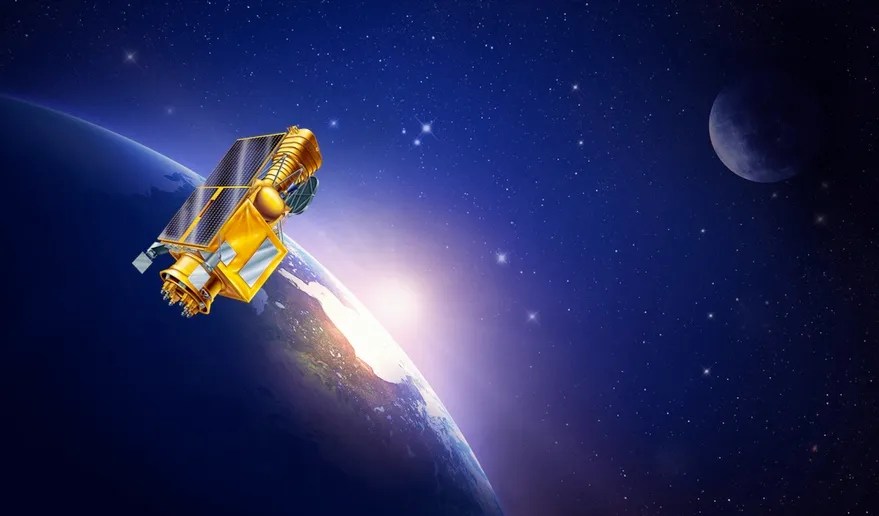
The Chinese Academy of Sciences is considering potential missions including a Ceres orbiter and a huge telescope to hunt for clues about the nature of dark matter. More than 20 candidates are vying for funding for further study under the Chinese Academy of Sciences Strategic Priority Program on Space Science, also known as the New Horizon Program, and are currently undergoing evaluation.

Space.com: “Extremophiles on Mars Could Survive for Hundreds of Millions of Years

One of Earth’s toughest microbes could survive on Mars, lying dormant beneath the surface, for 280 million years, new research has shown. The findings increase the probability that microbial life could still exist on the Red Planet. Deinococcus radiodurans, nicknamed “Conan the Bacterium,” is one of the world’s toughest microbes, capable of surviving in radiation strong enough to kill any other known life-form. Experiments have now shown that if Conan the Bacterium or a similar microbe existed on Mars, it could survive 33 feet (10 meters) beneath the surface, frozen and dried out, for 280 million years.