Audit Report: Artemis III May Not Be Possible Until 2027

The legislative branch’s audit arm, the Government Accountability Office (GAO), has some bad news regarding the Artemis mission to the moon – the landing on the Moon may need to wait until 2027.

Here is what the auditors said in their November 30 report, NASA Artemis Programs: Crewed Moon Landing Faces Multiple Challenges, about NASA’s delays:

As of September 2023, the Human Landing System program had delayed eight of 13 key events by at least 6 months. Two of these events have been delayed to 2025—the year the lander is planned to launch. The delays were caused in part by the Orbital Flight Test, which was intended to demonstrate certain features of the launch vehicle and lander configuration in flight. The test was delayed by 7 months to April 2023. It was then terminated early when the vehicle deviated from its expected trajectory and began to tumble. Subsequent tests rely on successful completion of a second Orbital Flight Test.

The Human Landing System was awarded to SpaceX, which has been having a few issues getting everything to work on schedule. Of course, this is just one of many issues that contribute to potential delays (such as the space suit), but I expect SpaceX does not want to be labeled as the drag on the program when we are trying to beat the Chinese to the Moon.

The audit report is comprehensive and serves as a warning that things are slipping and may continue to slip without sufficient attention.

Artemis represent an international effort to bring together the best parties from the government and private sector for something amazing. The Apollo missions to the Moon were run by one country as a central government program. This is a chance for everyone to shine using a whole new approach. We just need to keep up the momentum.

Space Stories: Japan Bolsters it Space Investments, The Next Starship, and Russia’s Declining Space Program

Image (Credit): Artist’s rendering of JAXA’s proposed lunar rover with Toyota. (Toyota/JAXA)

Here are some recent stories of interest.

Forbes: “Modern Space Race: Japan Pledges $6.6 Billion For Developing Space Sector As U.S. And China Plan Historic Missions

The Japanese government has said it will establish a $6.6 billion (¥1 trillion) fund to develop the country’s space industry as programs in the U.S., Russia, China and India rush to put men on the moon, build lunar sites and plan for the future of the International Space Station in a renewed race for celestial supremacy...Nikkei, a Japanese newspaper, reported that funding will be given to companies developing technologies that could be used to support national security or those that could rival Elon Musk’s SpaceX by developing rockets and “satellite constellations”—groups of satellites that operate as one system.

PayloadSpace.com: “SpaceX Announces a Starship Version Two is in the Works

With just two Starship integrated test flights under its belt, SpaceX announced last week it is already working on a major overhaul of its second-stage Starship vehicle. The design changes will be significant enough to speciate the ship, giving it the title of Version 2. SpaceX plans to finish and launch four or five additional Starship V1 prototypes before transitioning to its V2 product line, Elon Musk said on X. Insights gained from the upcoming flights will be integrated into the next-gen rocket.

Center for European Policy Analysis: “Russia’s Earthly Aggression Cripples its Celestial Plans

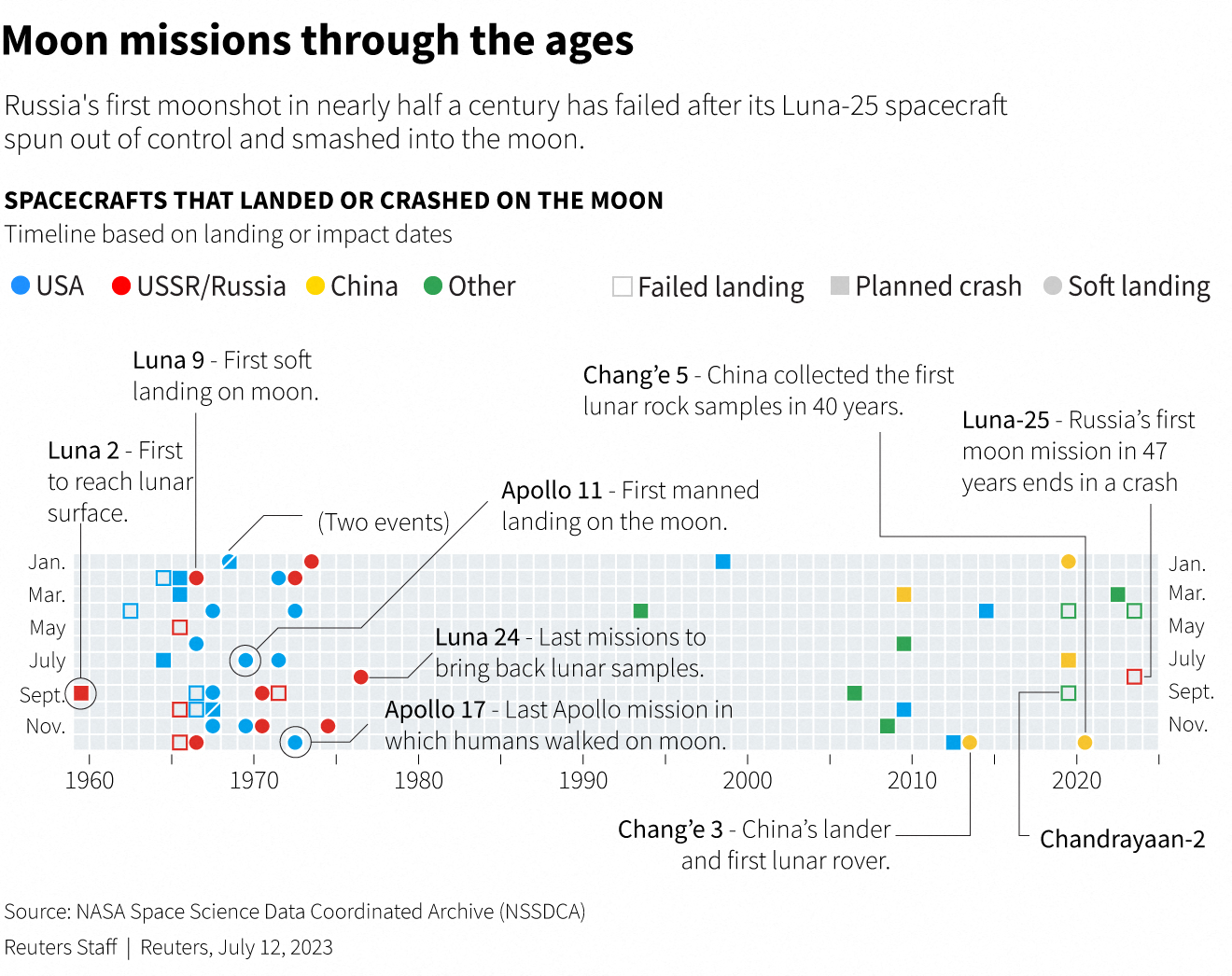
When the US imposed sanctions to degrade Russia’s aerospace industry, including embargoes on semiconductors, lasers, sensors, and navigation equipment, Dmitry Rogozin, then chief of Russia’s space program, warned it might cause the International Space Station to fall on the US or Europe. These comments and others from a supposedly serious scientific organization did cause a crash — the decades-old US-Russia space partnership was effectively ended after decades of joint work, including the Soviet era, that had benefited science, détente, and humanity. The events of 2022-2023 have made it more likely Russia would step away from exploration and, with China, focus on military applications in space. 

Note: The helpful graphic below is used in the Center for European Policy Analysis story.

Podcast: Are We Ready to Start Settlements Off-Planet?

Credit: Penguin Press

You may want to tune into another episode from The Planetary Society’s podcast Planetary Radio is you are pondering space settlements on the Moon and Mars. The recent program, A City on Mars, is a discussion with authors Kelly and Zach Weinersmith who wrote “A City on Mars: Can We Settle Space, Should We Settle Space, and Have We Really Thought This Through?

The bottom line is that we should not rush towards permanent settlements at either location until we know more about the human body, the human mind, and human politics (good luck with the last one).

The conversation covers a variety of risks, including the effects of gravity on the human body, the ability to procreate in space, and the effectiveness of treaties as nations plan to settle and mine the Moon and Mars. The authors note that we have not had ample time to study all of these issues even with the International Space Station (ISS) in orbit because this has not been the focus of many space efforts to date. For instance, the ISS does not test the impact of radiation on humans because it is in low Earth orbit within the protection of the planet’s magnetic field.

Overall, the authors advise time and more study before jumping into a settlement. This may mean putting off permanent settlements for a few hundred years.

And what about Elon Musk’s plan to start shipping colonists to Mars in his lifetime? As with many things related to Mr. Musk, he does oversell ideas. His energy in the infrastructure realm is good, but his predictions related to humanity in general are usually unreliable.

Image (Credit): Artist’s rendering of a Martian space city. (SpaceX)

Is Elon Musk Experiencing a Rapid Unscheduled Disassembly?

Image (Credit): 2015 explosion of a SpaceX Falcon 9 rocket. (ABC News)

SpaceX may have suffered a rocket loss yesterday, but everyone agrees that this is part of the process when trying something big.

What can we then say about Mr. Musk creating a second loss last week, but in this case it was a loss of confidence in his leadership at Twitter (yes, the site is also oddly called “x” even though the web address is still twitter.com)? Is that also part of the process when trying something big, or is he simply becoming a loss leader that is getting in his own way. And, more importantly to this site, is he squandering his other assets, including SpaceX?

The latest incident involves his support of an earlier post on Twitter that defamed the American Jewish community. It is unclear why Mr. Musk cannot act like an adult and focus on his businesses, but his actions have led to multiple firms pulling their advertising dollars from Twitter.

I agree his irresponsible behavior is nothing new, but it is starting to raise even more eyebrows as his businesses become more entangled with US Government missions. He is not just pushing a declining social app and electric cars, but rather he is also launching critical military satellites, bringing astronauts to the International Space Station, and planning to heavily support our return to the Moon.

Exhibit A – Kelsey D. Atherton, Chief Editor at the Center for International Policy, had this to say recently about Mr. Musk and SpaceX:

In the immediate term, Congress needs to investigate whether Musk’s public comments present a breach of contract on ethical or reliability grounds. Congress could require that any company that receives launch contracts must go public, ensuring at least some mechanism for shareholders to oust a CEO should they become a public or security liability.

I recommend reading the entire article. It is one voice at the moment, but the evidence is growing that Mr. Musk may be the wrong person to rely on in these times when he clearly cannot control himself. His “Rapid Unscheduled Disassembly” is painful to watch and something we need to guard against.

Starship Self-Destructs on Second Launch Attempt

Image (Credit): Starship hot-staging separation earlier today. (SpaceX)

Earlier today, SpaceX lost contact with its Starship rocket about 10 minutes into the launch. This happened after the second-stage separation, so while a successful landing of the rocket did not occur, the rocket had more success than the launch earlier this year.

After what appeared to be a self-detonation of the Starship rocket, the Federal Aviation Administration stated, “The anomaly resulted in a loss of the vehicle. No injuries or public property damage have been reported.” That includes the launchpad, which was basically destroyed during the last launch.

Baby steps.

It is not clear if this latest incident will lead to another long delay before another attempt is possible. And such tests are increasingly expensive when your reusable parts continue to blow up rather than land.

A lot is riding on these launches, as well as the reusable feature, given that NASA is estimating that as many as 20 Starship launches will be necessary under the Artemis III moon mission. Of course, if someone asked NASA to schedule 20 Space Launch System launches in this way, I doubt we would even be talking about an Artemis program.

Mr. Musk has promised a lot to the US space program. We need his full attention on this project.