Space Stories: Venusian Balloons, Sun Observations, and a Private Moon Trip

Image (Credit): Test of the one-third scale prototype aerobot designed to withstand the corrosive chemicals in Venus’ atmosphere. (Near Space Corporation)

Here are some recent stories of interest.

NASA.gov: “JPL’s Venus Aerial Robotic Balloon Prototype Aces Test Flights

A scaled-down version of the aerobot that could one day take to the Venusian skies successfully completed two Nevada test flights, marking a milestone for the project…The shimmering silver balloon ascended more than 4,000 feet (1 kilometer) over Nevada’s Black Rock Desert to a region of Earth’s atmosphere that approximates the temperature and density the aerobot would experience about 180,000 feet (55 kilometers) above Venus. Coordinated by Near Space, these tests represent a milestone in proving the concept’s suitability for accessing a region of Venus’ atmosphere too low for orbiters to reach, but where a balloon mission could operate for weeks or even months.

SkyandTelescope.org: “‘Chinese Observatory Will Study Violent Events on the Sun

China has launched a solar observatory to study solar flares and eruptions, and their connection with the Sun’s magnetic field…[the Advanced Space-based Solar Observatory (ASO-S)] is planned to operate at 720 kilometers (447 miles) above Earth’s surface in a Sun-synchronous orbit that will allow it to observe the Sun at all times. Its primary, four-year mission is timed to make the most of the 2024–2025 solar maximum, when the Sun is at its most active during its 11-year cycle.

Space.com: “‘SpaceX Says its 2nd Private Starship Trip Around the Moon will Help Make Humanity Multiplanetary

SpaceX’s newly announced tourist mission to the moon could help humanity extend its footprint far beyond Earth, company representatives say. That mission, which was revealed today (Oct. 12), will send wealthy entrepreneur Dennis Tito, his wife Akiko and 10 other people on a weeklong journey around the moon aboard SpaceX’s huge Starship vehicle, which is still in development. Who those 10 other passengers will be is unknown; only the Titos have reserved seats at the moment.

A Day in Astronomy: Launch of the Orbiting Solar Observatory 7

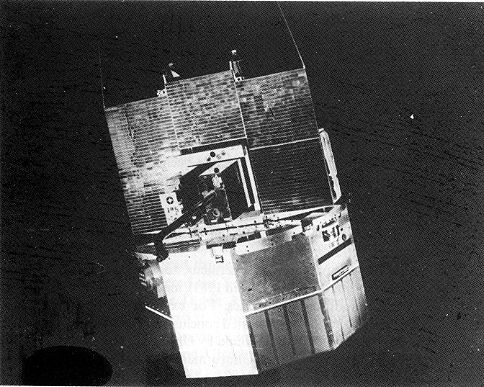
Image (Credit): Artist’s impression of NASA’s Orbiting Solar Observatory 7 circling the Earth. (NASA)

On this day in 1971, NASA launched the Orbiting Solar Observatory 7 satellite to study the Sun. It successfully completed its mission and remained in orbit through July 9, 1974.

According to a December 31, 1972 report by Ball Brothers Research Corporation, the goal of the Orbiting Solar Observatory program was to make observations and measurements contributing to:

  • Determination of details of the sun’s atmospheric structure, composition and physical state and the process of energy transport radially outward and inward;
  • Determination of origin, energy supply, and solar/terrestrial consequences of transient solar phenomena such as sun spots, flares, radio bursts, and particle bursts;
  • Prediction of transient solar events and their consequences by combining data with those from other spacecraft, rockets, balloons, and ground-based observations; and
  • Secondary objectives including study of the earth and celestial objects.

You can read more about the Orbiting Solar Observatory 7 mission here.

NASA launched eight successful Orbiting Solar Observatory missions in all, but the program had some problems along the way. One satellite launched in 1965 failed to reach orbit, with the satellite burning up in the atmosphere. In another case, a rocket motor test in 1964 went awry, killing three men and wounding eight others.

Astronomy Ideas on Borrowed Time?

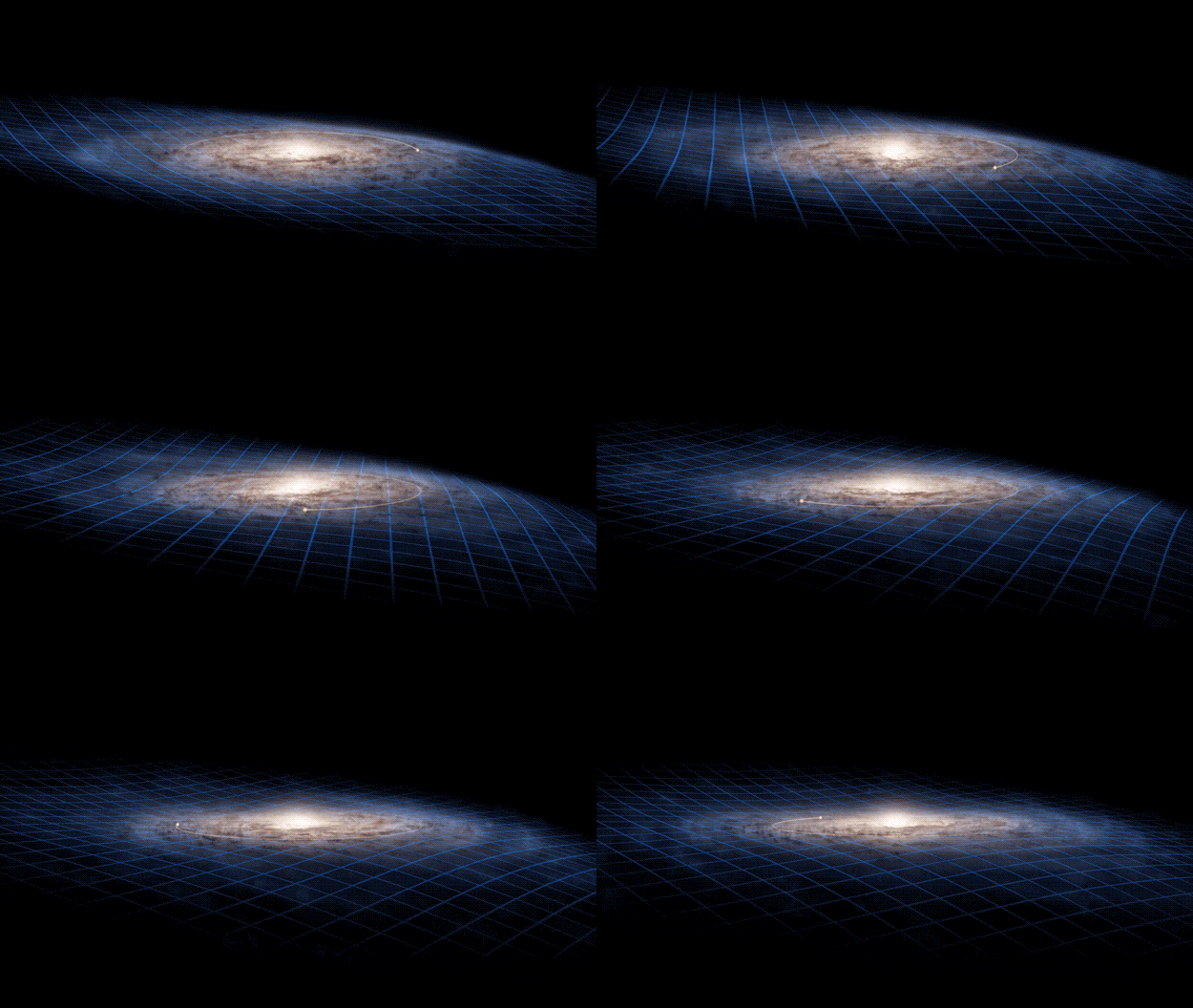
Image (Credit): The position of our Sun as it orbits the Milky Way’s center. (Stefan Payne-Wardenaar)

A recent Big Think story, “5 Consensus Ideas in Astronomy That Might Soon be Overturned,” comes as a good time as we reach further into space and back into time using the James Webb Space Telescope (JWST) and contemplate other telescopes that should come online shortly.

The story highlights these five ideas:

  • Dark energy is a cosmological constant;
  • Stars predate black holes;
  • Jovian planets protect terrestrial ones;
  • Most of the galaxy is uninhabitable; and
  • Globular clusters are planet-free.

For instance, regarding the uninhabitable areas of the galaxy, the Big Think story states:

Among its many discoveries, the ESA’s Gaia mission has found that the Milky Way galaxy not only has a warp to its galactic disk, but that the warp in the disk precesses and wobbles, completing a full rotation for roughly every three revolutions of the Sun [shown in yellow above] around the galactic center. Most astronomers assume that regions with too many stellar cataclysms in them, like the centers of galaxies, may be completely uninhabitable. But this picture is far from certain.

It is worth reading through the list and keeping these ideas in mind, and then following the JWST stories as they unfold. I bet you will be able to make a much longer list as old consensus ideas come apart and new ideas quickly follow.

Pic of the Week: Martian Eclipse

Image (Credit): Eclipse of the Sun by Phobos from the surface of Mars. (NASA/JPL-Caltech/ASU/MSSS/SSI)

This week’s pic is actually a video from NASA’s Perseverance Mars rover capturing Phobos as it partially blocks out the sun. You can see the video here and read more from NASA here.

It is certainly more dramatic than the two shots below from the Martian rover Opportunity in 2004. Deimos is just a speck within the image on the left.

Image (Credit): Eclipse of the Sun by Deimos (left) and Phobos (right) from the surface of Mars. (NASA/JPL/Cornell)

Largest Comet to Date Approaching the Sun

Image (Credit): Comparison of comet C/2014 UN271 (Bernardinelli-Bernstein) to several other comets. (NASA, ESA, Zena Levy (STScI))

A monster comet that takes 3 million years to circle the Sun is being closely analyzed by astronomers. The comet, C/2014 UN271 (Bernardinelli-Bernstein), will come closest to the Sun in 2031, but even then it will be about 1 billion miles away. At the most distant point in its orbit, the comet is about half a light year away from the Sun.

As shown in the graphic above, this is a large comet that could fully cover the state of Rhode Island. It was first detected by astronomers back in November 2010, when it was still 3 billion miles from the Sun. With the help of the Hubble Space Telescope, the astronomers were able to learn more about it this year.

The comet is believed to be a product of the Oort Cloud circling far outside our solar system. Of course, the Oort Cloud itself is a theory that has never been directly observed. But what about the Voyager spacecraft that left our solar system? Well, if you are willing to wait another 300 years, and the spacecraft are still working, you may have an answer.

You can read more about the comet at this NASA site.