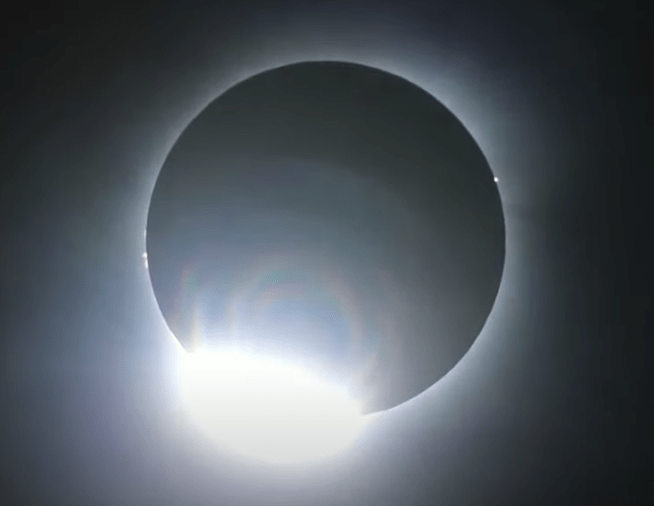
Image (Credit): TheTotal Solar Eclipse as seen in Houlton, Maine. (David Bowman of NASA Langley Research Center)
If you missed the Total Solar Eclipse or just want to see what it looked like in other parts of the country, NASA and other observatories have you covered. Check out the NASA video, “2024 Total Solar Eclipse: Through the Eyes of NASA (Telescope Feed),” showing the eclipse from Texas to Maine.
No good astronomical event happens without accompanying pain, or so it would seem given all of the news stories about tomorrow’s eclipse. We are hearing plenty of stories about overpriced hotels, traffic jams, and even the intervention of FEMA. Just wait until you hear all of the stories about people who paid a fortune to find the eclipse blocked by clouds.
Here are a few of the crazy headlines from the areas impacted by the pending eclipse:
As far as hotel rooms, The Guardian news story above states:
Amid the clamor for accommodation, one travel agency said it had been forced to rearrange lodging for more than 150 people after bookings made two years earlier at two Buffalo hotels were canceled. Rooms that had cost $129 to $159 were canceled and resold at $450 or more, according to Sugar Tours, owner, Chris Donnelly, who said it was “total price gouging”.
It is all pretty silly, but no one wants to be left out. NASA will have the better pictures and eclipse details, given its planned rocket launches, yet these folks need something for Facebook or Instagram.
I do not really care for the crowds, so I will await the press stories and NASA images. Nonetheless, for those who feel the need to be on the front lines, I wish them a safe trip with clear skies.
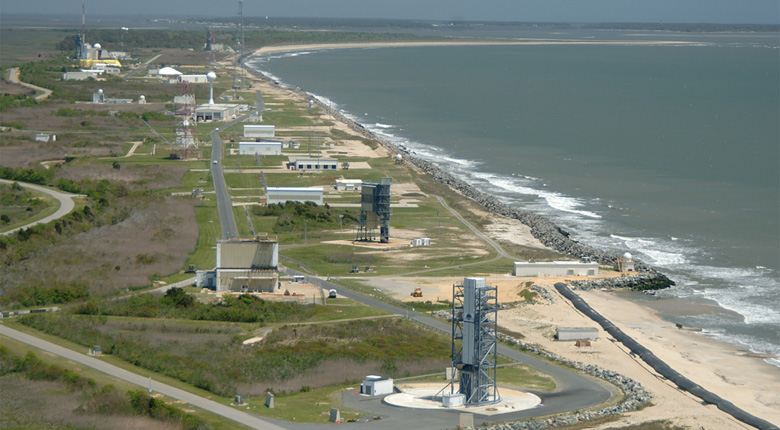
Image (Credit): NASA’s Wallops Flight Facility in Virginia. (Timmons Group)
While Virginia will not be in the direct path of the upcoming Total Solar Eclipse, it will be playing a role related to the eclipse that day.
NASA’s Wallops Flight Facility on the Virginia coast will be launch three rockets to study disturbances in the Earth’s ionosphere during the eclipse. The rockets will be launched 45 minutes before, during, and 45 minutes after the peak local eclipse.
These launches are part of NASA’s Atmospheric Perturbations around Eclipse Path (APEP) mission. Such launches during an eclipse are not unusual as NASA hopes to learn a few things from this study.
Aroh Barjatya, a professor of engineering physics at Florida’s Embry-Riddle Aeronautical University campus, stated:
Understanding the ionosphere and developing models to help us predict disturbances is crucial to making sure our increasingly communication-dependent world operates smoothly.
Credit: New York Department of Economic Development
This week’s image comes from the great state of New York, which is advertising the upcoming Total Solar Eclipse on April 8.
New York is one of the state’s that will experience the eclipse, and the New York Department of Economic Development is not missing the chance to ensure everyone knows this.
A handy map also provides the timing of the eclipse in each city.
Credit: New York Department of Economic Development
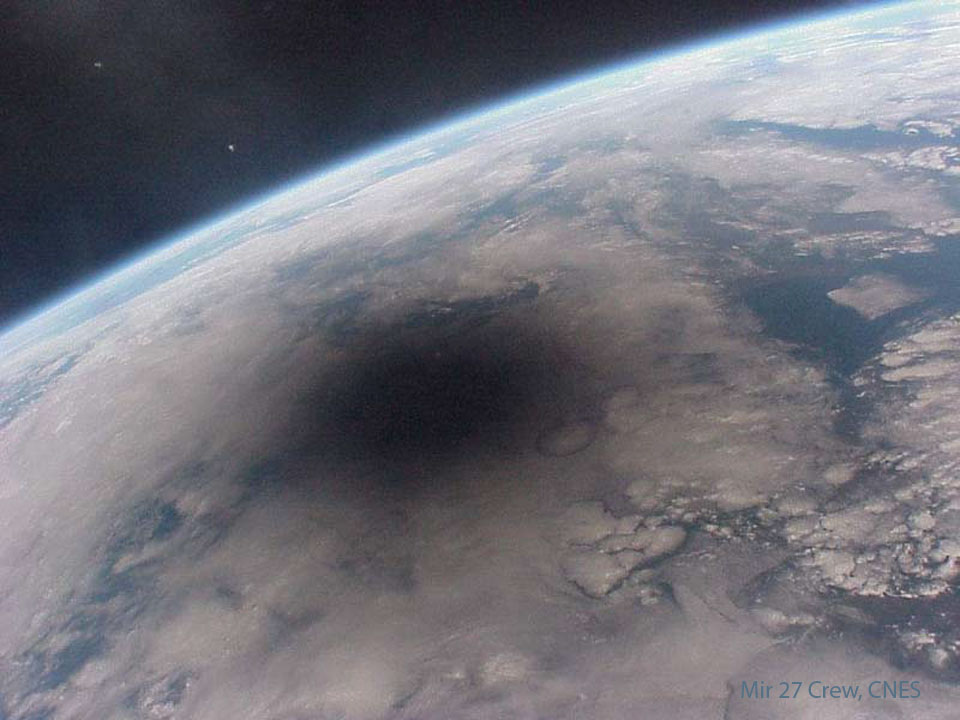
Image (Credit): A view of the Moon’s shadow on Earth during the solar eclipse on August 11, 1999. The image was captured by Russia’s Mir space station. (Mir 27 Crew)
On April 8, should you be outside staring at the Total Solar Eclipse, you may want to take a few precautions so that you can witness future eclipses as well. In other words, protect your eyes!
NASA has provided a few tips related to photographing the eclipse. Please keep all of this in mind.
For instance, NASA notes:
Looking directly at the Sun is dangerous to your eyes and your camera. To take images when the Sun is partially eclipsed, you’ll need to use a special solar filter to protect your camera, just as you’ll need a pair of solar viewing glasses (also called eclipse glasses) to protect your eyes. However, at totality, when the Moon completely blocks the Sun, make sure to remove the filter so you can see the Sun’s outer atmosphere – the corona.