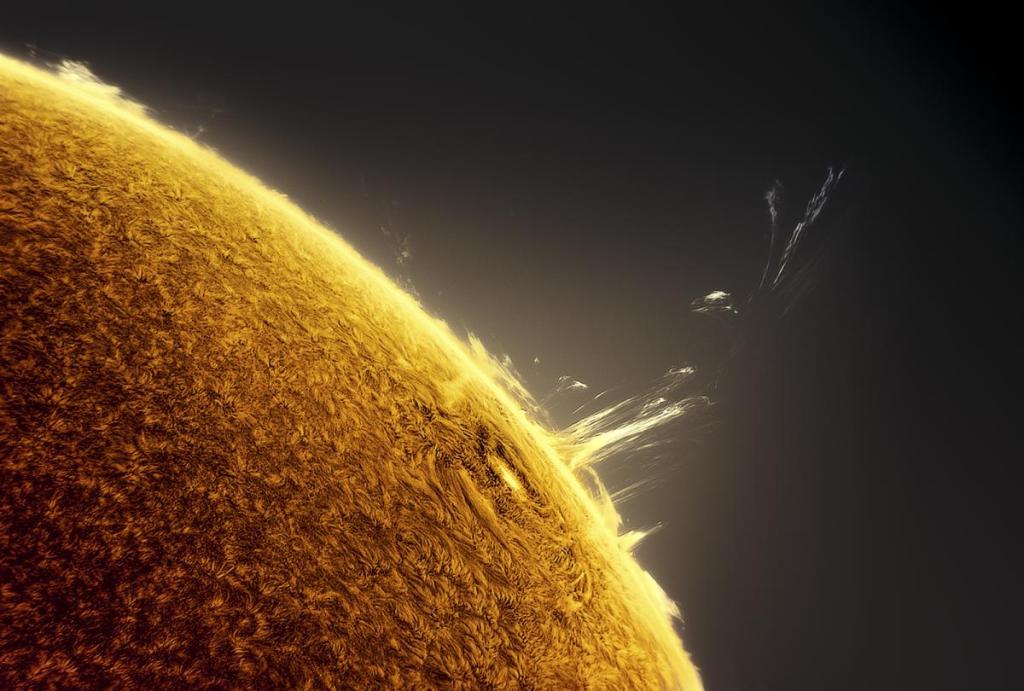
Image (Credit): Solar Flare X1 from AR2994 in ‘Motion.’ (Miguel Claro)
This week’s image is one of the finalist photos in the 2023 Astronomy Photographer of the Year shortlist held by the Royal Museums Greenwich. Check out the site for other fascinating finalist images.
Here is a little more about this solar flare image from photographer Miguel Claro taken in the Dark Sky Alqueva region, Évora district, Portugal:
“I was testing my new camera from Player One Apollo-M Max and photographing another region of the Sun, when I was notified by the SpaceWeatherLive app that an eruption was ongoing at 13.47 (UTC, Universal Time) with the release of an extraordinary X1-class solar flare [X class flares are the largest],” Miguel says.
“I had to immediately change my initial plans and pointed the telescope as quickly as possible to the limb where the flare departed from sunspot AR2994, already hidden behind the edge of the Sun. According to SpaceWeatherLive, ‘the explosion produced enough radiation for a strong shortwave radio blackout over the mid-Atlantic ocean and Europe’. Conditions were unstable, but I managed to make a short timelapse of about 27 minutes.”
The ESA (European Space Agency) and SpaceX are targeting no earlier than 11:11 a.m. EDT (8:11 a.m. PDT) Saturday, July 1, to launch the Euclid spacecraft. Euclid is an ESA mission with contributions from NASA that will shed light on the nature of dark matter and dark energy, two of the biggest modern mysteries about the universe.
An intrepid space mission had another brief glimpse of its final destination this week, as the European Space Agency’s BepiColombo flew past Mercury for a third time. The team confirms that the spacecraft is in good health post flyby, and that all instruments performed as planned. “Everything went very smoothly with the flyby and the images from the monitoring cameras taken during the close-approach phase of the flyby have been transmitted to the ground,” said Ignacio Clerigo (ESA) in a recent press release. “While the next Mercury flyby isn’t until September 2024, there are still challenges to tackle in the intervening time.”
An international team of astronomers has discovered a planet-like object that is hotter than the sun. Their report has been accepted for publication in the journal Nature Astronomy and is currently available on the arXiv pre-print server. Brown dwarfs are sometimes called failed stars and do not qualify for the category of either a planet or a star. In this new effort, the researchers have identified one that orbits a star so closely that its temperature is hotter than our sun.
Image (Credit): The ISS before the Sun. (Thierry Legault)
This week’s image was taken by French astrophotographer Thierry Legault. It shows the International Space Station (ISS) transiting the Sun on June 9th. The other three dark objects are sun spots.
At the time this image was taken, two NASA astronauts, Stephen Bowen and Warren “Woody” Hoburg, were installing a new solar array on the station.
Image (Credit): NGC 1333 as captured by the Hubble Space Telescope. (NASA, ESA, STScI)
This week’s image is from the Hubble Space Telescope. It captures the colorful, star-filled NGC 1333, which is about 960 light-years away. Quite a lot is going on in this image – both seen and unseen.
This explanations from the European Space Agency (ESA) will hopefully answer many of your questions regarding this image:
Hubble’s colourful view, showcasing its unique capability to obtain images in light from ultraviolet to near-infrared, unveils an effervescent cauldron of glowing gases and pitch-black dust stirred up and blown around by several hundred newly forming stars embedded within the dark cloud. Even then, Hubble just scratches the surface; most of the star-birthing firestorm is hidden behind clouds of fine dust — essentially soot — that are thicker toward the bottom of the image. The black areas of the image are not empty space, but are filled with obscuring dust.
To capture this image, Hubble peered through a veil of dust on the edge of a giant cloud of cold molecular hydrogen — the raw material for fabricating new stars and planets under the relentless pull of gravity. The image underscores the fact that star formation is a messy process in a rambunctious Universe.
Ferocious stellar winds, likely from the bright blue star at the top of the image, are blowing through a curtain of dust. The fine dust scatters the starlight at blue wavelengths.
Farther down, another bright super-hot star shines through filaments of obscuring dust, looking like the Sun shining through scattered clouds. A diagonal string of fainter accompanying stars looks reddish because the dust is filtering their starlight, allowing more of the red light to get through.
The bottom of the picture presents a keyhole peek deep into the dark nebula. Hubble captures the reddish glow of ionised hydrogen. It looks like the finale of a fireworks display, with several overlapping events. This is caused by pencil-thin jets shooting out from newly forming stars outside the frame of view. These stars are surrounded by circumstellar discs, which may eventually produce planetary systems, and powerful magnetic fields that direct two parallel beams of hot gas deep into space, like a double lightsaber from science fiction films. They sculpt patterns on the hydrogen cocoon, like laser lightshow tracings. The jets are a star’s birth announcement.
This view offers an example of the time when our own Sun and planets formed inside such a dusty molecular cloud, 4.6 billion years ago. Our Sun didn’t form in isolation but was instead embedded inside a mosh pit of frantic stellar birth, perhaps even more energetic and massive than NGC 1333.
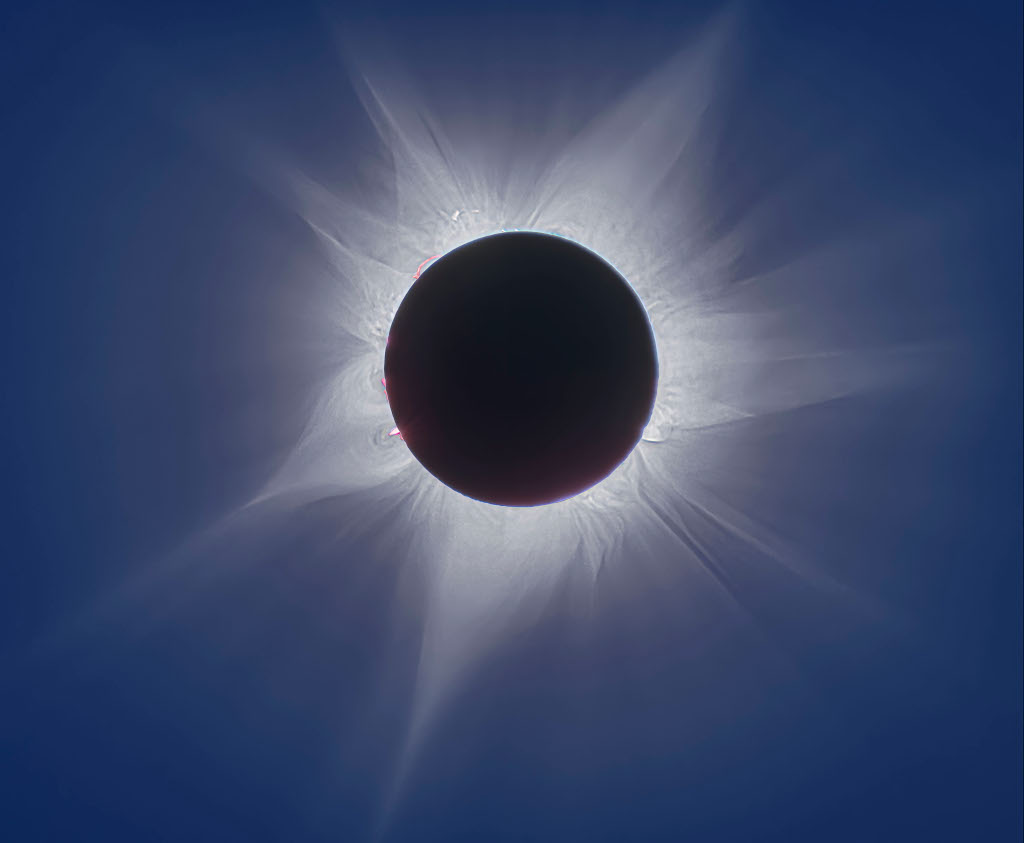
Along a narrow path that mostly avoided landfall, the shadow of the New Moon raced across planet Earth’s southern hemisphere on April 20 to create a rare annular-total or hybrid solar eclipse. From the Indian Ocean off the coast of western Australia, ship-borne eclipse chasers were able to witness 62 seconds of totality though while anchored near the centerline of the total eclipse track. This ship-borne image of the eclipse captures the active Sun’s magnificent outer atmosphere or solar corona streaming into space. A composite of 11 exposures ranging from 1/2000 to 1/2 second, it records an extended range of brightness to follow details of the corona not quite visible to the eye during the total eclipse phase. Of course eclipses tend to come in pairs. On May 5, the next Full Moon will just miss the dark inner part of Earth’s shadow in a penumbral lunar eclipse.