Starlink: DOD Pays for Ukrainian Service

Image (Credit): Map of Ukraine. (BBC News)

Elon Musk got his way. The US Department of Defense (DOD) will be paying an undisclosed amount for the Starlink services being used in Ukraine. This is good news for the Ukrainians had they feared interruption of this vital link with the rest of the world, yet I imagine this will also put SpaceX’s Starlink system at greater risk given that it now is a clearly a subcontractor to the US defense initiatives.

As the media has pointed out, Musk started to cut back on Starlink services to make a point about it being used as part of the war, with one Senator noting:

I was personally disappointed to see discontinuation of full services at such a critical time for Ukraine self-defense…Do you feel there’s a connection between the availability of this capability to our partners in Ukraine in this conflict, and relationships we have with companies like SpaceX?

It appears the relationship has improved now that DOD has opened its checkbook. I guess the next move will be taken by the Russians. And if the past is any guide, things may get ugly.

If You Thought the Skies Were Crowded, Just Wait

Credit: Starlink.

The Washington Post recently published a story, “China’s military aims to launch 13,000 satellites to rival Elon Musk’s Starlink,” that can only terrify astronomers here on Earth trying to view the stars. The title says it all – the space race continues to clutter the skies with more and more low-Earth satellites broadcasting back to the surface. It is a dippy Dyson Sphere that contains scientists rather than energy.

Starlink’s success in Ukraine really bothers the Chinese, who see the network as a lifeline for Taiwan as well. The article quotes Chinese military researchers, who state:

Once the Starshield is completed, it will be tantamount to installing networked surveillance cameras all over the world. At that time, military operations including the launch of ballistic missiles, hypersonic missiles and fighter jets will hardly escape the monitoring of the United States.

I would prefer the space race between the US and China focused on the Moon or Mars rather than local invasions, but that is the state of the world at the moment. Not that the race to the Moon was a completely tame affair. For instance, the US contemplated exploding a nuclear bomb on the surface of the Moon to impress the Russians and everyone else. Fortunately, Project A119 never happened.

Good Article: The Sad State of Russia’s Space Program

Image (Credit):  A destroyed Russian tank in the village of Dmytrivka, Ukraine. (CNN/Alex Chan Tsz Yuk/SOPA Images/Sipa/Reuters)

Wired magazine’s latest article, “Russia’s Space Program Is in Big Trouble,” summarizes a sad trend since Russia’s invasion of Ukraine. With all of the nation’s attention on an unnecessary war, the space program, like many things nowadays in Russia, has taken a back seat.

Problems can be seen with the spacecraft – two Russian capsules at the International Space Station (ISS) sprung leaks – as well as ground control. Assets at Russia’s spaceport in Kazakhstan are being seized, while corruption and other problems are delaying a new spaceport within Russia’s borders.

Russia also lacks a partner for a new space station after the ISS, and its mission to the Moon with China look’s tenuous. Does the country have a plan for the future beyond militarizing space?

The article concludes with these words:

The Soviet Union may have put the first human into space—but now, 60 years later, Russia faces a near-future in which it is no longer able to do that. 

No Pyrrhic victory in Ukraine will change this.

Extra: The Wall Street Journal also had a good article about the situation in Russia. The article, “Russia’s Economy is Starting to Come Undone,” includes an interview with Oleg Mansurov, who hoped to create the next SpaceX with his company SR Space. However, the situation in Ukraine has caused his investors to flee. As a result, he is staying afloat as an IT company for now. He notes:

We became more focused not on the development of a long-term product that would make some kind of qualitative leap but on simply becoming a classic business and generating revenue…We understood we just had to survive.

Top Astronomy Stories in 2022

Image (Credit): The stellar nursery 30 Doradus, nickname of the Tarantula Nebula, captured by the James Webb Space Telescope. (webb.nasa.gov)

Given that 2022 was a busy year, I thought I would highlight the top astronomy stories on the site – the good and the bad covering space missions to TV shows. Unlike other websites, I waited until the new year to create the list just in case we were visited by extraterrestrials. In this way, we now have a full catalog of the 2022 happenings.

Here is the list in no particular order other than science first, politics and commercial space second, and entertainment third.

  1. James Webb Space Telescope begins operation – see site link here;
  2. Double Asteroid Redirection Test (DART) successfully shifts the course of an asteroid pair – see site link here;
  3. Artemis I Orion capsule successfully orbits the Moon – see site link here;
  4. Commercial satellites become an increasing threat to Earth-based telescopes – see site link here;
  5. China completes its first space station – see site link here;
  6. Boeing is closer to being the second U.S. company to send astronauts to the International Space Station – see site link here;
  7. Ukraine invasion derails the Russian space program – see site link here;
  8. Russia reconfirms support for International Space Station – see site link here;
  9. Star Trek gets it right by returning to the past with Strange New Worlds – see site link here; and
  10. Star Wars gets it right with its new Andor series. – see site link here.

I cannot wait to see what 2023 will bring.

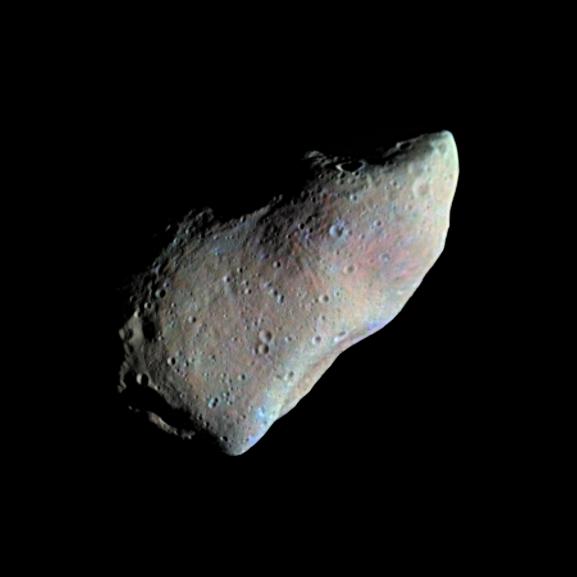
A Day in Astronomy: Visit to Asteroid Gaspra

Image (Credit): Asteroid Gaspra in the asteroid belt, visited by the Galileo spacecraft on its way to Jupiter. (NASA/JPL/USGS)

On this day in 1991, NASA’s Galileo spacecraft flew by asteroid Gaspra, which is located in the asteroid belt between Mars and Jupiter. Galileo conducted a quick fly-by while flying towards Jupiter and its moons. The spacecraft also visited the asteroid Ida.

Asteroid Gasprawas first discovered back in 1916 by Russian astronomer G. N. Neujmin, who decided to name it after the Black Sea retreat of Gaspra, a Ukrainian spa town currently occupied by the Russians.

Here is some additional information from NASA about the asteroid, which has similar features to the asteroids now serving as moons to Mars (Phobos and Deimos):

A striking feature of Gaspra’s surface is the abundance of small craters. More than 600 craters, 100-500 meters (330-1650 feet) in diameter are visible here. The number of such small craters compared to larger ones is much greater for Gaspra than for previously studied bodies of comparable size such as the satellites of Mars. Gaspra’s very irregular shape suggests that the asteroid was derived from a larger body by nearly catastrophic collisions. Consistent with such a history is the prominence of groove-like linear features, believed to be related to fractures. These linear depressions, 100-300 meters wide and tens of meters deep, are in two crossing groups with slightly different morphology, one group wider and more pitted than the other. Grooves had previously been seen only on Mars’s moon Phobos, but were predicted for asteroids as well.

You car read more about the overall Galileo mission here.

Image (Credit): Artist’s rendering of the Galileo spacecraft arriving at Jupiter. (NASA)