Space Stories: Astronomical Damage in Ukraine, An Awakened Black Hole, and Understanding Jupiter’s Giant Red Spot

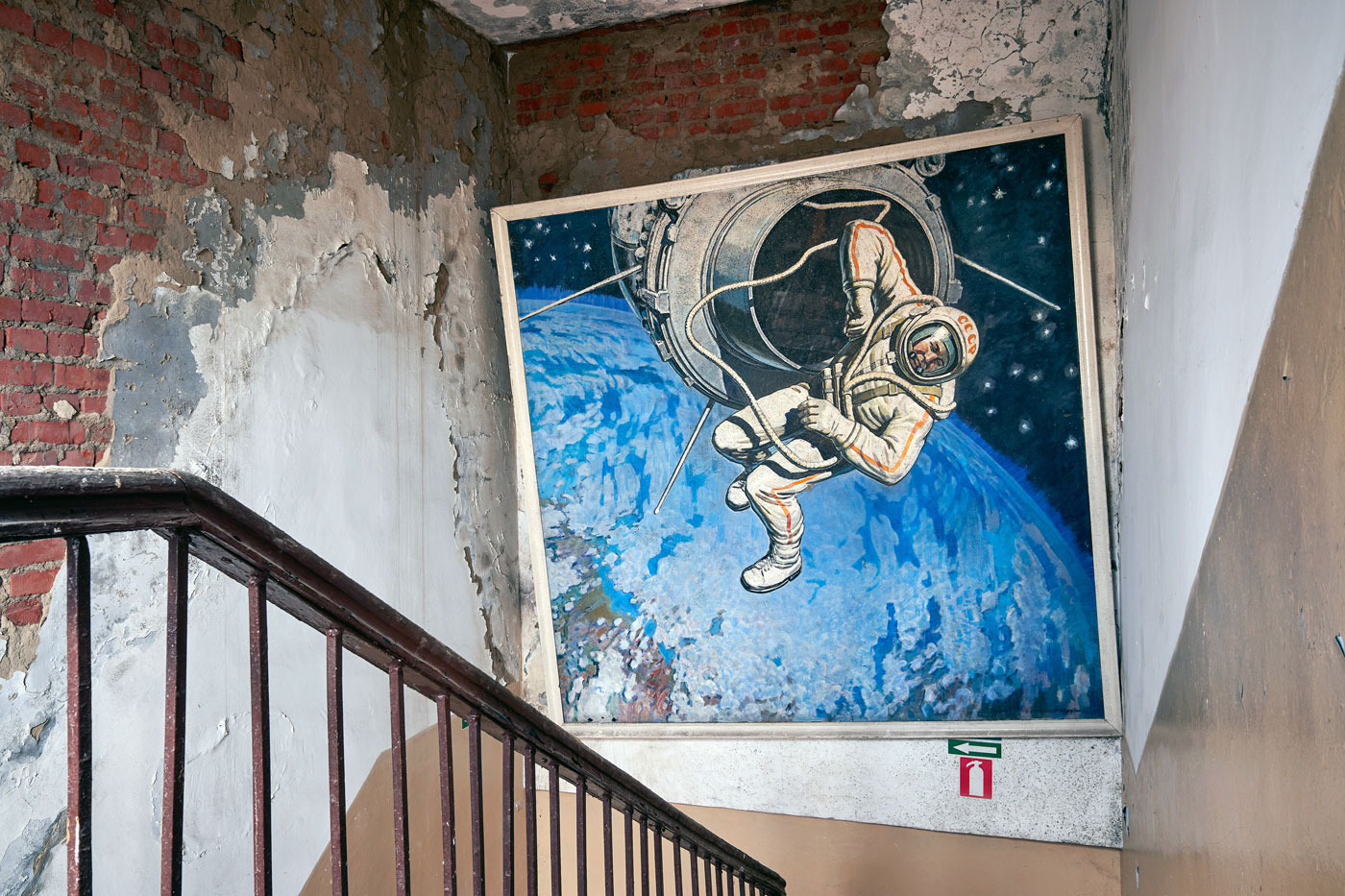
Image (Credit): Stairwell of the Braude observatory’s main building with a painting of Alexei Leonov, the Soviet cosmonaut who performed the first spacewalk in 1965. (Science.org/Eric Lusito)

Here are some recent stories of interest.

—Science.org: “A Shattered Window to the Radio Sky“

In November 2023, photographer Eric Lusito made a rare visit to the Braude Radio Astronomy Observatory near Kharkiv, Ukraine, once one of the nation’s flagship scientific facilities. Since his visit, the Kharkiv region, which was partly occupied by Russian forces in 2022 but liberated later that year, has again faced a renewed Russian assault. As of this writing, military specialists say that effort has stalled. Here is Lusito’s account of his visit.

—The Guardian: “Astronomers Detect Sudden Awakening of Black Hole 1m Times Mass of Sun“

The mysterious brightening of a galaxy far, far away has been traced to the heart of the star system and the sudden awakening of a giant black hole 1m times more massive than the sun. Decades of observations found nothing remarkable about the distant galaxy in the constellation of Virgo, but that changed at the end of 2019 when astronomers noticed a dramatic surge in its luminosity that persists to this day. Researchers now believe they are witnessing changes that have never been seen before, with the black hole at the galaxy’s core putting on an extreme cosmic light show as vast amounts of material fall into it.

—University of the Basque Country: “Establishing Age and Origin of Jupiter’s Great Red Spot“

As a popular icon among objects in the Solar System, Jupiter’s Great Red Spot (GRS) is probably the best-known atmospheric structure. Its large size (right now its diameter is that of the Earth) and the contrast of its reddish colour against the planet’s pale clouds make it an object that can be easily seen even with small telescopes…Speculation about the origin of the GRS dates back to the first telescopic observations made by the astronomer Giovanni Domenico Cassini, who in 1665 discovered a dark oval at the same latitude as the GRS and named it the ‘Permanent Spot’ (PS), since it was observed by him and other astronomers until 1713. Track of it was subsequently lost for 118 years and it was not until 1831 and later years that S. Schwabe again observed a clear structure, roughly oval in shape and at the same latitude as the GRS; that can be regarded as the first observation of the current GRS, perhaps of a nascent GRS.

Space Quote: More Musk Mayhem on the Ukrainian Front

“Musk has taken on the role of apologist for indicted war criminal Vladimir Putin. “There is no way in hell that Putin is going to lose,” Musk said during an audio event on X. Musk called on social media followers to lobby the Senate not to pass an aid package for Ukraine. Further, Musk is actively working to thwart US foreign policy. Musk is certainly entitled to voice his opinions. However, he is not authorized to conduct foreign policy with FCC issued licenses. This is especially true when his use of those licenses supports the military of a foreign power that is actively engaged in an illegal war and has engaged in countless war crimes including routinely targeting hospitals, schools, and apartment buildings. Musk’s company is licensed to serve the public interest, convenience, and necessity. Musk cannot use FCC licenses to militarily aid Russia, a state that is subject to U.S. sanctions. Musk’s repeated abuse of the Starlink system has placed these licenses in jeopardy.”

-Portion of the Ukrainian Congress Committee of America’s (UCCA) filing with the Federal Communications Commission on April 24, 2024. The UCCA represents four fraternal organizations – the Ukrainian National Association, the Ukrainian Workingmen’s Association, the Providence Association of Ukrainian Catholics, and the Ukrainian National Aid Association.

What is Musk Up to in Ukraine?

Image (Credit): A starlink satellite dish. (Visitukraine.today)

Last year we learned that Elon Musk denied the Ukrainians access to Starlink when operating in the occupied portions of their country. He stated he did not want to be “complicit in a major act of war and conflict escalation.” And yet now we learn that Russia may be using Starlink in this same territory to illegally attack Ukraine, and Mr. Musk seems flustered and cannot seem to believe it is even possible.

It is unlikely that SpaceX is unable to determine where its equipment is being operated and whether it is being used by an invading party to suppress a sovereign nation. Mr. Musk has done a lot of good for Ukraine, yet his statements about Ukraine’s need to give up territory and now this kerfuffle seem to be part of his improper straying into world affairs that are not his affairs. Maybe it is time for the U.S. government to get involved if he is allowing an enemy to use his equipment to destroy a U.S. ally.

When asked about this Russian misuse issue, SpaceX stated:

If SpaceX obtains knowledge that a Starlink terminal is being used by a sanctioned or unauthorized party, we investigate the claim and take actions to deactivate the terminal if confirmed.

Let’s hope this is the case. It may not be an easy task to sort out the users if both Ukranian and Russian troops are operating in the same area, but it may be critical to the survival of Ukranian forces at a time that Washington is sitting on its hands and incapable of assisting Ukraine nor its NATO partners depending on such assistance.

These are bleak times for Ukraine. It would be unfortunate if all the good will Starlink has acquired is erased with this misdirection of company assets.

Note: Former Congressman Adam Kinzinger tweeted, “Why is @elonmusk shilling for Russia now> Why is he still a US govt contractor?” None of this is good for Musk, SpaceX, or America.

Update: Now we read that Elon Musk may be blocking Taiwan’s use of Starlink. I thought the US government was running Starlink under a separate program called Starshield. Mr. Musk really needs to be taken out of the equation.

Space Stories: Preparing for a Commercial Space Station, Ukraine Protests New ISS Crew, and Metal 3D Printing in Space

Image (Credit): Artist’s rendering of the Starlab commercial space station in orbit. (Starlab Space)

Here are some recent stories of interest related to space stations.

—SpaceNews: “Starlab Commercial Space Station to Launch on Starship“

Starlab Space, the joint venture developing the Starlab commercial space station, has selected SpaceX’s Starship to launch the station on a single flight. Starlab Space, a joint venture of Voyager Space and Airbus Space and Defence, announced Jan. 31 it reached an agreement with SpaceX to launch the Starlab station on Starship. The companies did not disclose terms of the agreement or a projected launch date, although a spokesperson for Starlab Space said the company was confident that Starlab would be launched before the decommissioning of the International Space Station, currently scheduled for 2030.

—Kyiv Post: “Ex-Russian Military Officer Joins NASA for ISS Mission; Ukrainian Outrage Follows“

Alexander Grebenkin, a former Russian military officer and current Roscosmos cosmonaut, is set to travel to the International Space Station as part of the NASA team, as announced on the NASA website, where Ukrainians have commented their outrage. NASA, in collaboration with SpaceX, plans to launch Crew-8 to the International Space Station no earlier than Thursday, Feb. 22.

—Aviation Week Network: “European Space Agency Launches ‘First’ Metal 3D Printer To ISS“

The European Space Agency (ESA) has launched what it says is the “first metal 3D printer” to be hosted on the International Space Station (ISS). While plastic 3D printers have been used aboard the ISS since 2014, a machine that prints stainless steel would be new and could allow astronauts greater self-sufficiency, including the ability to make complex metallic structures in orbit, as well as at future Moon and Mars bases, ESA said Jan. 30.

The Moon Has One More Crater

Image (Credit): Contrast between two views of the lunar surface from June 27, 2020, and Aug. 24, 2023, which is before and after the crash of Russia’s Luna-25 spacecraft. (NASA’s Goddard Space Flight Center/Arizona State University)

If President Putin wanted to leave a mark, he has done so on the Moon. NASA’s Lunar Reconnaissance Orbiter (LRO) has apparently located the spot where the Luna-25 spacecraft crashed, as shown in the before and after shot above.

Given that craters can last for billions of years on the Moon’s surface, we can rest assured that the Russians have made an indelible mark on a distant land.

Russia, let’s call it a win and recall those troops from Ukraine.

By the way, maybe we should call the new crater Putin’s Sunset.