Space Stories: Venus Without Oceans, Evidence of Black Holes on Earth, and Organic Material on Ceres

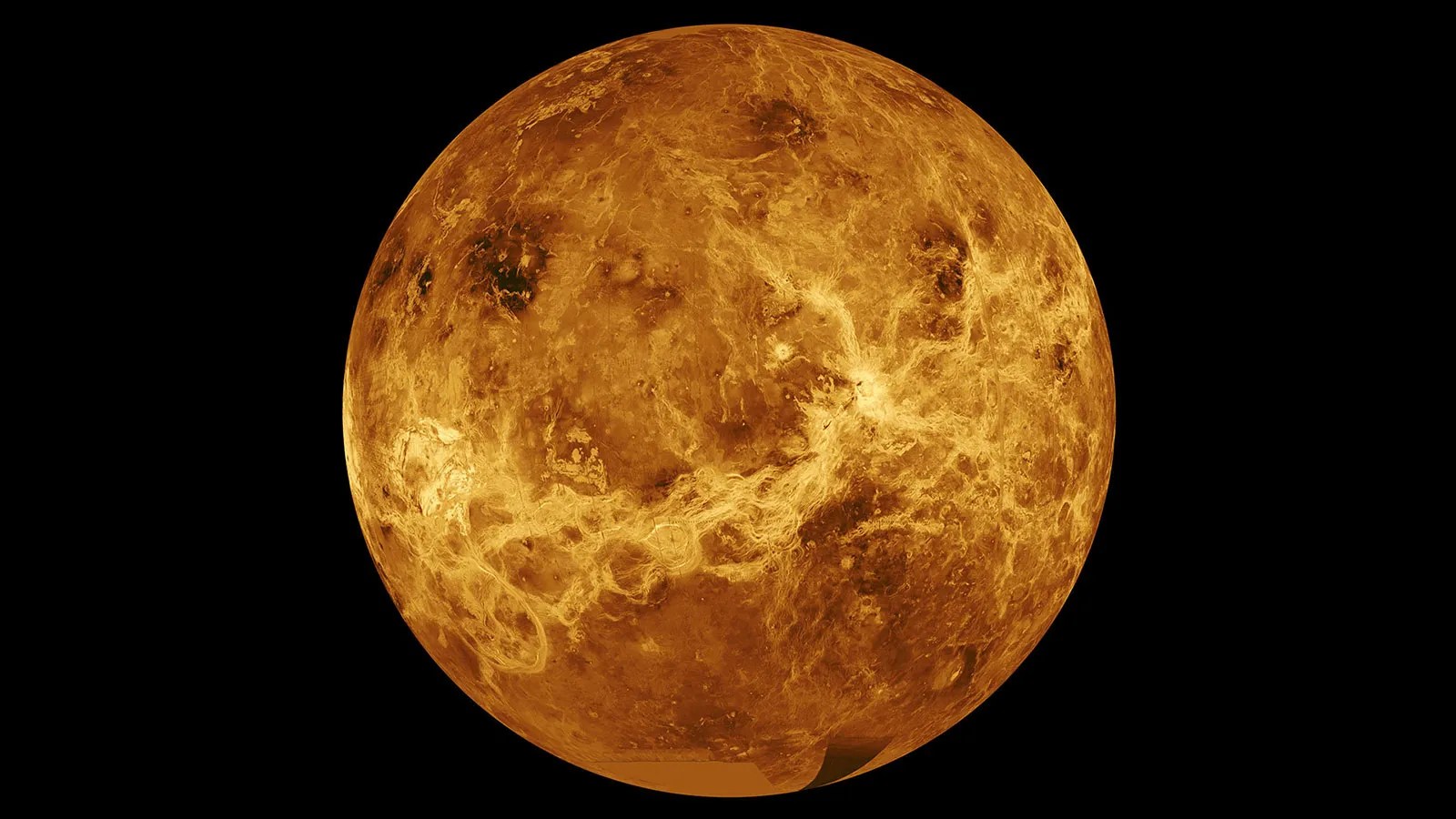
Image (Credit): The planet Venus. (NASA)

Here are some recent stories of interest.

—Astronomy.com: “Venus May Never Have Had Oceans“

The story of the inner early Solar System goes something like this: Billions of years ago, there were three rocky worlds with oceans of liquid water. Perhaps all three could have been primed for life. But as Mars lost its atmosphere and Venus’ atmosphere experienced a runaway greenhouse effect, only Earth could support life by the end. But a trio of researchers at the University of Cambridge, U.K., have a different view — that all those billions of years ago, Venus was already too hot to support oceans. There was water vapor (we still see evidence of this today), but it never had the chance to condense into oceans. Instead, Venus was a steam world, one that could reach surface temperatures as high as 1,340 degrees Fahrenheit (727 degrees Celsius). By most metrics, this means the surface of Venus was already a hellish, inhospitable world — and it never got much better.

—University at Buffalo: “Evidence of Primordial Black Holes may be Hiding in Planets, or Even Everyday Objects Here on Earth“

Imagine the formation of a black hole and you’ll probably envision a massive star running out of fuel and collapsing in on itself. Yet the chaotic conditions of the early universe may have also allowed many small black holes to form long before the first stars. These primordial black holes have been theorized for decades and could even be ever-elusive dark matter, the invisible matter that accounts for 85% of the universe’s total mass. Still, no primordial black hole has ever been observed. New research co-led by the University at Buffalo proposes thinking both big and small to confirm their existence, suggesting that their signatures could range from very large — hollow planetoids in space — to minute — microscopic tunnels in everyday materials found on Earth, like rocks, metal and glass.

—Astronomy.com: “New Evidence of Organic Material Identified on Ceres, the Inner Solar System’s Most Water-rich Object After Earth“

Six years ago, NASA’s Dawn mission communicated with Earth for the last time, ending its exploration of Ceres and Vesta, the two largest bodies in the asteroid belt. Since then, Ceres —a water-rich dwarf planet showing signs of geological activity— has been at the center of intense debates about its origin and evolution. Now, a study led by IAA-CSIC, using Dawn data and an innovative methodology, has identified eleven new regions suggesting the existence of an internal reservoir of organic materials in the dwarf planet. The results, published in The Planetary Science Journal, provide critical insights into the potential nature of this celestial body.

Space Stories: Missing Water on Venus, More About Planet Nine, and Possible Life on an Exoplanet

Image (Credit): Venus from a composite of data from NASA’s Magellan spacecraft and Pioneer Venus Orbiter. (NASA/JPL-Caltech)

Here are some recent stories of interest.

—University of Colorado at Boulder: “Venus Has Almost No Water: A New Study May Reveal Why“

Planetary scientists at the University of Colorado Boulder have discovered how Venus, Earth’s scalding and uninhabitable neighbor, became so dry. The new study fills in a big gap in what the researchers call “the water story on Venus.” Using computer simulations, the team found that hydrogen atoms in the planet’s atmosphere go whizzing into space through a process known as “dissociative recombination” — causing Venus to lose roughly twice as much water every day compared to previous estimates.

—UniverseToday: “New Evidence for Our Solar System’s Ghost: Planet Nine“

Does another undetected planet languish in our Solar System’s distant reaches? Does it follow a distant orbit around the Sun in the murky realm of comets and other icy objects? For some researchers, the answer is “almost certainly.” The case for Planet Nine (P9) goes back at least as far as 2016. In that year, astronomers Mike Brown and Konstantin Batygin published evidence pointing to its existence. Along with colleagues, they’ve published other work supporting P9 since then. Now, they’ve published another paper along with colleagues Alessandro Morbidelli and David Nesvorny, presenting more evidence supporting P9. It’s titled “Generation of Low-Inclination, Neptune-Crossing TNOs by Planet Nine.” It’s published in The Astrophysical Journal Letters.

—Astonomy.com: “Possible Hints of Life Found on Exoplanet K2-18b – How Excited Should We Be?”

Data from the James Webb Space Telescope (JWST) has shown that an exoplanet around a star in the constellation Leo has some of the chemical markers that, on Earth, are associated with living organisms. But these are vague indications. So how likely is it that this exoplanet harbours alien life? …The planet in question is named K2-18b. It’s so named because it was the first planet found to orbit the red dwarf star K2-18.

India Has Even Greater Space Ambitions

Image (Credit): Logo of the Indian Space Research Organization. (ISRO)

After recently sending a rover to the Moon and a spaceship to the Sun, India announced plans to build its own space station by 2035 and also send its own astronaut to the Moon by 2040. It also wants to start work on missions to Venus and Mars. How is that for ambitious?

In a press release this week, India’s Prime Minister Shri Narendra Modi stated the following:

Building on the success of the Indian space initiatives, including the recent Chandrayan-3  and Aditya L1 Missions, Prime Minister directed that India should now aim for new and ambitious goals, including setting up ‘Bharatiya Antariksha Station’ (Indian Space Station) by 2035 and sending first Indian to the Moon by 2040.

To realize this Vision, the Department of Space will develop a roadmap for Moon exploration. This will encompass a series of Chandrayaan missions, the development of a Next Generation Launch Vehicle (NGLV), construction of a new launch pad, setting up human-centric Laboratories and associated technologies.

Prime Minister also called upon Indian scientists to work towards interplanetary missions that would include a Venus Orbiter Mission and a Mars Lander.

The space race continues with India showing itself as a strong player in space, potentially replacing Russia as one of the key space-faring nations. It benefits everyone to have more nations studying our solar system. It is unfortunate that Russia has concerned itself with less dignified matters back here on Earth. Maybe it will look to the stars again one day soon.

A Day in Astronomy: The Founding of the European Space Agency

On this day in 1975, the European Space Agency (ESA) was founded after the combination of  the European Space Research Organisation (ESRO) and the European Launcher Development Organisation (ELDO). Ten countries were part of this new organization, which has since grown to 22 members (noted below). The Agency also has associate members and other cooperating partners.

You can find a list of the ESA’a past, present, and planned space missions here, which includes:

Note: According to the International Astronautical Federation, the ESA member include Austria, Belgium, the Czech Republic, Denmark, Estonia, Finland, France, Germany, Greece, Hungary, Ireland, Italy, Luxembourg, the Netherlands, Norway, Poland, Portugal, Romania, Spain, Sweden, Switzerland and the United Kingdom. Latvia, Lithuania and Slovenia are Associate Members. Canada takes part in certain programmes under a cooperation agreement. ESA has signed European Cooperating States Agreements with Bulgaria, Cyprus and Slovakia, and cooperation agreements with Croatia and Malta.

Space Stories: Volcanoes on Venus, Exoplanet Radio Signals, and Bright Baby Jupiter

Image (Credit): Map of volcanoes located on Venus. (Washington University in St. Louis)

Here are some recent stories of interest.

—Washington University in St. Louis: “Scientists Share ‘Comprehensive’ Map of Volcanoes on Venus — all 85,000 of Them“

Byrne and Hahn’s new study includes detailed analyses of where volcanoes are, where and how they’re clustered, and how their spatial distributions compare with geophysical properties of the planet such as crustal thickness. Taken together, this work provides the most comprehensive understanding of Venus’ volcanic properties — and perhaps of any world’s volcanism so far. That’s because, although we know a great deal about the volcanoes on Earth that are on land, there are still likely a great many yet to be discovered under the oceans. Lacking oceans of its own, Venus’ entire surface can be viewed with Magellan radar imagery.

—CNN: “Repeating Radio Signal Leads Astronomers to an Earth-Size Exoplanet“

Astronomers have detected a repeating radio signal from an exoplanet and the star that it orbits, both located 12 light-years away from Earth. The signal suggests that the Earth-size planet may have a magnetic field and perhaps even an atmosphere…Scientists noticed strong radio waves coming from the star YZ Ceti and the rocky exoplanet that orbits it, called YZ Ceti b, during observations using the Karl G. Jansky Very Large Array of telescopes in New Mexico. The researchers believe the radio signal was created by interactions between the planet’s magnetic field and the star.

—ScienceNews: “Baby Jupiter Glowed so Brightly it Might have Desiccated its Moon“

A young, ultrabright Jupiter may have desiccated its now hellish moon Io. The planet’s bygone brilliance could have also vaporized water on Europa and Ganymede, planetary scientist Carver Bierson reported March 17 at the Lunar and Planetary Science Conference. If true, the findings could help researchers narrow the search for icy exomoons by eliminating unlikely orbits. Jupiter is among the brightest specks in our night sky. But past studies have indicated that during its infancy, Jupiter was far more luminous. “About 10 thousand times more luminous,” said Bierson, of Arizona State University in Tempe.