The National Air and Space Museum is Open for Business

Image (Credit): The “Destination Moon” exibition at the refurbished National Air and Space Museum. (Smithsonian Museum)

If you have been awaiting the refurbishing of the Smithsonian’s National Air and Space Museum, then you will be happy to know that the museum reopened on October 14th. Only now you cannot simply stroll into the museum. Instead, you need to obtain a free timed-entry pass. Unfortunately, this seems to be the current system used by numerous museums to control traffic as well as capture all of your personal information so they can swamp you with junk mail and offers. Anyway…

Here are the a few of the new exhibits the museum is highlighting (go here for the full list):

  1. “Walking On Other Worlds”: Experience what it’s like in distant parts of our solar system in the “Walking on Other Worlds” interactive experience in the Kenneth C. Griffin Exploring the Planets Gallery. This immersive media exhibit presents visitors with a seven-minute “tour” of seven different worlds: Venus, Earth’s Moon, Mars, Jupiter, Saturn’s moon Titan, asteroid Ryugu, and comet 67P.
  2. Science Fiction Artifacts: New to display is a full-sized T-70 X-wing Starfighter “flown” by Poe Dameron (Oscar Isaac) in Star Wars: The Rise of Skywalker (2019). The screen-used vehicle is on long-term loan from Lucasfilm and is displayed hanging outside the planetarium. Star Trek is also represented in the new exhibitions. 
  3. ISS Cupola: In the One World Connected gallery, put yourself in the shoes of astronauts on the International Space Station (ISS) with the ISS Cupola interactive. Every 90 minutes, astronauts on board the ISS can see the Sun rise from the station’s Cupola, a European Space Agency-built observatory module. 

Given that NASA’s Artemis 1 mission is shooting for the Moon again, the timing is perfect. Of course, in December 2022 it will have been 50 years since the last human walk on the Moon’s surface, so we have a lot to celebrate as well as a lot of time to make up. Let’s hope a future update to the National Air and Space Museum includes models of spacecraft used to get humans to Mars.

And remember, you can also visit the Steven F. Udvar-Hazy Center outside the Washington Beltway that contains large planes, jets, and spacecraft that cannot fit in the DC museum, including the Space Shuttle Discovery. Last time I went there I could walk right in without using a timed-entry pass.
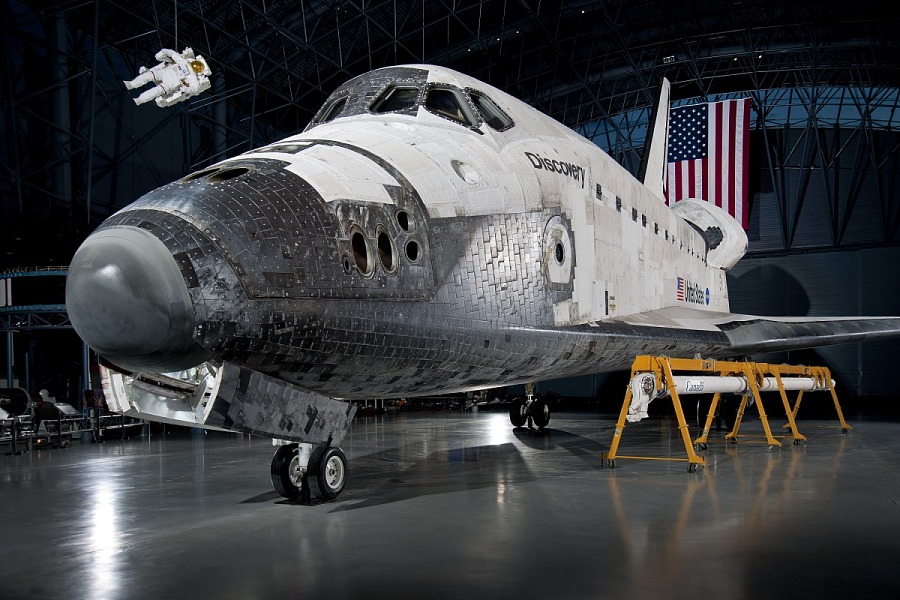
Image (Credit): Space Shuttle Discovery at the Steven F. Udvar-Hazy Center. (Smithsonian Museum)


Space Stories: Venusian Balloons, Sun Observations, and a Private Moon Trip

Image (Credit): Test of the one-third scale prototype aerobot designed to withstand the corrosive chemicals in Venus’ atmosphere. (Near Space Corporation)

Here are some recent stories of interest.

NASA.gov: “JPL’s Venus Aerial Robotic Balloon Prototype Aces Test Flights

A scaled-down version of the aerobot that could one day take to the Venusian skies successfully completed two Nevada test flights, marking a milestone for the project…The shimmering silver balloon ascended more than 4,000 feet (1 kilometer) over Nevada’s Black Rock Desert to a region of Earth’s atmosphere that approximates the temperature and density the aerobot would experience about 180,000 feet (55 kilometers) above Venus. Coordinated by Near Space, these tests represent a milestone in proving the concept’s suitability for accessing a region of Venus’ atmosphere too low for orbiters to reach, but where a balloon mission could operate for weeks or even months.

SkyandTelescope.org: “‘Chinese Observatory Will Study Violent Events on the Sun

China has launched a solar observatory to study solar flares and eruptions, and their connection with the Sun’s magnetic field…[the Advanced Space-based Solar Observatory (ASO-S)] is planned to operate at 720 kilometers (447 miles) above Earth’s surface in a Sun-synchronous orbit that will allow it to observe the Sun at all times. Its primary, four-year mission is timed to make the most of the 2024–2025 solar maximum, when the Sun is at its most active during its 11-year cycle.

Space.com: “‘SpaceX Says its 2nd Private Starship Trip Around the Moon will Help Make Humanity Multiplanetary

SpaceX’s newly announced tourist mission to the moon could help humanity extend its footprint far beyond Earth, company representatives say. That mission, which was revealed today (Oct. 12), will send wealthy entrepreneur Dennis Tito, his wife Akiko and 10 other people on a weeklong journey around the moon aboard SpaceX’s huge Starship vehicle, which is still in development. Who those 10 other passengers will be is unknown; only the Titos have reserved seats at the moment.

Podcast: Astronomy in a Nutshell

Image (Credit): “How to Terraform Venus (Quickly)” video. (Kurzgesagt)

In a recent Clear+Vivid podcast episode, Alan Alda interviewed Philipp Dettmer, who is the CEO of the online science channel Kurzgesagt (German for “in a nutshell”). Mr. Dettmer discussed his difficulties with school as a child, his eventual love of learning, and his desire to help others to learn.

I recommend you listen to his story on the podcast, but also explore the various videos on his Youtube site, including a number of them that deal with astronomy, such as:

It is science as well as scientific speculation, but it is all good for the brain.

Television: More Space Stories This Summer

Image (Credit): The eight plants of our solar system. (NOVA)

If you are looking for space series beyond the Moon, PBS has a few more shows for you. With the James Webb Space Telescope releasing the first photos next week, now is the time to brush up on the mission with a NOVA special. And check out the earlier NOVA piece on the planets as well. Dates and times may vary by region.

NOVA: Ultimate Space Telescope, July 13 at 9pm (28 minutes):

How did NASA engineers build and launch the most ambitious telescope of all time? Follow the dramatic story of the James Webb Space Telescope—the most complex machine ever launched into space. If it works, scientists believe that this new eye on the universe will peer deeper back in time and space than ever before to the birth of galaxies, and may even be able to “sniff” the atmospheres of exoplanets as we search for signs of life beyond Earth. But getting it to work is no easy task. The telescope is far bigger than its predecessor, the famous Hubble Space Telescope, and it needs to make its observations a million miles away from Earth—so there will be no chance to go out and fix it. That means there’s no room for error; the most ambitious telescope ever built needs to work perfectly. Meet the engineers making it happen and join them on their high stakes journey to uncover new secrets of the universe.

NOVA: The Planets, July 7 & 14 at 8pm (5 episodes)

Among the stars in the night sky wander the eight-plus worlds of our own solar system—each home to truly awe-inspiring sights. Volcanoes three times higher than Everest, geysers erupting with icy plumes, cyclones larger than Earth lasting hundreds of years. Each of our celestial neighbors has a distinct personality and a unique story. In this five-part series, NOVA will explore the awesome beauty of “The Planets,” including Saturn’s 175,000-mile-wide rings, Mars’ ancient waterfalls four times the size of any found on Earth, and Neptune’s winds—12 times stronger than any hurricane felt on our planet. Using unique special effects and extraordinary footage captured by orbiters, landers and rovers, we’ll treat viewers to an up-close look at these faraway worlds. We’ll stand on the dark side of Pluto, lit only by the reflected light of its moons, watch the sun set over an ancient Martian waterfall, and witness a storm twice the size of Earth from high above Saturn. And, we’ll reveal how each of them has affected our own planet: Earth. 

Whatever Happened to NASA’s Mariner 8?

Image (Credit): The planet of Mars. (NASA)

An earlier post noted the anniversary of NASA’s Mariner 9 spacecraft to Mars, launched on May 30, 1971, but what about Mariner 8? What happened to that Mars bound spacecraft?

Both Mariner 8 and 9 we developed together so one could replace the other if needed, which was pretty smart. The Russians did the same thing with their first trip to Mars in 1971, successfully sending Mars 2 (launched May 19) and Mars 3 (launched May 28).

Mariner 8 was supposed to be the first U.S. spacecraft to orbit Mars. It was launched on May 8, 1971 but never achieved Earth orbit due to a launch vehicle failure. Instead, it fell into the Atlantic Ocean.

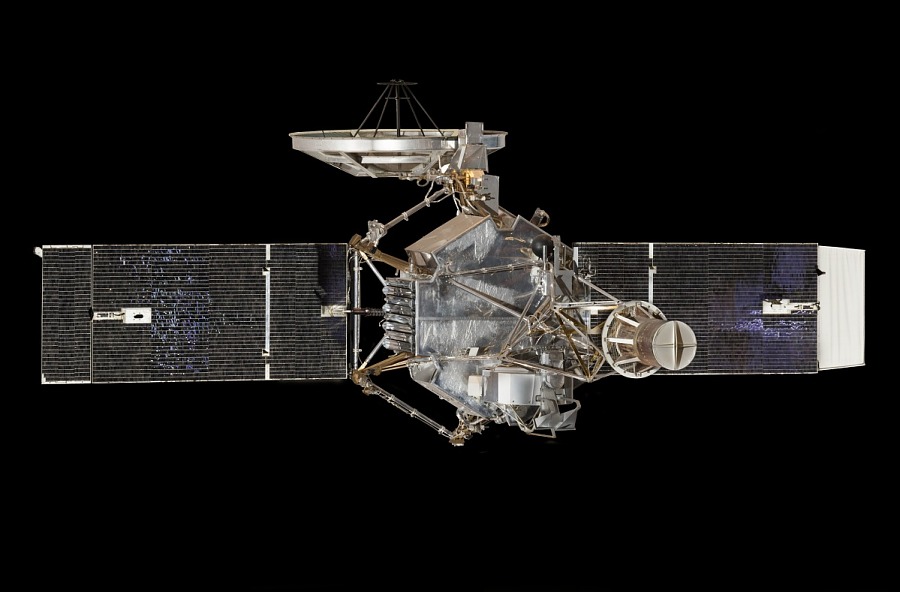
Of the 10 Mariner missions, 7 were successfully took space craft to Mars, Venus, and Mercury. Unfortunately, like Mariner 8, Mariner 1 failed after launch. Fortunately, like Mariner 9, Mariner 2 was a back up spacecraft that ensure mission success. Mariner 3 failed after launch because of a battery issue, but its double Mariner 4 was successful. Here are the 10 missions (you can find more about them here):

  • Mariner 1: Venus mission launched on July 22, 1962. — Failed
  • Mariner 2: Venus mission launched on August 27, 1962. — Success
  • Mariner 3: Mars mission launched on November 5, 1964. — Failed
  • Mariner 4: Mars mission launched on November 28, 1964. — Success
  • Mariner 5: Venus mission launched on June 14, 1967. — Success
  • Mariner 6: Mars mission launched on February 25, 1969. — Success
  • Mariner 7: Mars mission launched on February 25, 1969. — Success
  • Mariner 8: Mars mission launched on May 8, 1971. — Failed
  • Mariner 9: Mars mission launched on May 30, 1971. — Success
  • Mariner 10: Mercury and Venue mission launched on November 3, 1973. — Success

While three spacecraft failed, all of the missions were successful because of the redundancy built into the system. We do not seem to have such luxuries anymore, though NASA’s Mars Exploration Rover (MER) mission had two Mars rovers, Spirit and Opportunity, to increase the chances of success. 

Image (Credit): Mariner 2 spacecraft. (Smithsonian National Air and Space Museum)