Videos: The Odds of Life Elsewhere in the Universe

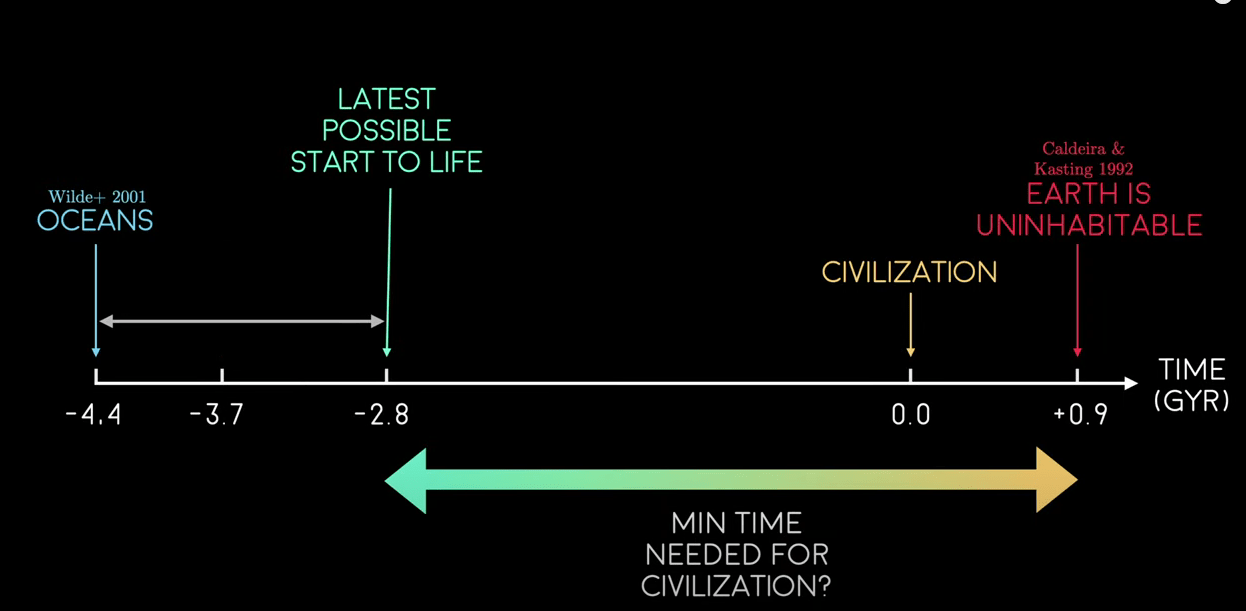
Image (Credit): One of the graphics from the video discussing the progress of life leading to civilization here on the Earth. (Cool Worlds)

Earlier today, a new Cool Worlds video was posted to Youtube titled “The Odds of Life – THIS CHANGED MY MIND.” Its an interesting piece narrated by Professor David Kipping regarding whether life is common in the universe. You will see that Professor Kipping is excited to share his results as he walks you through various papers before concluding that simple life may be more common than he believed earlier, making the chance of an advanced civilization a little more likely.

As always, it’s a fun story to follow as it answers one questions and stirs up other questions. For example, as part of his talk he notes an earlier paper that hypothesized the existence of an earlier technological civilization here on Earth about 350 million years ago. The paper is titled The Silurian Hypothesis: Would it be Possible to Detect an Industrial Civilization in the Geological Record.

Here is the abstract of this paper:

If an industrial civilization had existed on Earth many millions of years prior to our own era, what traces would it have left and would they be detectable today? We summarize the likely geological fingerprint of the Anthropocene, and demonstrate that while clear, it will not differ greatly in many respects from other known events in the geological record. We then propose tests that could plausibly distinguish an industrial cause from an otherwise naturally occurring climate event.

Professor Kipping said he hoped to create another video to discuss this idea about earlier civilizations. In the meantime, you may want to take a look at the paper.

Video: An Argument Against Grabby Aliens

Image (Credit): Grabby alien model. (grabbyaliens.com)

Check out a recent video from the YouTube channel Cool Worlds titled “Do ‘Grabby Aliens’ Solve The Fermi Paradox?” for an interesting argument against a now popular idea.

Grabby aliens, as defined by Google AI, are

…a hypothetical type of “loud” alien civilization that are known for inhibiting the development of other technological civilizations in their area of influence. The concept of quiet and loud aliens is used to model hypotheses about the existence of extraterrestrial intelligence, particularly in the context of the Fermi Paradox.

You can read all about this theory at grabbyaliens.com. Then you can listen to Professor David Kipping provide three reasons why he does not believe this theory is workable.

As always, he provides an entertaining and enlightening view of the cosmos.

Video: More About Rogue Planets

Credit: Image by Valentin from Pixabay

Cool Worlds Lab released another great video recently that discusses rogue planets, or planets without a host star, in a video titled “A JuMBO Mystery – This Shouldn’t Happen!

A JuMBO means Jupiter-mass binary objects, which is just part of the story in this video. The presentation starts with a finding from astronomers using the James Webb Space Telescope, who identify 520 rogue planet candidates. This is interesting in itself, but the intriguing part is that a number of these planets are found in pairs. This would not make a lot of sense if we believed these planets were once within a solar system before being pushing into space.

The video discusses the various theories explaining these JuMBOs and rogue planets in general. It also discusses the potential impact on our own solar system, such as whether we lost one of our own planets in the past and/or a nearby rogue planet (and its moons) is out there today waiting to be discovered.

As always, Cool Worlds Lab keeps astronomy even more interesting.

Video: Cool Worlds Labs Emphasizes the Need for Greater NASA Funding

Image (Credit): A graphic explaining the various instruments on the Chandra X-ray Observatory. (NASA)

Even with a good space week in hand, we still need to keep an eye on NASA’s budget to maintain a robust set of programs to explore the cosmos. A recent Youtube video by Cool Worlds Labs, “NASA’s in Trouble,” highlights those budgetary issues and focuses on what individuals can do as well, such as visiting https://www.savechandra.org/ and asking Congress to restore funds cut from the Chandra X-ray Observatory.

Professor David Kipping makes it clear he is not going to remain silent while these cuts are being considered. He and his team demonstrate their love for astronomy in every video and podcast, making them great ambassadors in this debate for continued NASA funding.

The video is forthright about the internal issues creating budgetary issues. For example, the considerable cost overruns and delays prior to the launch of the now successful James Webb Space Telescope came at a cost to other NASA programs over many years. And similar overruns are expected with future large projects as well, further squeezing other line items in the budget.

The video also highlights some promising developments that could help to lower costs in the future, though the issue on the table now is NASA’s FY 2025 budget.

View the video for yourself to learn more about the proposed budget cuts as well as what you can do to help.

Video: Check Out Aeon Astronomy & Space Travel Videos

Aeon is a website of ideas run by Aeon Media. It’s mission is to explore and communicate knowledge that addresses our shared need to make sense of the world.

While it covers quite a few topics, I wanted to highlight some of its videos on astronomy and space travel. Below are just a few I recommend. You should explore the site on your own to learn more.

Check them out and many more. It is a well organized site that operates on donations, so don’t be afraid to contribute if you really enjoy the pieces.

Image (Credit): One of the videos available on the Aeon site. (Aeon)