NASA’s Travel Agency

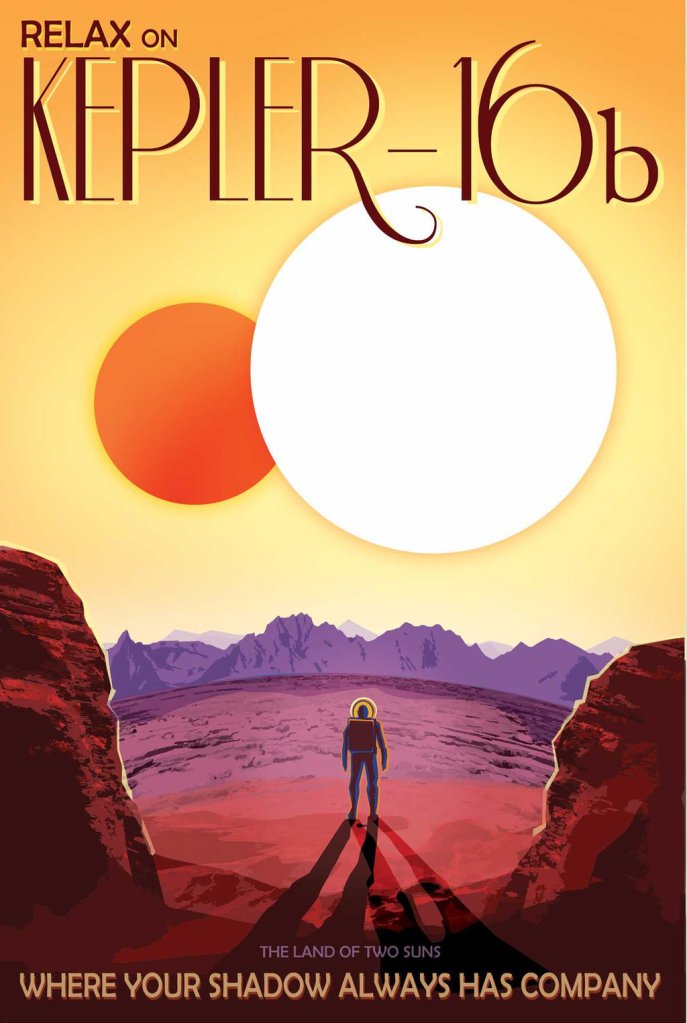
Source: NASA’s Jet Propulsion Laboratory.

If you are getting tired of staying home these days, NASA has some fun destinations in mind for you. Late last year, NASA’s Jet Propulsion Laboratory (JPL) put together “Visions of the Future” to show you where the space agency hopes to go someday. You may not want to pack just yet, but whether it is this solar system or some other solar system, NASA wants to help.

The poster above for Kepler-16b comes with this enticing description:

Like Luke Skywalker’s planet “Tatooine” in Star Wars, Kepler-16b orbits a pair of stars. Depicted here as a terrestrial planet, Kepler-16b might also be a gas giant like Saturn. Prospects for life on this unusual world aren’t good, as it has a temperature similar to that of dry ice. But the discovery indicates that the movie’s iconic double-sunset is anything but science fiction.

You might also enjoy this NASA video showing some space activities in these prime locations.

I dropped in a few more posters below, but be sure to check out all of them. A big thanks also to the folks at JPL for these fun images. The 14 posters were created by nine artists, designers, and illustrators.

Of course, these free photos are already being sold on Etsy.com and elsewhere as posters and t-shirts.

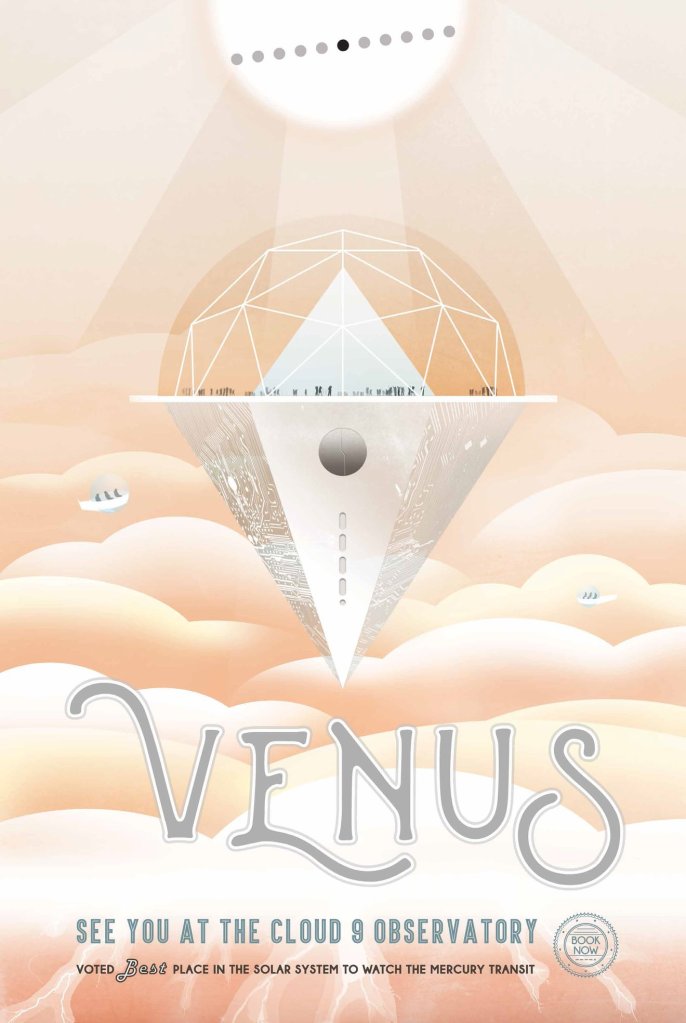
Source: NASA’s Jet Propulsion Laboratory.

How Many Satellites Are Too Many?

You may have remembered my earlier post showing all of the items already in orbit around the Earth. Well, it appears Elon Musk believes we can handle billions of satellites in low Earth orbit (LEO). And while the current number of orbiting satellites is only in the thousands, Mr. Musk’s SpaceX has already placed 1,700 Starlink satellites in LEO, with plans for a total of 42,000 such satellites under the program.

Not everyone agrees with unchecked growth. Josef Aschbacher, the European Space Agency’s (ESA) director-general, stated, “You have one person owning half of the active satellites in the world. That’s quite amazing. De facto, he is making the rules.” I agree with the ESA about the need for some rules in this area given the rapid growth. And we may need to look a little deeper into that “billions” number. Mr. Musk has been known to overstate things.

Mr. Musk is part of the move fast and break things club. Yet that can lead to problems when the things breaking up are expensive satellites leaving debris in their wake. We may need to find a better way.

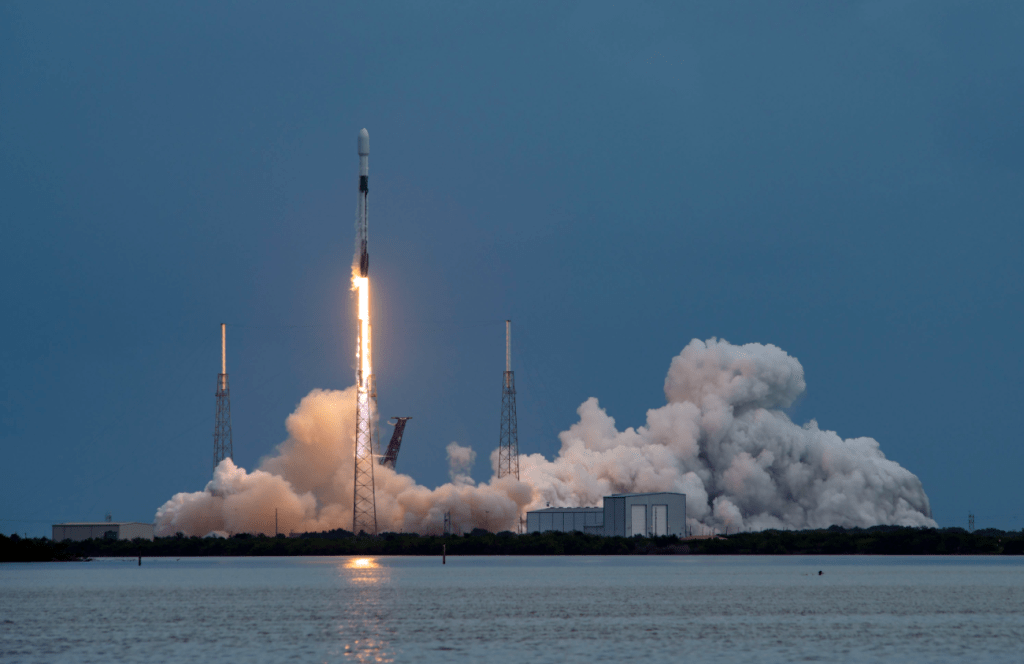
Source: October 24, 2021 launch of SpaceX’s Falcon 9 rocket carrying 60 Starlink satellites to orbit from Space Launch Complex 40 at Cape Canaveral Air Force Station in Florida. See the SpaceX press release, which contains this image.

Whatever Happened to Mars-One?

Source: Artist’s impression of a Mars One community on Mars from MIT

I remember the image above from Mars One and thinking that maybe the private sector could find an innovative way to beat governments to Mars. I also remember the profiles of individuals volunteering for a one-way trip to Mars to be part of the proposed Martian colony. So much for that idea. Mars One ran out of money and appears to be little more than a website at this point, where you can read the following:

In 2016 Mars One ran out of funds and was unable to continue the selection program and the technical studies. In the years after that, several attempts were made to raise additional funds, but they were unsuccessful. Despite that, Mars One has had an impact on Mars exploration by promoting the idea of permanent settlement. We, Mars One’s co-founders, are still convinced that the first crews that go to Mars should (or will have to) go there to stay. 

So Mars One still believes a one-way trip is the best approach. If so, it appears Mars One did not have the secret for a very long existence on Mars. An MIT study discussing the venture said the new martians would have survived a short time before expiring as they attempted to grow their food:

As the air inside the habitat continued to leak, the total atmospheric pressure would drop, creating an oppressive environment that would suffocate the first settler within an estimated 68 days.

I am not sure how that would have helped the drive to Mars if the first spot we established was a graveyard.

So give Mars Once credit for keeping the dream alive, and even being optimistic about the technology someday appearing to make it possible, though not in time for its scheduled mission. Fortunately, it went out of business before derailing our hopes for a successful manned mission to Mars.

Source: Mars One.