Dead End: No Life Found in Martian Rock

Source: Meteorite from The Guardian.

A 4-billion-year-old meteorite from Mars did not show any signs of life, according to The Guardian newspaper. That said, the 4-pound rock found in Antarctica in 1984 that presumably broke off of Mars’ surface billions of years ago does have compounds that could lead to life.

More samples should be on their way if NASA’s Perseverance Rover mission on Mars can assist with the return of Martian samples back here to Earth for additional study. So there is still hope that we will find more interesting results down the road.

Extra: The origin (now debunked) story on this rock from a NASA research team of scientists at the Johnson Space Center, Houston, TX, and at Stanford University, Palo Alto, CA, was titled “Meteorite Yields Evidence of Primitive Life on Early Mars.”

Source: Mars from NASA

Is the U.S. Running Low on Astronauts?

Source: NASA OIG.

Does NASA need more astronauts than it has for upcoming missions? The Office of Inspector General’s (OIG) office believes NASA may have a problem. In a January 11, 2022 OIG report, NASA’s Management of its Astronaut Corps, the auditors found:

The processes NASA uses to size, train, and assign astronauts to specific missions are primarily calibrated toward meeting the current needs of the [International Space Station]. For example, NASA’s process for sizing the astronaut corps is designed to ensure that a sufficient number of astronauts are available to meet the Agency’s flight manifest needs, which includes maintaining a planned crew of between three and four astronauts on the Station over the next 5 years. However, the astronaut corps is projected to fall below its targeted size or minimum manifest requirement in fiscal year (FY) 2022 and FY 2023 due to attrition and additional space flight manifest needs. More concerning, the Astronaut Office calculated that the corps size would exactly equal the number of flight manifest seats NASA will need in FY 2022. As a result, the Agency may not have a sufficient number of additional astronauts available for unanticipated attrition and crew reassignments or ground roles such as engaging in program development, staffing Astronaut Office leadership and liaison positions, and serving as spokespeople for the Agency. In light of the expanding space flight opportunities anticipated for the Artemis missions, the corps might be at risk of being misaligned in the future, resulting in disruptive crew reorganizations or mission delays.

The real point it that bad human resource management may lead to mission delays, including the Artemis lunar landing mission. So what does the OIG recommend? The report states:

To ensure the training process for future Artemis missions is developed with sufficient time for implementation and revision, the Director of the Flight Operations Directorate and the Chief of the Astronaut Office should coordinate with Artemis program offices to complete the development and chartering of the framework of Artemis boards and panels to ensure alignment with future mission training needs for new vehicles and missions, including Orion, next-generation spacesuits, [human landing system], and Gateway.

NASA management agreed with all four recommendations in the OIG report aimed at resolving this shortage issue. I know these back office management issues can be dry, but without a solid pipeline of talent into the space program we will simply have a diminished program. Luckily, the auditors are doing their job and alerting management. Now is it NASA’s job to turn all of this around.

Television: The End of “The Expanse”

Source: The Expanse on Amazon Prime.

This week Amazon Prime released the final episode of the The Expanse, a brilliant space drama that has been running for six seasons, first on Syfy and later on Amazon Prime. Based on a series of books written by James S. A. Corey (a two-person team), it tells the story of a settled solar system where the old problems dividing all of us are simply moved onto a larger playing field. Mars and Earth are jockeying for power while the miners in the asteroid belt creating the necessary resources feel forgotten and abused. War ensues as does new discoveries (and related weapons), which simply get folded into the ongoing battles. And the playing field widens again as a portal, called the Ring, gives the warring factions access to more star systems and planets.

The television series is a wonder to watch, with excellent acting, fantastic story-lines, and the creative use of venues in our solar system, from Ceres in the asteroid belt to the various moons of Jupiter, Saturn, and Uranus. It is also a very dark show as it illustrates an ugly side to our expansion into new worlds – ruthless ambition, terrorism, revolution, and civil war.

I have not seen anything like it since the remake of Battlestar Galactica, and I would put it on the same level (with some better special effects given the time that has passed). But the most important part is the characters, and you will find a team in the center of this series that you would follow anywhere.

If you are new to the series, you are in for a lot of fun. If you are finishing the series like me and you have only experienced the television show, I think the next step is to dig into the books to live in this world a little longer.

Extra: Check out this Den of Geek article concerning whether The Expanse will continue in any format – “The Expanse: The Possibility of a Season 7 or Sequel Series.”

Pic of the Week: Perseverance and Ingenuity

Source: Perseverance and Ingenuity from The Planetary Society.

This week’s photo is from the Planetary Society’s Year in Pictures collection. The photo shows NASA’s latest Mars rover, Perseverance, as well as the helicopter Ingenuity in the background (hard to see at first). A better image of the helicopter is provided below. The rover landed on Mars in February 2021 at the Jezero Crater and has been conducting science ever since that time. NASA plans to send some of the Perseverance’s soil samples back to Earth for more study. You can learn more about this Mars mission here.

Source: Ingenuity Helicopter from NASA.

Videos: The Golden Record on the Voyager Spacecraft

Source: NASA.

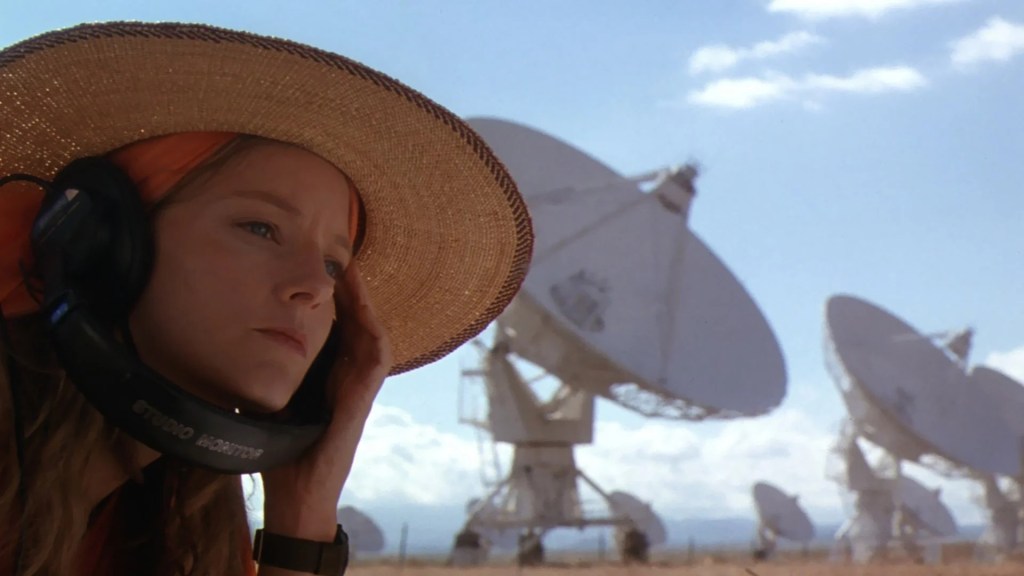
Years ago, two spacecraft exited our solar system at about 35,000 miles per hour with a message to anyone who finds them detailing our location in the galaxy, the beauty of the Earth, and our culture in terms of warm wishes, music, and natural sounds. Crafted by Carl Sagan and others, the golden discs or records placed on Voyager I and II also contains instructions on how to read the material. And thanks to the site Open Culture, we can learn more about how one would unravel these instructions. It reminds me of Jodie Foster’s character in the movie Contact as she tried to interpret signals being received from afar. I recommend you check out the two videos that are part of the “How to Decode NASA’s Message to Aliens” page.

Source: Jodie Foster in Contact from Warner Bros. Pictures.