Podcast: A New Space Age?

Source: BBC.

If you are looking for a new podcast, or just want to listen to an interesting conversation, I recommend BBC’s recent Inside Science episode about human travel to the Moon and Mars. Titled “A New Space Age?,” the December 30, 2021 episode discusses NASA’s Artemis lunar program, the timetable for travel to Mars, and whether or not we even need to send humans into space.

Dr. Kevin Fong leads a panel of experts to discuss these topics:

— Dr. Mike Barratt, a senior NASA astronaut and medical doctor based at the Johnson Space Center;

— Dr. Anita Sengupta, Research Associate Professor in Engineering at the University of Southern California; and

— Oliver Morton, Briefings editor at the Economist and author of several books on the Moon and Mars.

If you enjoy the conversation, you may want to look around a few of the other episodes as well, such as the December 16, 2021 episode on the James Webb Space Telescope.
What Else Can be Found at Lagrange 2?

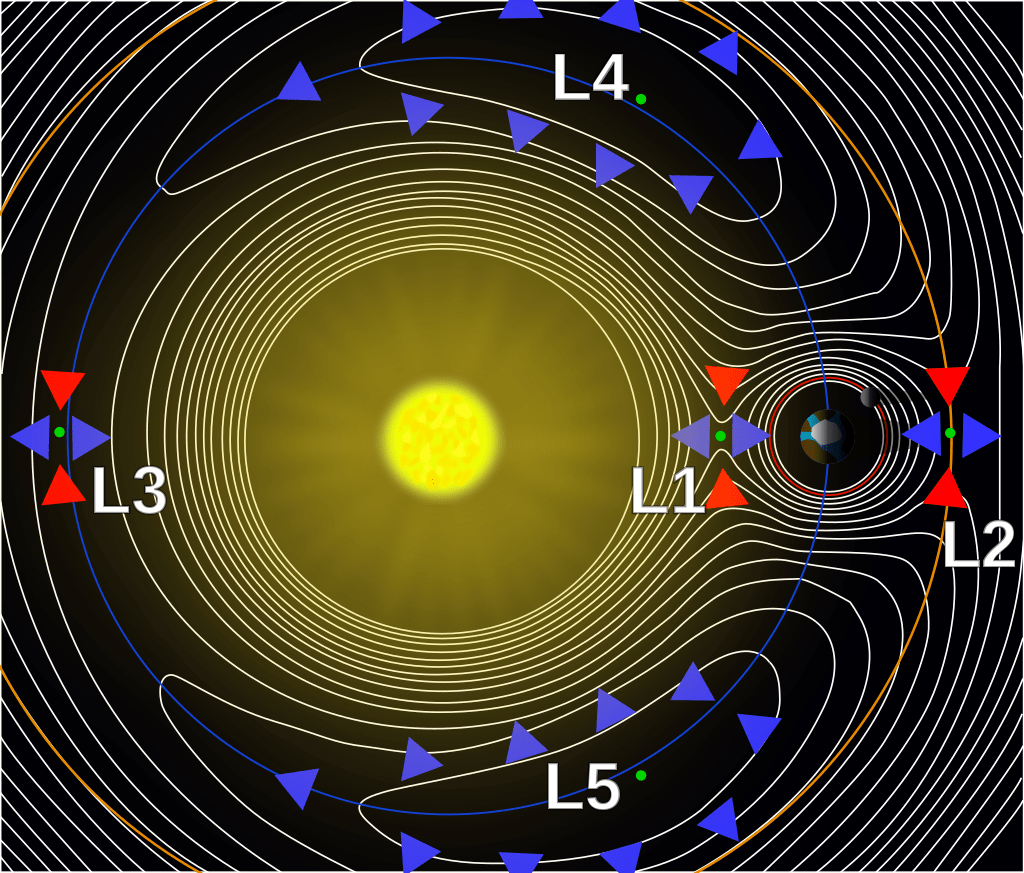
Source: Lagrange Points from Wikipedia.

Now that the James Webb Space Telescope (JWSP) has deployed its 21-foot, gold-coated primary mirror, it is in good shape as it heads for the Sun-Earth’s second Lagrange point, known as L2, which is nearly 1 million miles from Earth. However, it will not be the first spacecraft to park in this spot to conduct a scientific mission.

I looked around to get a good inventory of what was operating, and will be operating, at L2 when JWST arrives and found the best listing on Wikipedia. Here is the inventory:

Past missions at L2:

  • From 2001 to 2010: NASA’s Wilkinson Microwave Anisotropy Probe (WMAP) observed the cosmic microwave background.
  • From 2003 to 2004: NASA’s WIND studied radio waves and plasma that occur in the solar wind and in the Earth’s magnetosphere (now in L1).
  • From 2009 to 2013: The European Space Agency’s (ESA) Herschel Space Observatory sifted through star-forming clouds to trace the path by which potentially life-forming molecules, such as water, form.
  • From 2009 to 2013: The ESA’s Planck spacecraft observatory mapped the anisotropies of the cosmic microwave background at microwave and infrared frequencies, with high sensitivity and small angular resolution. 
  • From 2011 to 2012: Chinese National Space Programs’s Chang’e 2 tested the Chinese tracking and control network (after first serving as a lunar probe).

Current missions at L2:

  • Since 2014: The ESA Gaia probe has been measuring the positions, distances and motions of stars, with a mission to construct a 3D space catalog containing approximately 1 billion astronomical objects (stars, planets, comets, asteroids, quasars, and more).
  • Since 2019: The joint Russian-German high-energy astrophysics observatory Spektr-RG has been conducting a seven-year X-ray survey, the first in the medium X-ray band less than 10 keV energies, and the first to map an estimated 100,000 galaxy clusters.

Of course, there are future missions planned for L2, and plenty of craft operating in L1, L4, and L5. That will be a story or two for another time.

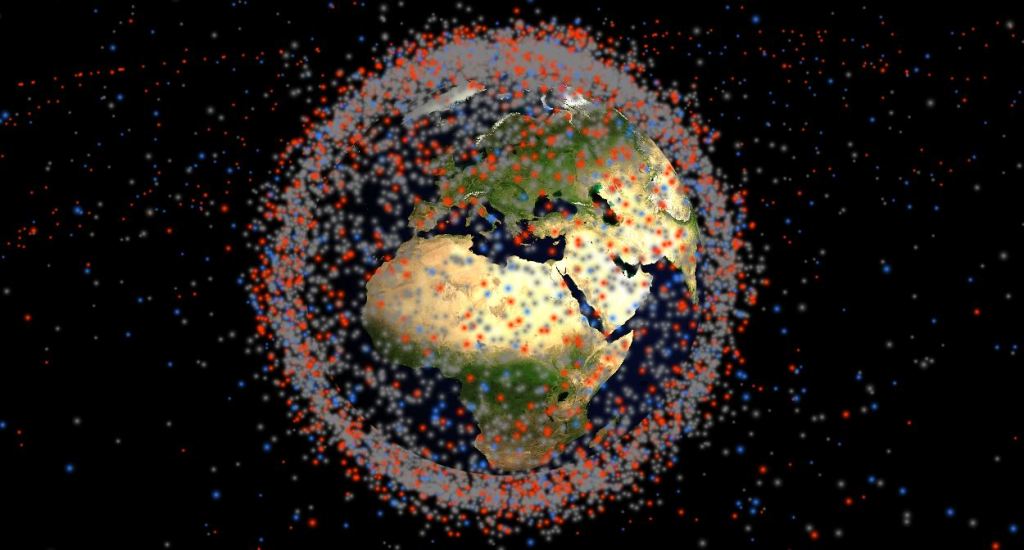
Plenty of Stuff in Orbit

Source: Stuffin.space.

When you have a chance you should check out the volume of objects circling our planet on the stuffin.space webpage (shown above). The site provides a realtime 3D map these objects, with daily updates from the Space-Track.org.

You can select a single piece of debris and read all about it. I selected one point and had this readout:

LEMUR 2 MCCAFFERTY

Int’l Designator: 2018-004N

Type: PAYLOAD

Apogee: 487 km

Perigee: 476 km

Inclination: 97.39°

Altitude: 477.94 km

Velocity: 7.63 km/s

Period: 94.08 min

I then looked up “LEMUR 2 MCCAFFERTY” and was directed to this site with the following background on the objects sent into orbit:

Lemur-2 is the initial constellation of low-Earth orbiting satellites built by Spire. These satellites carry two payloads for meteorology and ship traffic tracking.

A total of 100 such satellites are expected to be placed into orbit, so there will be plenty more to track related to this one program.

It is getting pretty crowded up there. I remember a similar image of clutter around our Earth in the Disney movie WALL-E (shown below).

Source: From the film WALL-E.

Nixon and the Space Shuttle

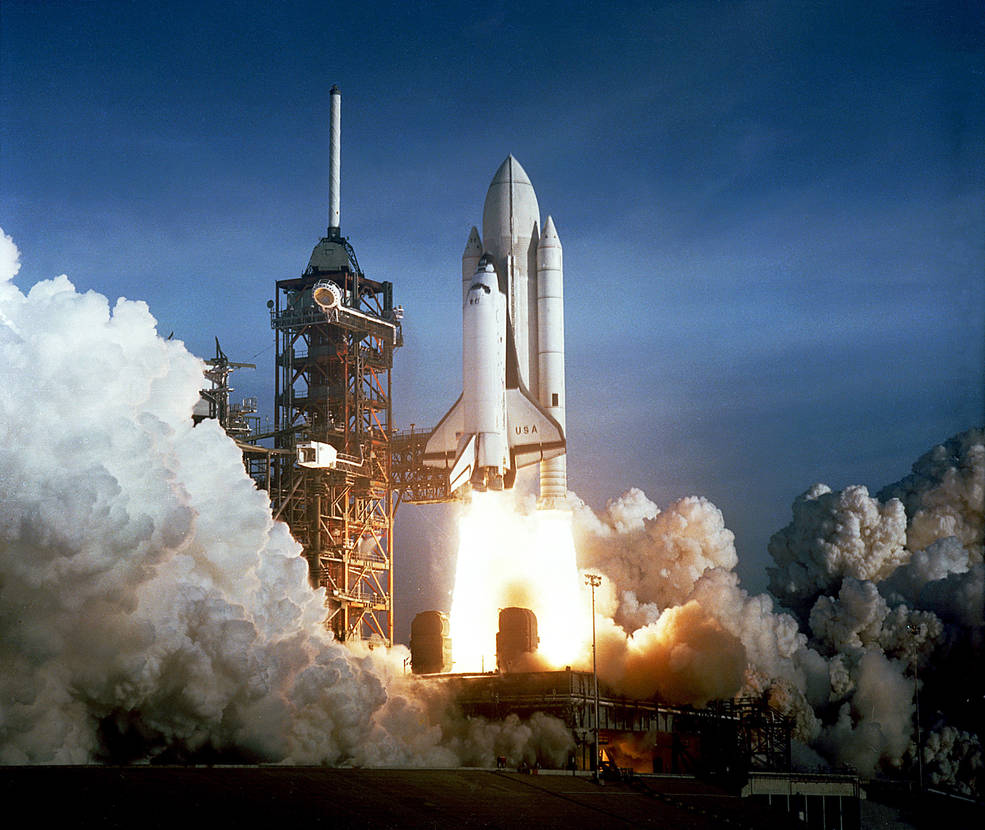
Source: NASA imagine showing Space shuttle Columbia lifting off from Launch Pad 39A on April 12, 1981, to begin STS-1.

Earlier his week NASA highlighted the 50 year anniversary of President Nixon’s decision to initiate a space shuttle program to follow the success of the Apollo Moon missions. The story states:

In January 1972, he directed NASA to develop and build a reusable space transportation system, commonly known as the space shuttle. The reusability of the shuttle’s components was expected to provide regular access to space to many customers, while at the same time reducing costs.

The space shuttle was proposed by the National Aeronautics and Space Council, which also proposed a trip to Mars. The Council’s report states:

As a focus for the development of new capability, we recommend the United States accept the long-range option or goal of manned planetary exploration with a manned Mars mission before the end of this century as the first target.

While the space shuttle was eventually operational by 1981, we still await a clear timeline for a trip to Mars. NASA said it will start with a trip back to the Moon first. Let’s hope we do not need to wait another 50 years before a manned trip to Mars.

Top 10 Astronomy Stories from 2021

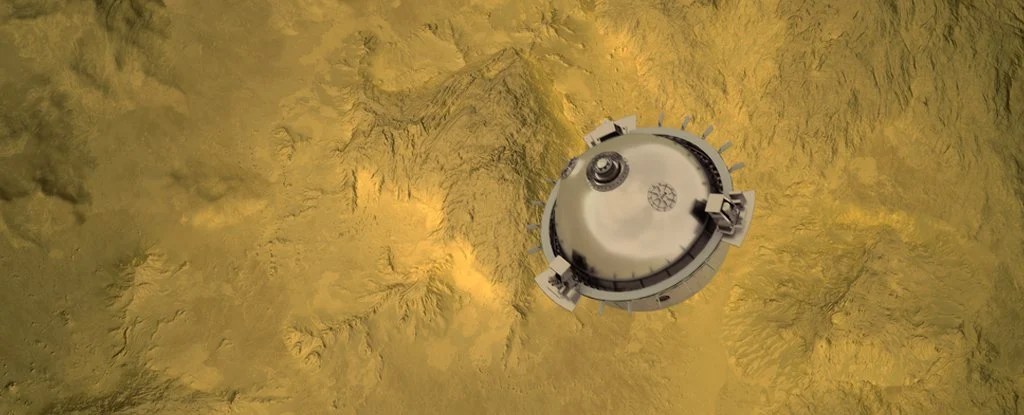
Source: Sciencealert.com webpage – “We’re Going Back to Venus! NASA Announces Two New Missions by 2030.”

Before we get too far into 2022, it is worth considering some of the top astronomy stories from 2021. Space.com put together a nice list that I highlighted below.

  1. Discovery of Comet Bernardinelli-Bernstein: “…It may be 10 times wider and 1,000 times more massive than a typical comet.”
  2. Amateur astronomer discovers a new moon around Jupiter: “The new moon, called EJc0061, belongs to the Carme group of Jovian moons.”
  3. NASA will return to Venus this decade: “…NASA has not launched a dedicated mission to the planet since 1989.”
  4. The sun is reawakening: “In early November, for instance, a series of solar outbursts triggered a large geomagnetic storm on our planet.”
  5. James Webb Space Telescope flies into space: “…JWST is heading to an observational perch located about a million miles from our planet.”
  6. Event Horizon Telescope takes high-resolution image of black hole jet: “The end result is a resolution that is 16 times sharper and an image that is 10 times more accurate than what was possible before.”
  7. Scientists spot the closest-known black hole to Earth: “Just 1,500 light-years from Earth…”
  8. Earth’s second ‘moon’ flies off into space: “…the object, known as 2020 SO, is a leftover fragment of a 1960s rocket booster from the American Surveyor moon missions.”
  9. Parker Solar Probe travels through the sun’s atmosphere: “The probe managed to get as low as 15 solar radii, or 8.1 million miles (13 million km) from the sun’s surface.”
  10. Perseverance begins studying rocks on Mars: “Perseverance is taking its observations from the 28-mile-wide (45 kilometers) Jezero Crater, which was home to a river delta and a deep lake billions of years ago.”

Visit the Space.com website for more details on each of these astronomy science stories.