Pic of the Week: Paris and the Moon

Each week the site will highlight an interesting image from the past 12 months showing a bit of this awesome universe. This week’s photo comes from a Reuters photographer. In the accompanying news story, this April 2021 view from Paris has the following label:

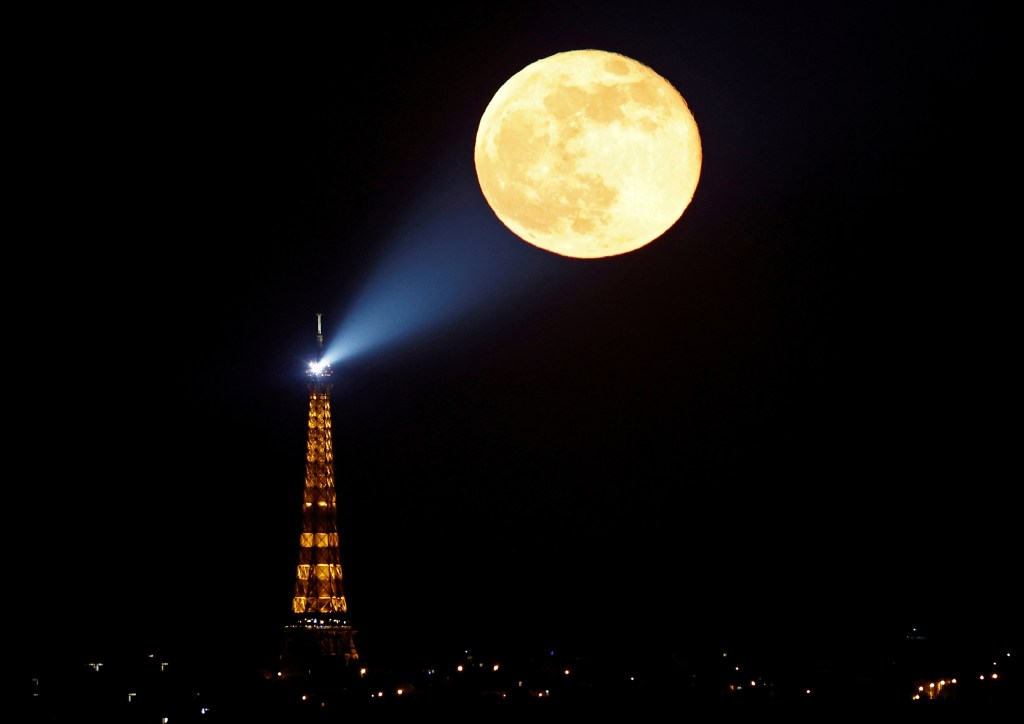
The full moon, known as the Super Pink Moon” rises behind the Eiffel Tower during a nationwide curfew due to tighter measures against the spread of the coronavirus disease (COVID-19) in Paris, France on April 27. 

Rogue Planets?

The Isaac Newton Group of Telescopes recently reported on its discovery of more than 70 new planets without a parent star:

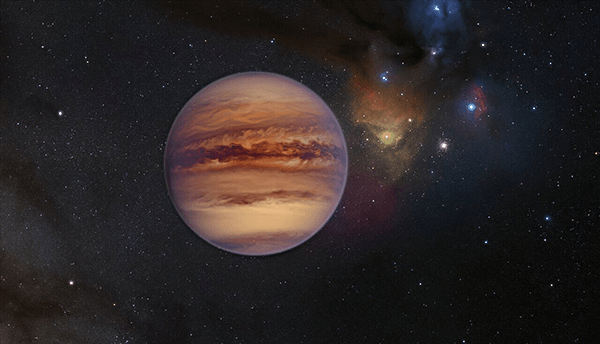
Using observations and archival data from several telescopes around the world and in orbit, including the Isaac Newton Telescope (INT), astronomers have discovered at least 70 new free-floating planets (FFPs) — planets that wander through space without a parent star to orbit — in the Upper Scorpius OB stellar association, which is the nearest region of star formation to our Sun. This is the largest sample of such planets found in a single group and it nearly doubles the number known over the entire sky.

The origin of these rogue planets is still a big question. The article states:

The nature and origin of FFPs remains unknown: do they form like stars through the gravitational collapse of small clouds of gas? Or do they form like planets around stars and are then dynamically ejected or stripped off? The number of FFPs discovered in the Upper Scorpius association exceeds the number of FFPs expected if they only form like stars from the collapse of a small molecular cloud, indicating that other mechanisms must be at play.

Astronomers believe there are billions of these rogue planets lurking around our galaxy. And we worry about a stray asteroid.

Space Investments are No Guarantee

Source: Virgin Orbit.

The recent initial public offering for Virgin Orbit, a commercial space launch company that spun-off from Richard Branson’s Virgin Galactic, did not go as well as planned. IG International reported that Virgin Orbit had hoped to raise $483 million as part of the public offering, but only raised $228 million. Moreover, the stock is down about 20 percent.

Virgin Orbit has already had some successfully launches from its modified Boeing 747, but the space launch industry is getting crowded and risky.

In June 2021, Virgin Orbit’s Tubular Bells: Part One mission for the US Department of Defense placed seven satellites to Low Earth Orbit – four R&D CubeSats for the US Department of Defense, two optical satellites for SatRevolution, and the Royal Netherlands Air Force’s first military satellite.  You can learn more about the past and planned US Department of Defense and NASA launches here.

Source: Virgin Orbit.

Meteor Watch: Time to Look Up

Looking up may have been useless the other day in Pennsylvania because of the cloud cover, but shaking houses were evidence enough of a meteor exploding in the atmosphere. On New Year’s Day, the incoming meteor exploded over southwestern Pennsylvania with the force of 30 tons of TNT.

The Facebook page for the National Weather Service in Pittsburgh, PA explained the initial situation (image below):

We have been getting a lot of questions about a loud explosion that was heard over southwest Pennsylvania earlier today. Data from GOES-16 may provide a clue.

This image is a product of the satellite’s Geostationary Lightning Mapper function, showing Total Optical Energy (basically, a measure of flash intensity). You can see the flash showing up here in the area of western Washington County, PA at 16:22Z (11:22 EST). This flash does not appear to be connected to any lightning activity in the area. One possible explanation is that a meteor exploded at some level above the ground. We do not have any confirmation of this at this time, but it seems to be the most likely explanation.

Later on, NASA Meteor Watch confirmed it was a meteor breaking up in the atmosphere. The meteor was estimated to be about a yard in diameter and weigh approximately half a ton.

Has Star Trek Gone Negative?

Source: Paramount+.

If you are a Trekkie, you have probably gained inspiration from the multitude of Star Trek series spawned from the original 1966 show. Star Trek: The Next Generation continues to be my favorite, yet I have also enjoyed all of the other earlier series and made it through at least one season of the latest Star Trek: Discovery. I admit it can be a little dark, but you still see hope for a better future around the edges.

Reason magazine believes the latest series is not up to par with the others. In a recent article, “Even if Modern Star Trek Doesn’t Think So, the World Is Getting Better,” the author states:

…Star Trek now seeks to reinforce the trepidation and existential doubt that is a hallmark of our modern culture. Instead of showing the potential of what humanity can become, Discovery seems to reflect more on what the feelings of the human condition are today.

The author also complains about Star Trek: Picard, but that is unfair. I found the series focused on Captain Picard to be both hopeful and fun. Maybe the author forgets about the dark role of Q in The Next Generation where all of humanity was a plaything. And what about the Borg? They were not exactly a sunny group of explorers. I left some of the Borg episodes with about as much hope as I did after seeing the Joker in The Dark Knight.

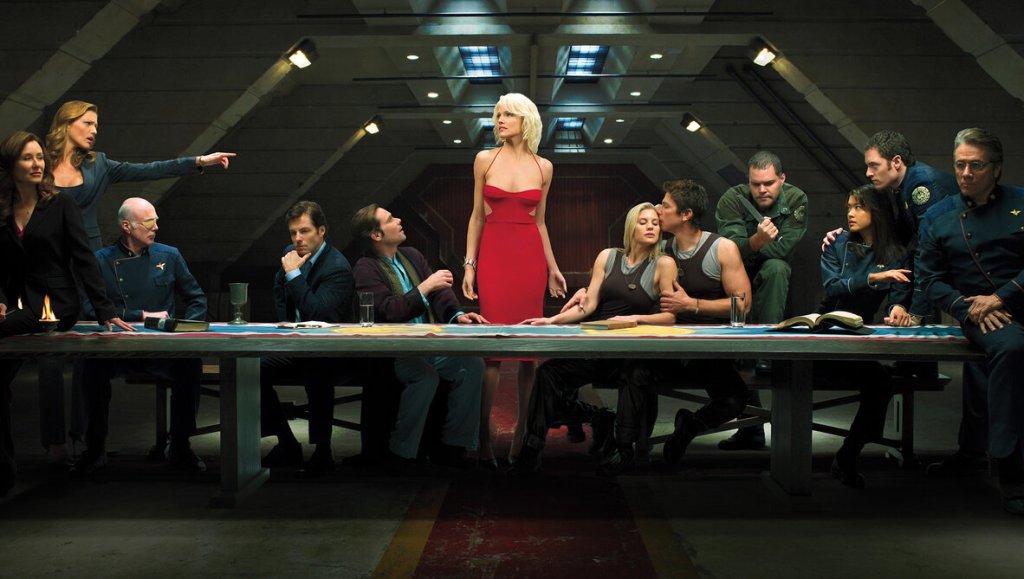
As far as the human conditions of today, the idea of a show paralleling present day reality is not all that new. I remember when the remake of Battlestar Galactica had episodes mirroring events taking place during the war with Iraq. The writers do live in the real world as well. I am not opposed to a little reflection with my viewing. Not even Sesame Street can escape the ongoing vaccine wars.

So I suggest viewers take a breath and pull up whatever version of the galaxy they can handle. I believe there is a Star Trek series for every season and every mood.

Source: Battlestar Galactica on SyFy.