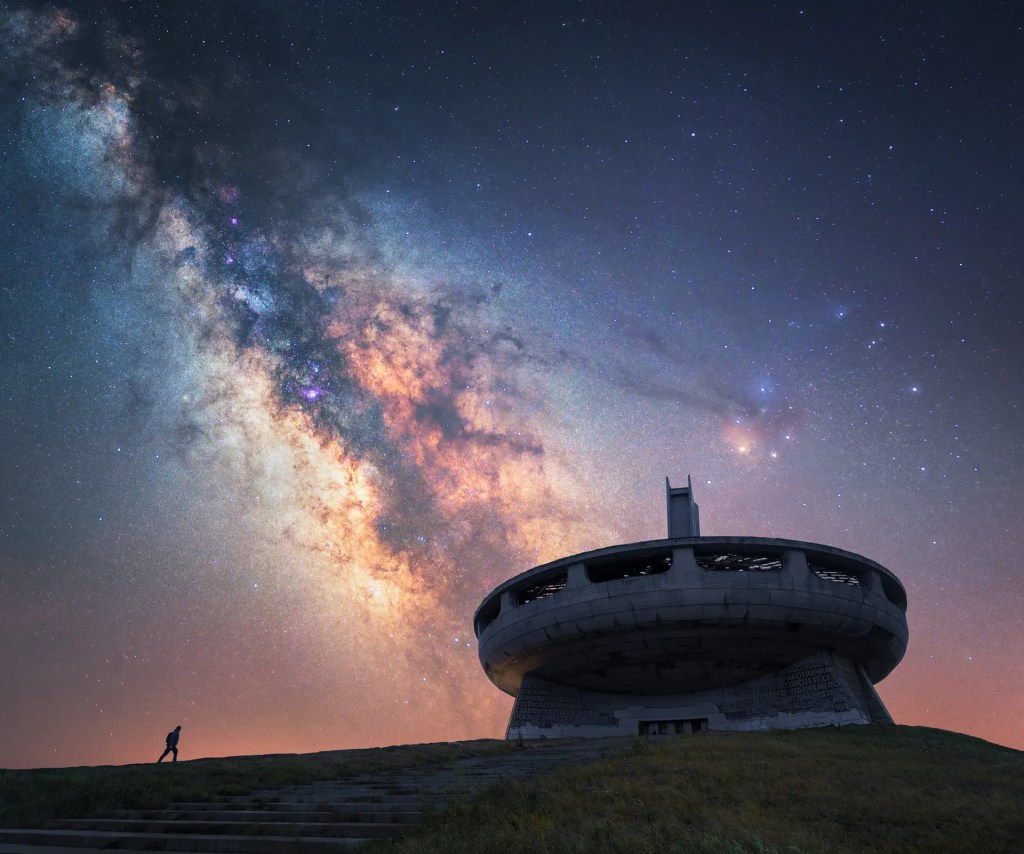
Royal Observatory Greenwich Winning Space Images

Image (Credit): “Back to the Spaceship” by Mihail Minkov. (Royal Observatory Greenwich)

London’s The Guardian newspaper recently reported on the winners in the Royal Observatory Greenwich’s 14th Astronomy Photographer of the Year competition. Once of the runner-up images, shown above, is titled “Back to the Spaceship” by Mihail Minkov. Located on Mount Buzludzha in Bulgaria, it was built as the House Monument of the Bulgarian Communist Party.

Here is a little more about the structure in the image from The Guardian:

Built between 1974 and 1981, this spaceship-like structure was designed by Georgi Stoilov and involved the removal of more than 15,000 cubic metres of rock from the peak of Buzludzha, reducing the mountain’s height by 9 metres.

Visit The Guardian to see all of the images selected by judges.

Extra: Just in case you are interested in that “space ship” shown above, I have provided another image below showing what it looks like in daylight. Not as scary, is it?

Image (Credit): House Monument of the Bulgarian Communist Party in Bulgaria. (SocialistModernism1 on Reddit)

The State of the Space Industry

Credit: The Space Foundation

A recent report by the Space Foundation shared the following figures:

  • The global space economy hit $469 billion in 2021;
  • The space sector saw 9 percent revenue growth since 2020; and
  • 1,022 spacecraft placed in orbit during the first six months of 2022.

In a troubling time around the globe, those are some pretty positive numbers. Just in terms of launched spacecraft, we can also see the commercial sector is playing a large role:

The [second quarter] edition also looks at the record pace of successful launches from Jan. 1 to June 30, with 72 rockets inserting 1,022 identified spacecraft into space. That is more spacecraft attaining orbit in just six months than were launched in the first 52 years of the Space Age. Most of those new satellites came from the commercial sector, which launched 958 spacecraft in the first half of 2022.

It is clearly not just a government space game, though the report also notes that government spending increased since 2020 around the globe, such as the U.S. (18 percent), China (23 percent), and India (36 percent).

As you can also see from the graphic above, 90 nations are now operating in space. We cannot pretend that all of this is for space exploration. While much of it relates to defense and commercial spacecraft looking downward, it still leaves plenty of spacecraft to explore our awesome universe.

Pic of the Week: Martian Polygons

Image (Credit): (NASA/JPL-Caltech/University of Arizona)

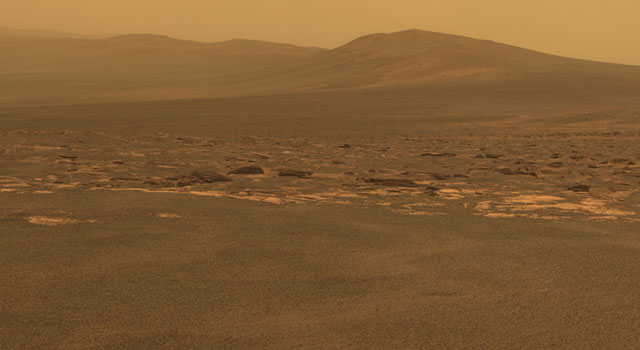
This week’s image is from NASA’s Mars Reconnaissance Observer. The Martian surface looks magical as we see the effects of water and ice. We tend to see Mars in one way – the view from a lander or rover showing a plain desert-like horizon (shown below) – but from above we can see it is so much more.

NASA has this to say:

Both water and dry ice have a major role in sculpting Mars’ surface at high latitudes. Water ice frozen in the soil splits the ground into polygons. Erosion of the channels forming the boundaries of the polygons by dry ice sublimating in the spring adds plenty of twists and turns to them.

Spring activity is visible as the layer of translucent dry ice coating the surface develops vents that allow gas to escape. The gas carries along fine particles of material from the surface further eroding the channels. The particles drop to the surface in dark fan-shaped deposits. Sometimes the dark particles sink into the dry ice, leaving bright marks where the fans were originally deposited. Often the vent closes, then opens again, so we see two or more fans originating from the same spot but oriented in different directions as the wind changes.

Image (Credit): The view from NASA’s Mars Exploration Rover Opportunity showing a portion of the west rim of Endeavour crater. (NASA/JPL-Caltech/Cornell/ASU)

Space Stories: The Milky Way, Super-Earths, and Anti-Satellite Tests

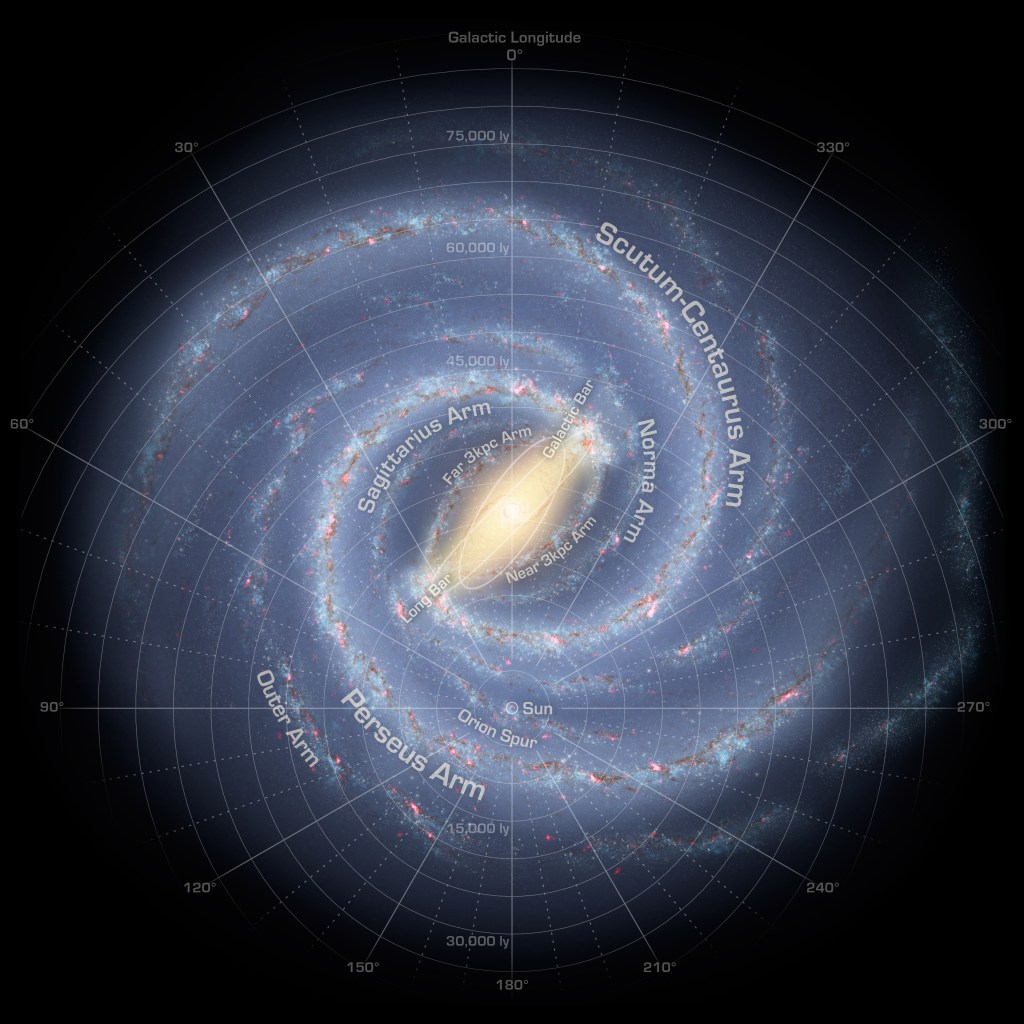
Image (Credit): This annotated artist’s concept illustrates the new view of the Milky Way, along with other findings presented at the 212th American Astronomical Society meeting in 2008 in St. Louis, Missouri. The galaxy’s two major arms (Scutum-Centaurus and Perseus) can be seen attached to the ends of a thick central bar, while the two now-demoted minor arms (Norma and Sagittarius) are less distinct and located between the major arms. The major arms consist of the highest densities of both young and old stars; the minor arms are primarily filled with gas and pockets of star-forming activity. The artist’s concept also includes a new spiral arm, called the “Far-3 kiloparsec arm,” discovered via a radio-telescope survey of gas in the Milky Way. This arm is shorter than the two major arms and lies along the bar of the galaxy. Our sun lies near a small, partial arm called the Orion Arm, or Orion Spur, located between the Sagittarius and Perseus arms. (NASA/JPL-Caltech/R. Hurt (SSC/Caltech))

Here are some recent stories of interest.

ScienceNews.org:Passing Through the Milky Way’s Arms May Have Helped Form Earth’s Solid Ground

Earth’s journey through the Milky Way might have helped create the planet’s first continents. Comets may have bombarded Earth every time the early solar system traveled through our galaxy’s spiral arms, a new study suggests. Those recurring barrages in turn helped trigger the formation of our planet’s continental crust, researchers propose August 23 in Geology.

Phys.org: “Astronomers Discover Two ‘Super-Earths’ Orbiting Nearby Star

An international team of astronomers reports the discovery of two new “super-Earth” exoplanets orbiting a nearby late-type M dwarf star. The newfound alien worlds, designated LP 890-9 b and LP 890-9 c, are slightly larger than the Earth. The finding has been published in Astronomy & Astrophysics.

Space.com: “Germany and Japan Pledge Not to Conduct Destructive Anti-satellite Tests

Germany and Japan have pledged not to conduct destructive anti-satellite tests that could create dangerous clouds of space debris in orbit. The announcements of these pledges were both made at the second session of the United Nations’ open-ended working group on reducing space threats, which is being held in Geneva from Sept. 12 to Sept. 16…Germany’s and Japan’s announcements follow similar pledges made by the United States, Canada and New Zealand in the wake of Russia’s irresponsible destruction of a satellite in November 2021 that created a massive cloud of space debris. 

Blue Origin Booster Mishap

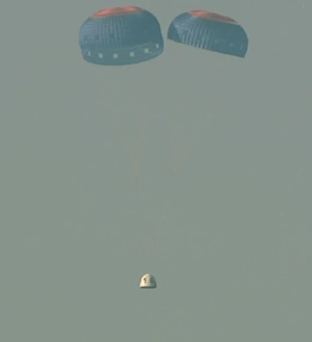
Image (Credit): Blue Origin’s NS-23 capsule returning to Earth after the mishap. (Blue Origin)

Delays and accidents are clear risks in the space industry, as we learned with the Artemis mission and now Blue Origin’s latest rocket launch. On Monday, a crewless New Shepard rocket launch (NS-23) went wrong, with the booster failing shortly after takeoff. Fortunately, the emergency system worked fine, indicating a crew would have returned safely in the capsule. In this case, the capsule was carrying a variety of experiments.

This same mission was scrubbed back on August 31st and September 1st due to weather issues. With this latest incident, future missions are on hold until the booster problem can be investigated by the Federal Aviation Administration. This was the first failure in the 23 New Shepard rocket missions launched to date.

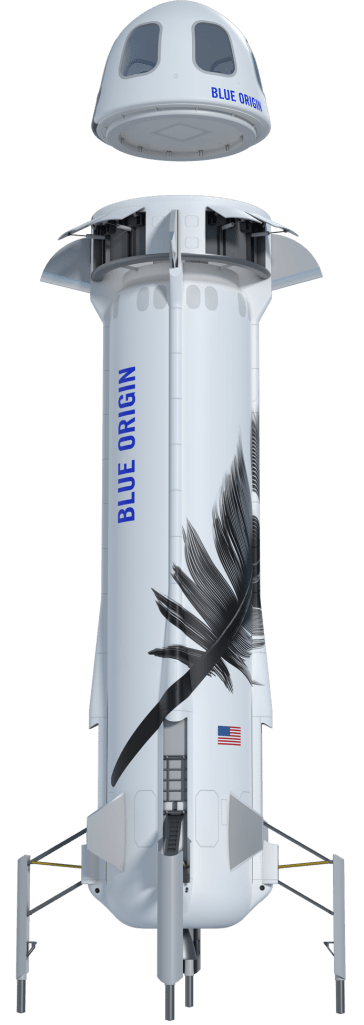
Image (Credit): Blue Origin’s New Shepard suborbital rocket system. (Blue Origin)