Image (Credit): Image from the earlier Space Race between the US and Soviet Union. (The Independent)
“Space will be the next great commons, a shared global resource like the oceans or cyberspace. History shows that these great commons are inevitably a source of competition and conflict, not voluntary cooperation. Whoever dominates space will determine the future of nations. We have to abandon the globalist fantasy that the U.S., China, and Russia will work together to keep space rules-based, free and open.”
Enough about Star Trek. It’s time to talk about Star Wars.
On September 21, Disney+ (the second Death Star of online content after the demise of Netflix) will be releasing its next Star Wars series called Andor. It’s a prequel to the movie Rogue One, starring Diego Luna as Cassian Andor five years before the events of the film. We learn more about how he went from a thief to a rebel against the evil Empire lead by Darth Vader and friends.
The trailer for Andor looks intriguing, with plenty of off planet action, something the series The Book ofBoba Fett really needed. My favorite to Star Wars series to date is still The Mandalorian, with Obi-Wan Kenobi a distant second. I am just glad they are not making an Endor series. I had enough of teddy bears taking down the Empire.
I will let Disney+ give you the plot for the show:
In Andor, audiences meet Cassian Andor five years before the attack on the Empire takes place. The prequel series will cover the five-year period in two 12-episode seasons, focusing on Cassian Andor’s journey towards discovering his full power. Rogue One: A Star Wars Story showed a loyal and ruthless Andor who spoke of his long-standing fight against the Empire — one that began when he was just six years old. This narrative left a lasting impression on Diego Luna, making it easy for him to sign on for this series. Referring to Andor’s statements in Rogue One, Luna wanted to know what it all meant, saying, “Why would a six-year-old give up his childhood to join a fight? When he talks about a dark past and doing terrible things for the Rebellion, what is he referring to? I think that story matters. There’s a lot of material there for us to play with, and I was excited to go into this journey and give these answers.” The series concentrates on Andor’s progression, looking back into his childhood, the fighter spirit that was always inside of him, and what he faced in his homeland that ultimately brings him to the Rebellion’s front lines. Luna explained that he wanted to tell this story to show “what needs to happen for a revolutionary to emerge.”
I have high hopes for this series compared to the last two. While HBO and Prime are battling it out over dragons versus elves, I am tuning into the Star Trek versus Star Wars battle. Luckily, there is something for everyone.
Here is a podcast if you like the debate format so you can listen to both sides before settling on your own position. Intelligence Squared has great discussions involving experts on a multitude of topics, but few touch upon astronomy. Hence, this is an episode worth sharing.
Here is the set up for this debate:
For decades, scientists around the world have dedicated their lives — and research dollars — to one question: Is there anyone else out there? In the early 1970s, NASA joined the hunt with its own program to search for extraterrestrial life, or SETI for short. When that was defunded by Congress, private efforts took hold. But just what have decades of SETI brought us? And how should we approach the search in those to come? For SETI’s supporters, finding other intelligent life in the cosmos is a fundamentally human endeavor. It probes our understanding of the cosmos, what it means to live and survive on Earth and beyond, and just where our species fits into the greater universe. But others warn that SETI is a distraction from other scientific endeavors that, at best, diverts critical resources and, at worst, will open a can of worms humanity isn’t ready to deal with. Just what would happen if we actually find other beings? Are we mature enough as a society to respond? In this episode, we ask the essential extraterrestrial question: to search or not to search?
The two experts debating this topic are:
Jill Cornell Tarter is an American astronomer best known for her work on the search for extraterrestrial intelligence. Tarter is the former director of the Center for SETI Research, holding the Bernard M. Oliver Chair for SETI at the SETI Institute.
Paul M. Sutter is a cosmologist and community outreach coordinator with the Department of Astronomy at Ohio State University. Sutter is also the chief scientist at the Center of Science and Industry in Columbus, Ohio.
I expect most of those visiting this page already have a strong opinion on this topic, but it is worth listening to the debate among these two experts anyway. Enjoy.
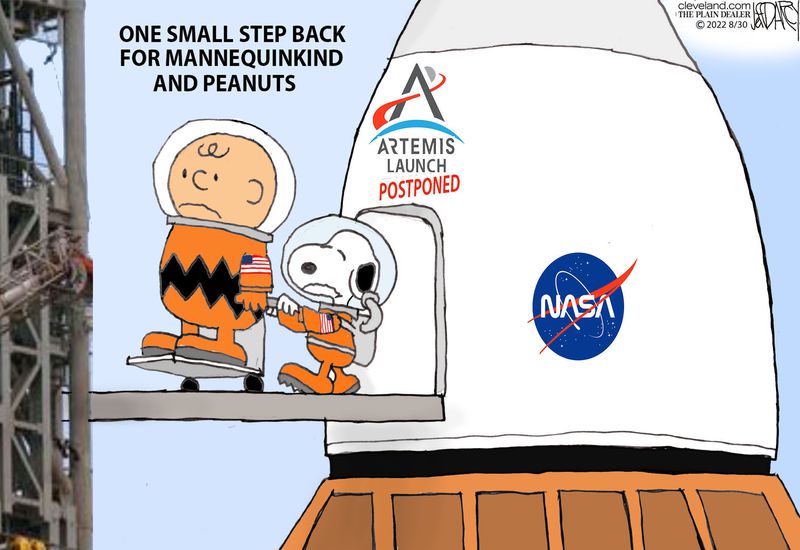
According to Artemis blog, NASA is looking at a new Artemis I launch date of either September 23 or September 27. The blog states NASA has requested the following launch periods:
Sept 23: Two-hour launch window opens at 6:47 a.m. EDT; landing on Oct. 18
Sept. 27: 70-minute launch window opens at 11:37 a.m.; landing on Nov. 5
Someone needs to update NASA’s Artemis I web-page, which as of today still shows a September 3, 2022 launch date.
Success is key for NASA to keep the momentum. Before the planned September 3rd launch, The Economist magazine (paper version) had an article titled “A Flying Turkey,” with the subtitle “The Space Launch System is yesterday’s rocket, powered by yesterday’s technology and brought about by yesterday’s thinking.” In addition to listing the Frankenstein approach used to cobble together a mission that makes reusable components non-reusable, it highlighted the ugly politics out of Alabama under Senator Shelby, calling the rocket system the “Senate Launch System.” The only endearing qualities of the Artemis missions appeared to be the commercial components under the last Artemis phase utilizing commercial partners.
This criticism is not new, but it will continue while NASA struggles to get Artemis I underway. We have already skipped out on the Moon for the last 50 years. Let’s get our heads back in the game!
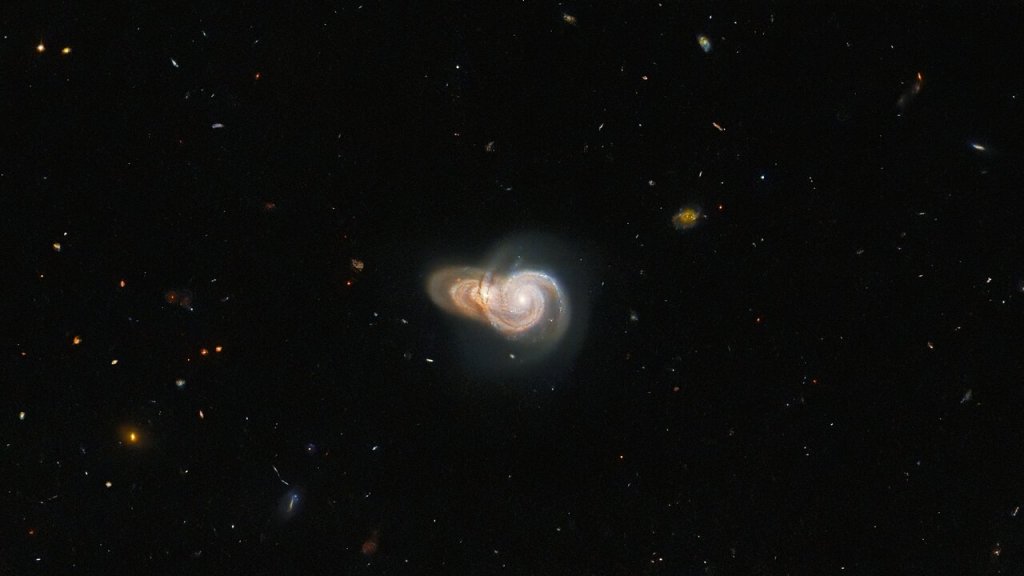
Image (Credit): Two spiral galaxies about 1 billion light-years away captured by the Hubble. (European Space Agency)
This week’s fascinating image from the NASA/ESA Hubble Space Telescope shows what appears to be two colliding spiral galaxies. A cropped version is shown below to highlight the colors. Here is more from ESA:
The two galaxies, which have the uninspiring names SDSS J115331 and LEDA 2073461, lie more than a billion light-years from Earth. Despite appearing to collide in this image, the alignment of the two galaxies is likely just by chance — the two are not actually interacting. While these two galaxies might simply be ships that pass in the night, Hubble has captured a dazzling array of interacting galaxies in the past.




 Our Awesome Universe