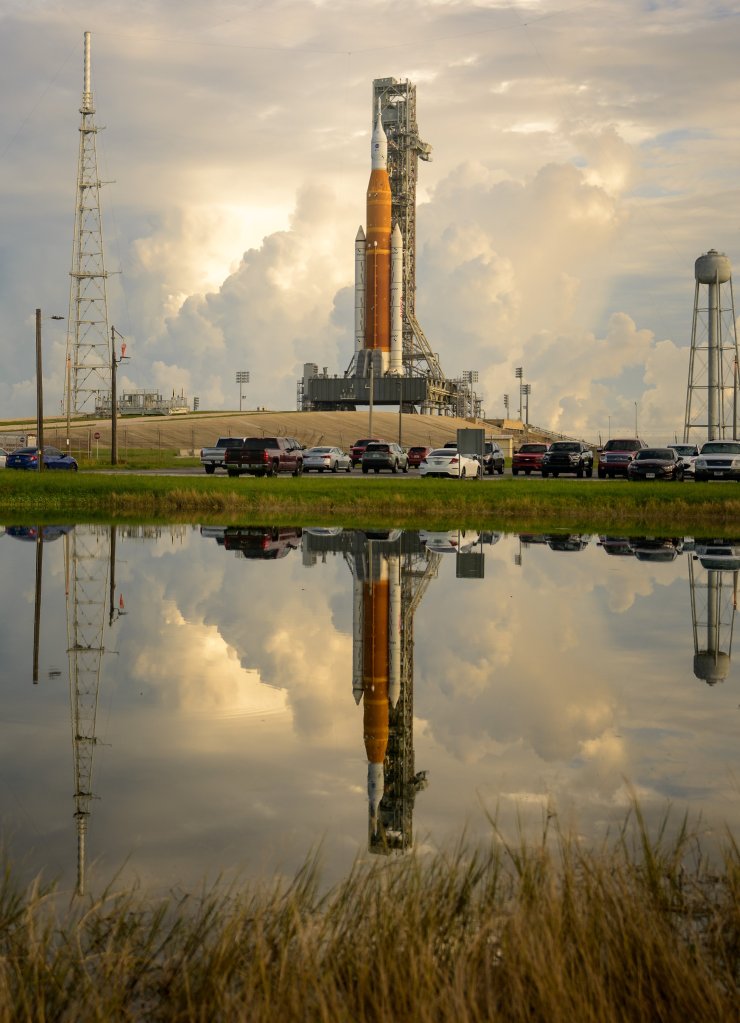
Artemis I: Failure is Not an Option

Image (Credit): Artemis I mission awaiting launch on September 3, 2022. (NASA)

This is the mission status from 11:22 am today:

The launch director waived off today’s Artemis I launch attempt at approximately 11:17 a.m. EDT. Teams encountered a liquid hydrogen leak while loading the propellant into the core stage of the Space Launch System rocket.  Multiple troubleshooting efforts to address the area of the leak by reseating a seal in the quick disconnect where liquid hydrogen is fed into the rocket did not fix the issue. Engineers are continuing to gather additional data.

An early September launch is not possible, so here are the future launch windows that NASA can consider:

September 19 – October 4 

  • 14 launch opportunities 
  • No launch availability on Sept. 29 and Sept. 30

October 17 – October 31 

  • 11 launch opportunities 
  • No launch availability on October 24, 25, 26, and 28 

November 12 – November 27 (preliminary) 

  • 12 launch opportunities 
  • No launch availability on November 20, 21, and 26 

December 9 – December 23 (preliminary) 

  • 11 launch opportunities 
  • No launch availability on December 10, 14, 18, and 23 

The JWST’s First Image of an Exoplanet

Image (Credit): Exoplanet HIP 65426 b in different bands of infrared light, as seen from the JWST: purple shows the Near-Infrared Camera (NIRCam) instrument’s view at 3.00 micrometers, blue shows the NIRCam instrument’s view at 4.44 micrometers, yellow shows the Mid-Infrared Instrument (MIRI) instrument’s view at 11.4 micrometers, and red shows the MIRI instrument’s view at 15.5 micrometers. These images look different because of the ways the different Webb instruments capture light. A set of masks within each instrument, called a coronagraph, blocks out the host star’s light so that the planet can be seen. The small white star in each image marks the location of the host star HIP 65426, which has been subtracted using the coronagraphs and image processing. The bar shapes in the NIRCam images are artifacts of the telescope’s optics, not objects in the scene. (NASA/ESA/CSA, A Carter (UCSC), the ERS 1386 team, and A. Pagan (STScI))

It was only a matter of time, but even so it was pretty quick. The James Webb Space Telescope (JWST) has taken a direct image of an exoplanet. HIP 65426 b, a gas giant that lies 355 light-years away, is from 15 to 20 million years old and about 6 to 12 times the mass of Jupiter. This gas giant is also about 100 times farther from its host star than Earth is from the Sun, allowing the JWST to see the exoplanet’s light separate from its sun.

This is not the first direct image of an exoplanet. The Hubble Space Telescope has also captured images of exoplanets. For instance, in 2008 an astronomer using Hubble images reported on Fomalhaut b, a Jupiter-mass exoplanet that is about 25 light-years away and approximately 200 million years old. It takes close to 872 years for the exoplanet to orbit its sun. Fomalhaut b will most likely be another target for JWST in the near future.

Image (Credit): Hubble Space Telescope optical image from 2006 showing the belt of dust and debris (bright oval) surrounding the star Fomalhaut and the planet (inset) that orbits the star every 872 years and sculpts the inner edge of the belt. A coronagraph (center) on the Advanced Camera for Surveys blocks out the light of the star, which is 100 million times brighter than the planet. (Paul Kalas/UC Berkeley, NASA, ESA)

Pic of the Week: A Variety of Galaxies

Image (Credit): Multiple galaxies captured by the NASA/ESA Space Telescope – noted below. (ESA/Hubble & NASA, W. Keel)

With all the excitement about the James Webb Space Telescope, let’s not forget about the ongoing great work being performed by the Hubble Space Telescope. This recently released Hubble image shows multiple galaxies as well as multiple types of galaxies.

Here is a full description from the European Space Agency:

This luminescent image features multiple galaxies, perhaps most noticeably LEDA 58109, the lone galaxy in the upper right. LEDA 58109 is flanked by two further galactic objects to its lower left — an active galactic nucleus (AGN) called SDSS J162558.14+435746.4 that partially obscures the galaxy SDSS J162557.25+435743.5, which appears to poke out to the right behind the AGN. 

Galaxy classification is sometimes presented as something of a dichotomy: spiral and elliptical. However, the diversity of galaxies in this image alone highlights the complex web of galaxy classifications that exist, including galaxies that house extremely luminous AGNs at their cores, and galaxies whose shapes defy the classification of either spiral or elliptical.