
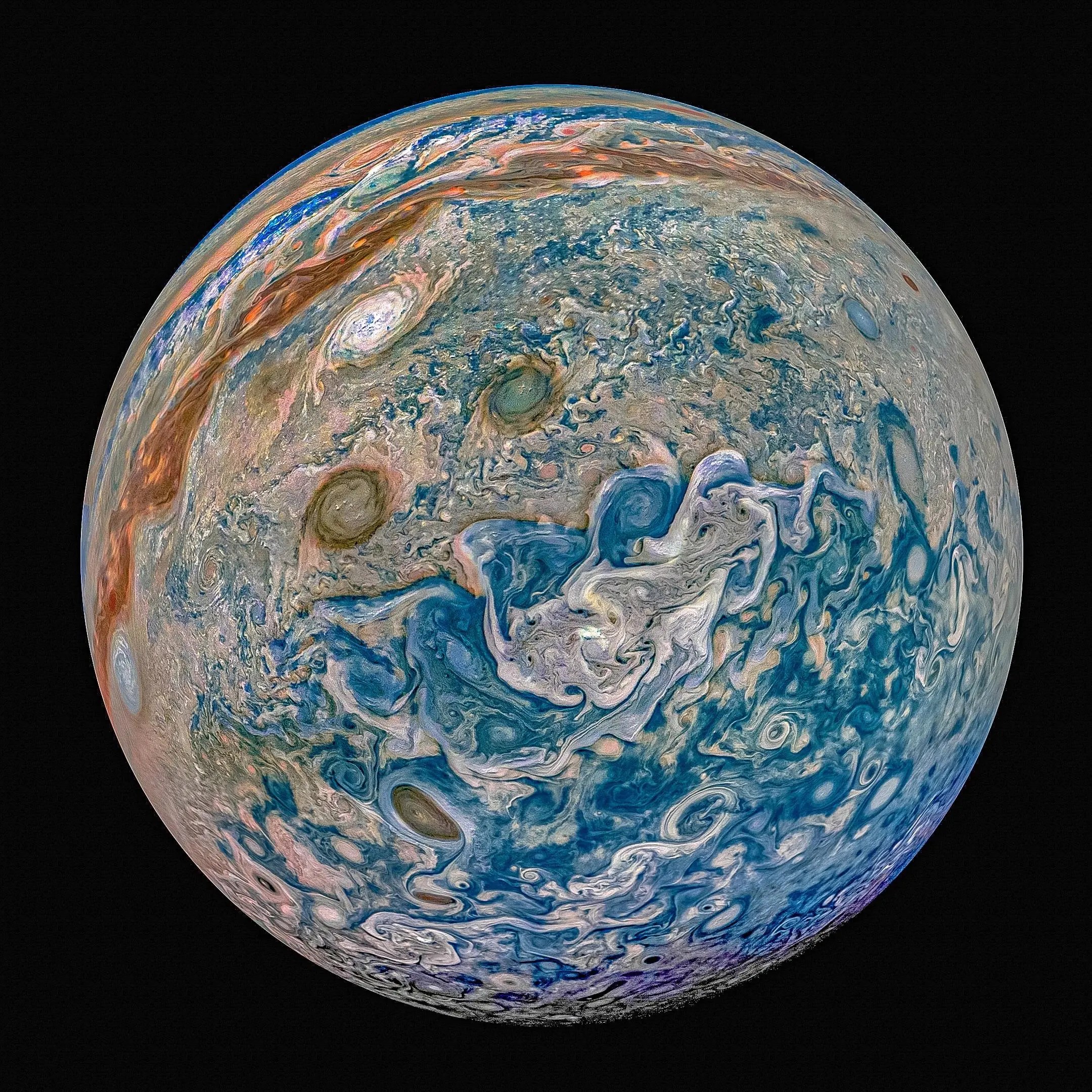
The Astrophysical Journal Letters abstract of study findings:
With JWST, we are directly imaging cold (∼200–300 K) solar-age giant exoplanets for the first time. At these temperatures, many molecular features appear, and water-ice clouds may condense and affect the emission spectrum; early photometric measurements of cold giant planets are already showing some tension with the predictions of cloud-free solar-metallicity atmosphere models. Here, we present new JWST/MIRI coronagraphic observations of the cold giant exoplanet Eps Ind Ab at 11.3 μm. Together with archival data, we use these new observations to study the atmosphere of this cold exoplanet, and we also refit its orbit, finding an updated mass of 7.6 ± 0.7MJup and an eccentricity of 0.24 +0.11/-0.08. The planet is significantly brighter (by 0.88 ± 0.08 mag) at 11.3 μm than at 10.6 μm, indicating the presence of ammonia. However, this ammonia feature is shallower than expected. This could indicate a low-metallicity or nitrogen-depleted atmosphere, but our preferred explanation is the presence of thick water-ice clouds that suppress the ammonia feature and the near-IR emission of Eps Ind Ab. Photometry of the small but growing sample of cold giant exoplanets demonstrates that they are consistently fainter than expected between 3 and 5 μm, consistent with the water-ice cloud hypothesis. 10.6 μm and 11.3 μm photometry of this cold exoplanet sample would be valuable to determine whether the suppressed ammonia feature is universal, and to frame a new open question about the underlying physical cause.
Citation: Elisabeth C. Matthews et al. a second visit to eps ind ab with JWST: new photometry confirms ammonia and suggests thick clouds in the exoplanet atmosphere of the closest super-Jupiter, ApJL 1002 L5 (2026).
DOI: 10.3847/2041-8213/ae5823
Study-related stories:
Max Planck Institute for Astronomy – “Cirrus Clouds Made of Water Ice May Surround a Jupiter-like Exoplanet”
Universe Today – “Webb Finds Water-Ice Clouds on Nearby Super-Jupiter”
Sci.News – “Webb Spots Icy Clouds on Distant Jupiter-Like Exoplane”

