
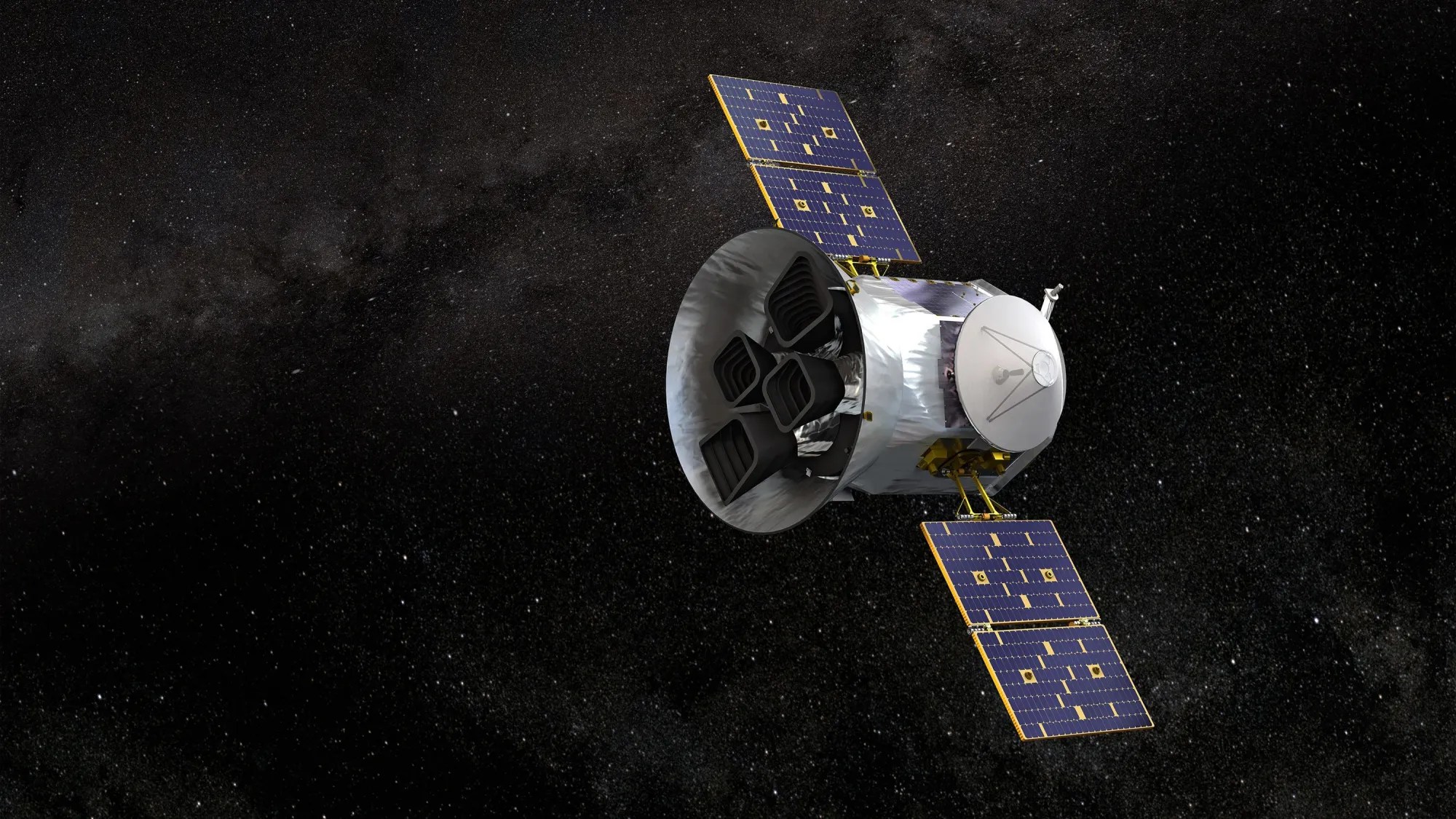
The Astronomical Journal abstract of study findings:
We present the deepest systematic search for planets around mid-to-late M dwarfs to date. We have surveyed 8134 mid-to-late M dwarfs observed by the Transiting Exoplanet Survey Satellite with a custom-built pipeline and recover 77 vetted transiting planet candidates. We characterize the sensitivity of our survey via injection–recovery and measure the occurrence rate of planets as a function of orbital period, instellation, and planet radius. We measure a cumulative occurrence rate of 1.10 ± 0.16 planets per star with radii >1 R⊕ orbiting within 30 days. This value is consistent with the cumulative occurrence rate around early M dwarfs, making M dwarfs collectively the most prolific hosts of small close-in planets. Unlike the bimodal radius valley exhibited by close-in planet populations around FGK and early M dwarfs, we recover a unimodal planet radius distribution peaking at 1.25 ± 0.05 R⊕. We additionally find 0.954 ± 0.147 super-Earths and 0.148 ± 0.045 sub-Neptunes per star, with super-Earths outnumbering sub-Neptunes 5.5:1, firmly demonstrating that the radius valley disappears around the lowest-mass stars. The dearth of sub-Neptunes around mid-to-late M dwarfs is consistent with predictions from water-rich pebble accretion models that predict a fading radius valley with decreasing stellar mass. Our results support the emerging idea that the sub-Neptune population around M dwarfs is composed of water-rich worlds. We find no hot Jupiters in our survey and set an upper limit of 0.012 hot Jupiters per mid-to-late M dwarf within 10 days.
Citation: Erik Diego Gillis et al. TESS planet occurrence rates reveal the disappearance of the radius valley around mid-to-late M dwarfs. AJ 171 317 (2026).
DOI: https://doi.org/10.3847/1538-3881/ae5810
Study-related stories:
Phys.org – “The Most Common Planets in the Galaxy Don’t Appear Around the Most Common Stars, TESS Observations Suggest”
Newsbreak – “TESS Uncovers Cosmic Surprise: Galaxy’s Most Common Planets Skip Its Most Common Star”
Universe Today – “Closing The Exoplanet Radius Gap”

